
 Worksheets
Genetics HW
Total questions: 72
Worksheet time: 2hrs 46mins
(a) is genetic material arranged in a double helix (or ladder shape) which can code for (b) .

Where in the cell is DNA found?
Nucleus
Cytoplasm
Chloroplast
Cell Membrane

What are sections of DNA (or sections on a chromosome) called?
DNA
Genes
Chromosomes
Nucleus

A gene determines a __________ such as eye or hair color.
nucleus
DNA
chromosome
Trait

How many pairs of chromosomes do humans have?
21
22
23
24

The union of egg and sperm to form a new offspring is
gene
fertilization
amino acids
DNA

How are similarities passed from parent to offspring?
through teaching
through learning
through blood
through genes

DNA is found in cheek cells
True
False

The same copy of DNA is in all the nuclei of an organism
True
False
What is the structure in the nucleus of a cell that holds one long molecule of DNA?
gene
chromosome
genome
RNA
The number of chromsomes depends on the type of organism.
true
false
Which nitrogenous base is not found on DNA?
cytosine
thymine
guanine
adenine
uracil
Each nucleotide is made up of three parts: a sugar, a phosphate, and a base. True or false?
True
False
There are (a) different kinds of bases found in DNA.
In DNA molecule, adenine always pairs with _________.
cystosine
guanine
thymine
uracil
The two nitrogenous bases that are joined by a hydrogen bond and create a "rung" on the DNA ladder.
gene
base pair
nucleotide
nucleotide sequence
The order of nucleotides that determine which protein is made.
base pair
chromosome
protein synthesis
nucleotide sequence


In the punnett square below, what belongs in the missing square
In the punnett square below, what belongs in the missing square
The genotype for a yellow plant is...


Mendel Grid
Karyotype
Punnett Square
Pedigree
_____ is the genetic makeup of an organism.
phenotype
genotype
How many alleles does a person carry for a trait?
1
2
3
4
How many alleles does a child get from each parent for a trait?
1
2
3
4
To look at families
To make predict what the offspring will be
To track traits in families' lineage
Nothing
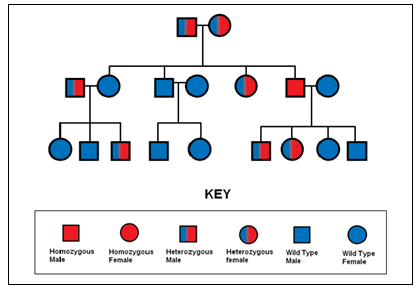
In a pedigree, which shape represents a male?
circle
square


Generation 2 individuals 5 and 6 are
brother and sister.
cousins.
married.
not related.
Mutations can be negative because
They can cause cancer.
They can cause birth defects.
They can help an organism thrive in its environment.
They can affect future offspring.
Mutations can benefit humans because they can:
Cause illness
Make an organism more suited to live in its environment.
Make organisms live shorter lives
Cause organisms to grow extra limbs.
A mutation is defined as:
A change in the cell's structure
Anything that changes in an embryo
Any change in the physical features of a human
A change in the DNA sequence
Mistakes in DNA replication or environmental substances (sun causing cancer, etc.)
The amino acids
Passed down by genetics
You accidentally get alleles from someone other than your parents
Who does a mutation effect?
individuals
only parents
a person's children
only children
Mutations can be random.
True
False
True or false, mutations create genetic diversity?
True
False
Mutations are __________.
Harmful
Harmful or beneficial
Neutral
Harmful, neutral, or beneficial
Your genotype is the combination of (a) from both parents. Your genotype also gives instructions for what (b) to make.
Which is NOT a characteristic of asexual reproduction?
One parent
Two parents
Offspring are clones
Genetically identical
How does the DNA of the offspring formed from asexual reproduction compare to the parent?
none of the DNA is transferred to the offspring
half of the DNA is transferred to the offspring
the DNA of the offspring is identical to the DNA of the parent
none of these are correct
All forms of asexual reproduction use _________________ to grow new cells and organisms.
mitosis
meiosis

What type of asexual reproduction is pictured?
binary fission
budding
vegetative propagation
fragmentation
Selective breeding is...
a process to create an organism with desired traits from parents with those desired traits to benefit humans
natural method of producing offspring with desired traits
creating a new species
making organisms reproduce during times of stress
One problem with selective breeding is
creating a new species
gene variety is lost
extinction of a species

Natural selection
Random chance
Selective breeding
Selective breeding
organisms better adapted to their environment tend to survive and produce more offspring
process used by humans to develop new organisms with desirable characteristics
What are sections of DNA called?
DNA
Genes
Chromosomes
Nucleus


the form of a gene that is always expressed
one of the possible forms (or variations) of a gene
the combination of two genes for a specific trait
the complete genetic makeup of a living thing
Which sex has the chromosomes XY?
Female
Male
Cannot be determined.
What sex has the chromosomes XX?
Female
Male
Cannot be determined.
A spider has a mutation that increases the amount of venom in each bite on its prey. This is an example of a ________ mutation.
neutral
beneficial
harmful
very harmful
Advantages of Asexual Reproduction (a) (b)
What is the big advantage of sexual reproduction?
Can quickly grow the population
Can adapt to changing environments
Offspring are guaranteed to be successful in an unchanged environment.
Only one parent is required to reproduce.
In sexual reproduction, the offspring are.
identical (uniform)
diverse (different)

___________________ is a type of asexual reproduction in which a piece of a parent organism breaks off to form an new organism (ex. starfish).
budding
fission
fertilization
regeneration

What type of asexual reproduction is taking place?
Fragmentation
Binary Fission
Regeneration
Budding
What are some advantages of asexual reproduction are: (select all that apply - there are 3)
offspring are already well-adapted for the environment
it only requires one organism
there is a lot of genetic variety
it takes less energy than sexual reproduction
Which of the following is an advantage of sexual reproduction?
All of the above
Removes bad genes from the population
Leads to genetic variations in new generation, which is fundamental for environmental adaptation
Organism is more protected – does not necessarily have the weakness of parent

