
 Worksheets
Unit 1 Review
Total questions: 58
Worksheet time: 58mins
Density =
Mass ÷ Volume
Volume ÷ Mass
Mass x Volume
Length x Width x Height
Mass =
Density ÷ Volume
Volume ÷ Density
Density x Volume
Length x Width x Height
Volume =
Density ÷ Mass
Mass ÷ Density
Density x Mass
A rock is broken into 5 pieces. Compared to the original rock, one of the pieces has _________ density.
a higher
a lower
the same
What is the density of a block that has a mass of 45.3g and a volume of 171.2 cm3?
0.3 g/cm3
7755.4 g/cm3
3.8 g/cm3
What is the density of a cube with 3.0 cm sides, and has a mass of 13.5 g?
1.5 g/cm3
0.5 g/cm3
4.5 g/cm3
2.0 g/cm3
What is the volume of a rock that has a mass of 452.9 g and a density of 103.4 g/cm3?
4.4 cm3
25.9 cm3
46,829.9 cm3
A piece of plastic has a mass of 35.5 g and a density of 1.1 g/cm3. What is its volume?
39.1 cm3
0.03 cm3
32.3 cm3
Three different samples of the same uniform substance will have the same _______. (Uniform means it is the same throughout.)
volume
shape
density
mass
What is the mass of a rock that has a volume of 71.0 cm3 and a density of 4.6 g/cm3?
326.6 g
15.4 g
0.1 g
A chocolate bar has a volume of 286.1 cm3 and a density of 1.3 g/cm3. What is its mass?
220.1 g
0.005 g
371.9 g
When oil spills in the ocean, the oil floats on top of the water. This is because...
there is less oil than water.
the oil is more dense than water.
the oil is less dense than water.
the oil is cooler than the water.

The diagram below shows a glass jar containing a clear liquid and a floating rock. Which conclusion about the relative density of the rock and the liquid is true?
The rock and the liquid have the same density.
The rock is less dense than the liquid
The rock is more dense than the liquid
If the object is cut in half, the density of each piece will be
greater than that of the original object
the same as that of the original object
less than that of the original object
29.0 mm = ______ m
0.029 m
290.0 m
0.29 m
0.0029 m
0.563 L = _____ mL
5,630.0 mL
5.63 mL
56.3 mL
563.0 mL
34.0 m = _____ mm
340.0 mm
3400.0 mm
0.034 mm
34,000.0 mm
Which measurement is the smallest?
1 mm
0.01 cm
0.001 m
0.0001 km
Place the following metric prefixes in order of smallest to largest:
milli-
deci-
deka-
hecto-
kilo-
Place the metric prefixes in the correct spots of the conversion staircase:
hecto-
centi-
kilo-
deka-
deci-
milli-
Using the conversion chart (metric staircase), as the units move to the left, the decimal place moves to the ____________.
Right
Sometimes to the right, sometimes to the left
Left
The decimal place doesn't change between units
Using the conversion chart, as the units move to the right, the decimal place moves to the ____________.
Right
Sometimes to the right, sometimes to the left
Left
The decimal place doesn't change between units
To do each conversion, you would move the DECIMAL POINT...
How do you convert 50 cm into mm?
ONE place to the RIGHT
How do you convert 5 cm into m?
TWO places to the LEFT
How do you convert 500 mm into m?
THREE places to the LEFT
How do you convert 5 m into cm?
TWO places to the RIGHT
Which unit of measurement is the shortest?
Millimeter
Meter
Kilometer
Centimeter
Which unit of measurement is the longest?
Millimeter
Meter
Kilometer
Centimeter
Match the following tools to what they are used to measure

Mass

Length

Volume

Temperature

What represents the best estimate for the height of the soda can?
30 centimeters
10 centimeters
3 centimeters
1 meter
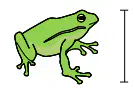
What represents the best estimate for the height of a frog?
60 centimeters
4 millimeters
8 centimeters
20 centimeters

Look at the ruler. What is the distance in centimeters (cm) from 0 to A?
(a)
Look at the ruler. What is the distance in millimeters (mm) from 0 to C?
(a)


50 ml of water was added to the graduated cylinder. After we drop in the object, the new water level goes up to 60 ml. What is the volume of the blocks?
8 ml
10 ml
60 ml
5 ml

What is the volume of the ring?
64 ml
68 ml
8 ml
4 ml

Which object has the greatest volume?
The empty one
The button
The nail
The battery
The screw

What is the best estimate of the volume of soda in a can?
2 liters
2 milliliters
350 liters
350 milliliters
Match the term with the correct definition:
Mass
The amount of matter in an object
Volume
The amount of space an object takes up
Temperature
The average kinetic energy of an object
Length
The distance between two points
A study was done to find is different tire treads affect the braking distance of a car.
Manipulated Variable
type of tire treads
Responding Variable
braking distance
Constant
type of car
The time it takes to run a mile depends on the person's running speed.
Manipulated Variable
The person's running speed
Responding Variable
Time it takes the person to run a mile
Constant
The type of path the person runs on
The height of the bean plants depends on the amount of water they receive.
Manipulated Variable
Amount of water the bean plants receive
Responding Variable
The height of the bean plants
Constant
The type of plant
The height of the bean plants depends on the amount of water they receive.
Manipulated Variable
Amount of water the bean plants receive
Responding Variable
The height of the bean plants
Constant
The type of plant
The higher the temperature of air in the oven, the faster a cake will bake.
Manipulated Variable
The temperature of the air in the oven
Responding Variable
How fast the cake bakes
Constant
The type of cake
Lemon trees receiving the most water produced the most lemons
Manipulated variable
The amount of water
Responding variable
The number of lemons
Constant
The amount of sunlight
An investigation found that more bushels of potatoes were produced when the soil was fertilized more.
Manipulated variable
The amount of fertilizer
Responding variable
How many bushels of potatoes produced
Constant
The amount of water
The amount of pollution produced by cars was measure for cars using gasoline containing different amounts of lead
Manipulated variable
The amount of lead
Responding variable
The amount of pollution produced
Constant
The distance the car travelled
Another name for the manipulated variable is
Independent Variable
Dependent Variable
Responding Variable
Constant Variable
Another name for the responding variable is
Dependent variable
Independent Variable
Manipulated Variable
Constant Variable
A student correctly determined the density of two rocks. If the volumes of the two rocks are equal, the rock with the greater density has a
rounder shape
smoother surface
greater mass
smaller size
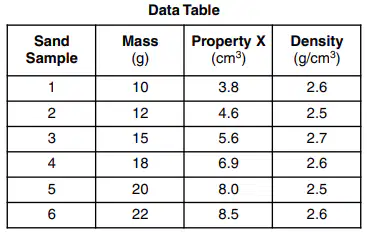
The data table shows three properties of six different-sized samples of quartz sand. One property of the samples is labeled X. A student used the data for mass and property X to calculate the density of each sand sample.
What property of the samples is represented by X?
weight
density
volume
temperature

The diagram below a rock suspended above an overflow container filled with water up to the overflow spout. A graduated cylinder is positioned next to the container to collect water that comes out of the overflow spout.
Which property of the rock can be directly determined when the rock is placed in the overflow container?
mass
density
volume
temperature
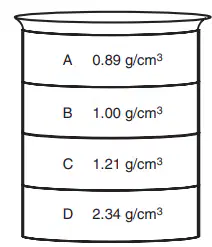
The diagram shows a tall beaker with four different liquids and their densities.
If a ball that has a density of 1.73 g/cm3 is placed in the beaker, where will the ball come to rest?
on top of liquid A
between liquids B and C
between liquids C and D
on the bottom of the beaker

What is the volume of the rock?

Both boxes have the same density
Label the correct units in the density formula.
Grams
mL
g/mL

Three liquids and two solids are placed in a graduated cylinder. The substances arrange themselves in the cylinder according to their densities. Use the information to identify the liquids and solids in the graduated cylinder. start with the top solid as substance 1, and the top liquid as substance 2, and so on
Gold
Mercury
water
Gasoline
Cork

Which object has the highest density in this picture?
A
B
C

In this image, the VOLUME of A is _____ the volume of B
equal to
greater than
less than

