
 Worksheets
Geologic History of Earth
Total questions: 45
Worksheet time: 23mins

The illustration provided shows three rock layers and an intrusion of basalt. When molten rock pushes its way into rock layers already formed, it creates an intrusion.
The rock strata indicates that the basaltic intrusion must have occurred _
after the limestone was deposited.
before the granite was formed.
after the sandstone was deposited.
before all three layers were formed.

According to the Principle of Superposition, which letter represents the oldest layer/event?
I
C
G
B

According to the Principle of Superposition, which letter represents the youngest layer/event?
I
C
E
D

According to the Principle of Superposition, which letter represents the layer/event that occurred AFTER the earthquake represented by letter B?
H
A
C
F

The diagram here provides information on when the fossils of certain organisms are found in the fossil record.
Which of the following conclusions can be drawn from the data in this diagram?
Jellyfish are the oldest living organisms that ever existed.
Trilobites and dinosaurs did not live at the same time.
Most mammals are in competition with birds for resources.
Mammals did not appear until after the dinosaurs went extinct.

The illustration here shows rock layers in their original order, along with a fracture in some rock layers caused by an earthquake.
Based on the evidence in the illustration, an earthquake occurred_
before layer W was deposited.
before layer X was deposited.
after layer Y was deposited.
after layer Z was deposited.

The illustration shows rock layers from three different locations and fossils the rock layers contain. The fossils are all trilobites, ancient organisms that were different over time.
Which conclusion can be drawn from the information in the illustration?
The trilobite Cyclopygidae appeared most recently of those shown here.
The trilobite Ceratopigidae appeared before all the others.
The trilobite Remopleiridae is the oldest of all the trilobites.
The trilobite Asaphidae appeared most recently of those shown here.
The fossil remains of organisms with skeletons are NOT found in the lowest layers of rock discovered.
How is the lack of fossilized skeletons in the lowest rock layers best explained?
Organisms with skeletons did not evolve until after these rock layers formed.
The fossils of organisms with skeletons are only found in the oldest rocks.
Fossil skeletons are usually crushed if other rock layers are above the ones they are in.
Organisms with skeletons live only at the highest altitudes, which is where they turn to fossils.
The statement that the oldest layer will be at the bottom in an undisturbed sequence of rock layers is called the Principle of ....
Cross-Cutting Relationships
Superposition
Intrusions
Stratigraphy
The Principle of Cross-Cutting Relationships states that an igneous intrusion is
always younger than the layers it cuts across
always older than the layers it cuts across
the same age as the rock it melted
none of the answers are correct
Relative age dating is used to determine the...
actual age of an event
age of one event in comparison with other events
length of time between two events
rate at which a geologic process occurs
Approximately how old is the Earth?
4.6 billion years old
4.6 million years old
1.4 billion years old
1.4 million years old

Fossils of trees were discovered in a sedimentary rock layer, and in a rock layer below were fossils of clams.
Based on this evidence, what conclusion can be made about the sequence of climates in the past in the area where the fossils were discovered?
Based on the evidence, trees existed before clams.
Based on the evidence, this area was a forest before it was an ocean or beach.
Based on the evidence, this area was an ocean or beach before it was a forest.
Based on the evidence, there was a forest that was flooded and eventually completely underwater.
The study of rock layers
Fossil
Rock Strata
Stratigraphy
Fossil Record
The preserved remains or trace of an organism that was once living
Fossil
Rock Strata
Stratigraphy
Fossil Record
The measurement to describe the timing and relationship of the events that have occurred throughout Earth's history
Rock Strata
Fossil Record
Stratigraphy
Geologic Time Scale
dinosaur
micro-organism
trilobite
cast and mold fossil

The best index fossils have which traits?
widespread geographically, long lifespan, rare
widespread geographically, short lifespan, abundant
specific place, long lifespan, abundant
specific place, short lifespan, rare

Using an index fossil what layers are the same age?
E,K,Q
A,K,Q
A,F,L

What is the best reason that fossil #4 is NOT a good index fossil?
It is not widespread
it is not short-lived (in numerous layers)
It is in half of the outcrops

Which fossil makes the best index fossil?
Fossil 1
Fossil 2
Fossil 3

What fossil is the best example of an index fossil?
a
b
c
d
The preserved remains or trace of an organism that was once living
Fossil
Rock Strata
Stratigraphy
Fossil Record
The sedimentary layers of rock in Earth
Fossil
Rock Strata
Stratigraphy
Fossil Record
The mineralized remains of organisms and the rock layers in which they are found
Fossil
Rock Strata
Stratigraphy
Fossil Record
A timeline of Earth's history based on relative and absolute dating is ...
the Law of Superimposition.
Uniformitarianism
the Geologic Time Scale.
the Theory of Evolution

The ______________ era covers almost 90% of earth's history and includes the Hadean, the Archean, and the Proterozoic eons.
Paleozoic
Mesozoic
Cenozoic
Precambrian

Which series of words describes lengths of geologic time from longest to shortest?
era >period >eon
eon > era >period
period >eon >era
era >eon >period
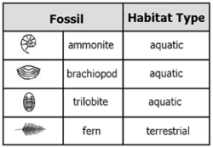
Geologists studied fossils taken from the top of a mountain. The chart lists several fossils taken from this location as well as their original habitat. (not in chronological order)
What can be concluded based on the fossil evidence?
The mountain climate was once much warmer than it is today.
The mountain climate was once much colder than it is today.
The mountain was covered by water at some point in the past.
The elevation in the area was much higher at some point in the past.
What are some things scientists can learn about from studying the Fossil Record?
the history of life
past environments (climate)
how organisms change over time
all of the above
What can we infer when we find an index fossil and a fossilized shark's tooth in the same layer of rock?
The two animals were alive during different time periods
The animals were alive in the same year as each other
Both animals were alive during the same time period
What can be inferred when an animal disappears from the fossil record?
the animal has gone extinct
the animal has evolved
the animals are no longer turned into fossils
Where did life on Earth start?
the ocean
land
with multicellular organisms
with reptiles

Which is younger than the clam fossil?
layer Z
broadleaf
intrusion X
reptile bone

Which is younger than the broadleaf fossil?
layer Z
layer Y
fern fossil
intrusion X

Where in the rock strata is it most likely that a mass extinction occurred?
1
2
3
4
5
Humans are fairly recent in Earth's History in comparison to Earth's past.
True
False

Look at the rock strata diagram. Which fossil is an index fossil?


Using the geologic time scale, which era did fish first appear (500 million years ago)?
Paleozoic
Mesozoic
Cenozoic
Precambrian

Using the geologic time scale, which period did dinosaurs first appear (245 million years ago)?
Triassic
Jurassic
Cretaceous
Devonian

Using the geologic time scale, which major biological event marks the END of the Mesozoic era?
Extinction of dinosaurs
First fish (vertebrae) evolve
Continents moved together forming Pangea
Oxygen appeared abundantly in the Earth's atmosphere
The first sign of life on Earth was known as ___________.
cyanobacteria
jellyfish
trilobites
marine plants

