
 Worksheets
Review Quiz; Electricity & Magnetism
Total questions: 80
Worksheet time: 1hrs 15mins

When two different types of insulators are rubbed together, ____________ electric charges are produced.
mobile
static
no
some

They are two types of electric charges: positive charge and negative charge.
True
False
Same or like charges ___________ each other.
attract
repel
Opposite charges ___________ each other.
attract
repel
The object that gains electrons will be ______________________.
positively charged
negatively charged
neutral
The object that loses electrons will be ______________________.
positively charged
negatively charged
neutral
Choose the correct reason why the hair stand and attracted to the balloon when the balloon is rubbed to the hair?
Both balloon and hair are neutral
Both balloon and hair are same charged
The balloon is negatively charged and hair is neutral
The balloon and hair are different charged

A glass rod becomes positively charged when it is rubbed with silk. This is because the glass rod
gains protons
loses protons
gains electrons
loses electrons

You walk across a shag carpet and become negatively charged. You became negatively charged because...
Protons from your body traveled to the carpet and therefore you became negatively charged
Protons from the carpet traveled to your body and therefore you became negatively charged
Electrons from your body traveled to the carpet and therefore you became negatively charged
Electrons from the carpet traveled to your body and therefore you became negatively charged.

Diagram shows a situation where we know Balloon C is negatively charged.
Which of these best applies to Balloon A?
Positively charged
Negatively charged
Positively charged or neutral
Negatively charged or neutral
What is the result of the force of attraction that exists between the positive charges on the ground and the negative charges in the clouds?
Raining
Lightning
Thunder
Whirlpool

Staying in the closed car is safe during lightning and thunder storms because________________.
Electric charge stays on the outer surface of the car only
The car is made of non metal
Electric charge can travel inside the car and we can get a shock
The car is an insulator

When a person randomly touches a metallic doorknob, he/she is prone to feel a short term electric shock. How can one effectively avoid this from happening?
Touching other people before touching the doorknob.
Touching a wooden surface before touching the doorknob.
Rub both hands on the clothes before touching the doorknob.

Will the balloons ATTRACT or REPEL each other?


The continuous flow of electric charges through a material
electric current
electric circuit
voltage
parallel circuit
A form of energy caused by the movement of electrons
electricity
voltage
electric current
parallel circuit

What is a circuit that only has ONE path for electricity to flow?
series circuit
closed circuit
parallel circuit
light bulb
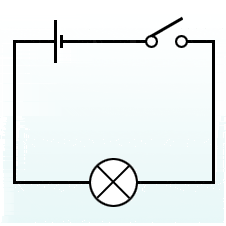


2 answers:
Open circuit or closed circuit?
Will the light bulb light up?
Open circuit
Closed circuit
Light bulb WILL light up
Light bulb WILL NOT light up

This is an example of a -------- circuit.
Series
Parallel
Combination

This is an example of a -------- circuit.
Series
Parallel
Combination

In this circuit, the bulb(s) that light up are:
1 only
2 only
1 and 2
None of them

In this circuit, the bulb(s) that light up are:
1 only
2 only
1 and 2
None of them

The bulbs have the same resistance. The brightest bulb in this circuit is:
1 only
2 only
Same brightness
None of them

The bulbs have the same resistance. The brightest bulb is:
1 only
2 only
1 and 2
None of them

This circuit will work.
Yes
No
What is another term for potential difference
Resistance
Current
Voltage
Charge
What do we measure potential difference in
Amps
Coulombs
Ohms
Volts
What do we measure potential difference with
Ammeter
Voltmeter
How do we connect a voltmeter
In parallel
In series
Resistance is
Measured using an ammeter
Units are 'volts'
How difficult it is for electrons to move through an object
The continuous movement of electrons in a wire
A conductor has _____ resistance. An insulator has ______ resistance.
Low; high.
Negative; positive.
Positive, negative.
High, low.
A resistor
Is the same as resistance
Is connected to a circuit in parallel
Is used in a circuit to control the amount of current
Is not measured in ohms
what is resistance measured in?
volts
ohms
amps
jouls
(I X R)
Voltage divided by Resistance
(V / R)
Current
Power
Ohms
Watts
Voltage divided by Current
(V / I)
Current
Power
Resistance
Watts
True or False: A magnet is attracting when it pushes objects away from each other.
True
False
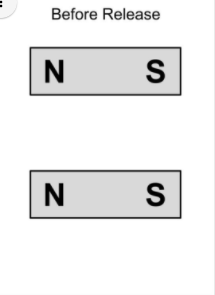
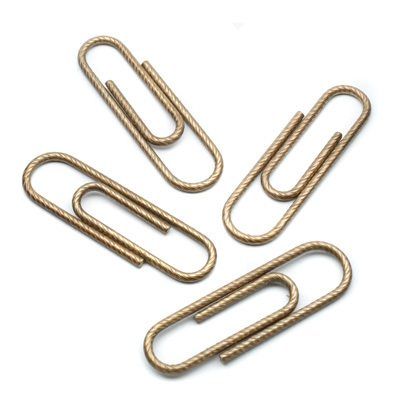
Magnetic
Not magnetic
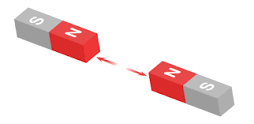
What will happen when these magnets are brought close together?
They will attract each other.
They will repel each other.
They will stay the same.
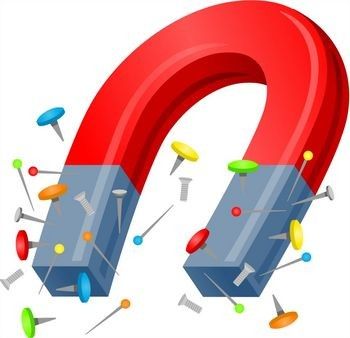
Where on a magnet is the magnetic force strongest?
The Poles
All over
Middle
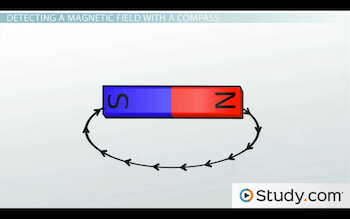
Earth is like a giant magnet due to....
its liquid iron core
the wind patterns of Coriolis Effect
the alignment of the continents
solar particles moving through the atmosphere
What’s the most important function of Earth’s magnetic field?
Earth's magnetic shield deflects asteroids and meteors
Earth's magnetic shield keeps energy from escaping into space
Earth's magnetic shield deflects most of the solar wind
Earth's magnetic shield helps birds and other animals navigate

Where is Earth's magnetic field strongest?
Along the outside lines
Along the inside lines on either side
Where the lines are close together at the poles
In the space outside of the lines
Electric currents produce _____________
electron clouds
magnetic fields
sound waves
A magnet is defined as
the force between two opposite poles
any material that has a magnetic field
the electron cloud surrounding an object
How can the strength of an electromagnet be increased? (mark all that apply)
increase the current flowing through the coil
increase the number of coils
add an amplifier to it
put iron core inside the coil
What happens to the compass when the wire is connected to the battery?
Nothing happens to the compass
The compass is repelled from the wire and it goes flying
The compass starts to spin around endlessly
The compass changes direction due to the magnetic field from the wire
What generates a magnetic field?
A moving electrical charge
A piece of steel
A cell phone
A permanent magnet
How can you make an electromagnet?
Wrapping a large coil of wire around a permanent bar magnet
Letting a wire stick to the side of a bar magnet
Wrapping a large coil wire around a ferromagnetic material and connecting to a battery

Which electromagnet is stronger?
A
B
Which of these bests describes an electromagnet?
A permanent magnet made from electric currents.
A temporary magnet made from electric currents.
A temporary magnet made from magnetic currents.

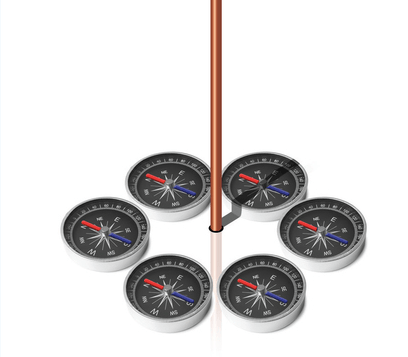
How can you test to see if there is a current running through a wire?
listen carefully to see if you hear a buzzing sound
place several compasses around the wire
place several batteries around the wire

