wayground logo

Free Printable Worksheets

Font size

S
M
L
XL
Worksheets

Mix and Flow Quiz #1 Review

Total questions: 42

Worksheet time: 45mins

Name
Class
Date
1.
The change of state from a gas to a liquid
a)
condensation
b)
deposition
c)
evaporation
d)
sublimation
2.
Vaporization that occurs only at the surface of a liquid
a)
vaporization
b)
deposition
c)
sublimation
d)
evaporation
3.
Solid becomes gas without first changing to liquid
a)
deposition
b)
sublimation
c)
evaporation
d)
condensation
4.
In which state are the particles least able to move?  (Which is the solid?)
a)
State A
b)
State B
c)
State C
d)
None
5.
When the temperature of matter increases the particles...
a)
speed up and move closer
b)
speed up and move farther apart
c)
slow down and move closer together
d)
slow down and move farther apart
6.

High viscosity can be described as...

a)

a liquid that flows quickly

b)

a liquid that flows slowly

7.

Which of these are fluids?

a)

Sand

b)

Water

c)

Oxygen

d)

Rocks

8.

What is Viscosity?

a)

A fluids colour.

b)

A fluids temperature.

c)

A fluids resistance to flow.

9.

Which of these factors affects Viscosity?

a)

Temperature

b)

Colour

c)

Taste

10.

The particles of a liquid with high cohesive force has high viscosity.

a)

TRUE

b)

FALSE

11.

Which of the following liquids is non-viscous?

a)

tomato sauce

b)

glue

c)

paint

d)

juice

12.

Liquids with very low viscosity ,flow very _______________________.

a)

fast

b)

not at all

c)

slow

d)

whenever it wants

13.

As temperature increases ,viscosity of liquid _______________.

a)

increases

b)

stays the same

c)

decreases

14.
A fish has a mass of 30g. What is the density of the fish?
a)
5 mL
b)
5 g/mL 
c)
6 g/mL
d)
6 g
15.
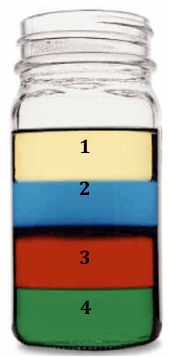
Put the liquids in order from most dense to least dense?
a)
4, 3, 2, 1
b)
1, 2, 3, 4
c)
3, 4, 2, 1, 
d)
4, 3, 1, 2
16.
The table below lists the densities of five metals. All of the following metals will float in mercury except...
a)
copper
b)
gold
c)
silver 
d)
zinc
17.
Two liquids are poured out of containers at the same height & time. Liquid 1 empties from the container before liquid 2. Which liquid has a lower viscosity? 
a)
liquid 1
b)
liquid 2
c)
both liquids have the same viscosity
d)
cannot be determined
18.

Which graduated cylinder has the highest viscosity

a)

The graduated cylinder with the ball at 20mL.

b)

The graduated cylinder with the ball at 30mL.

c)

The graduated cylinder with the ball at 40mL.

d)

The graduated cylinder with the ball at 50mL.

19.
A piece of copper has a mass of 89g and a volume of 10 cm3.  What would be the density of the copper?
a)
0.89 g/cm3
b)
89 g/cm3
c)
8.9 g/cm3
d)
890 g/cm3
20.
What units are used to measure Density?
a)
cm3/g
b)
g
c)
g/cm3
d)
cm3
21.
Why do some substances float on water?
a)
they are warmer than water
b)
they are cooler than water
c)
they are more dense than water
d)
they are less dense than water
22.
What is the measuring unit for mass?
a)
centimeter 
b)
millimeter 
c)
grams 
d)
pounds
23.
Which lab tool might you use to measure the volume of a liquid?
a)
electric scale
b)
bunsen burner
c)
test tube
d)
graduated cylinder
24.

If an object is neutrally buoyant it will ________.

a)

sink

b)

float

c)

neither float or sink

d)

objects cannot be neutrally buoyant...

25.

Which properties affect buoyancy?

(select all that apply)

a)

Mass

b)

Volume

c)

Density

d)

Luster

26.

The density of fresh water is 1 g/cm3.


Imagine the clay boat you just designed has a density of 1.5 g/cm3. What would happen to your boat if you placed it in fresh water?

a)

sink

b)

float

c)

neutrally buoyant

d)

no way of knowing what would happen

27.
Which is an example of a solute?
a)
Egg whites
b)
Sugar
c)
Water
d)
Acetone
28.
Which is an example of a solvent?
a)
Salt
b)
Egg whites
c)
Water
d)
Sugar
29.

Define the term soluble.

a)

Can dissolve in water

b)

Cannot dissolve in water

c)

Partially dissolves in water

30.
The amount of solute actually dissolved in a given amount of solvent.
a)
dilution
b)
concentration
c)
saturated solution
d)
supersaturated mixture
31.
How does a solution become supersaturated?
a)
dissolve lots of solute in it.
b)
dissolve a little solute in it. 
c)
dissolve more solute than you should be able to. 
d)
dissolve a super amount of solvent in it. 
32.
__________ are made up of solutes and solvents.
a)
Solutions
b)
Suspensions
c)
Heterogeneous Mixtures
d)
Pure Substances
33.

Which of the following would result in being able to dissolve a greater amount of solid in a solution?

a)

Lower the temperature.

b)

Decrease the pressure of the solution.

c)

Increase the pressure of the solution.

d)

Heat the solution.

34.

Which of the following would NOT increase the rate at which a sugar cube dissolves?

a)

Reducing the amount of solvent

b)

Crushing the sugar cube

c)

Stirring the solution

d)

Heating the solvent

35.

Sugar dissolves faster in hot tea compared to iced tea.

What is the factor affecting the rate of solubility in the statement above?

a)

Rate of stirring

b)

Temperature

c)

Size of solute

d)

Total surface area

36.

What combination would dissolve a solid solute the fastest?

a)

high temperature, no stirring

b)

no heat, no stirring

c)

sugar cube, no heat

d)

high temperature, stirring

37.

a)

soluble

b)

insoluble

38.

a)

soluble

b)

insoluble

39.

Which of the following usually makes a substance dissolve faster in a solvent?

a)

adding more solvent to the solution

b)

increasing the particle size of the solute

c)

lowering the temperature

d)

decreasing the number of particles

40.

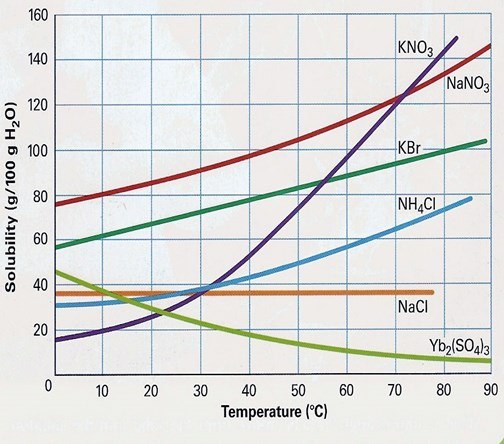
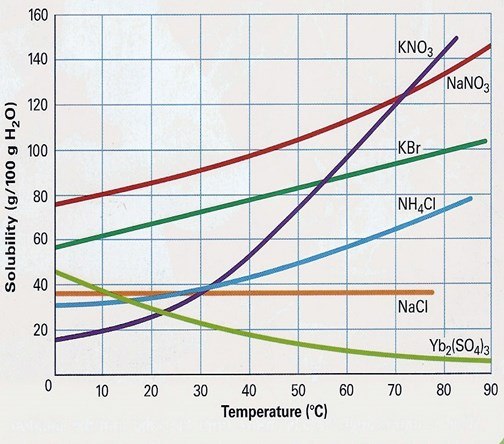
At 30'C, which substance has the lowest solubility?

a)

KNO3

b)

KBr

c)

NaCl

d)

Yb2(SO4)3

41.

Identify if the following solution would be saturated, unsaturated, or supersaturated: 103 g KBr at 70'C.

a)

Unsaturated

b)

Saturated

c)

Supersaturated

42.

How could you change a saturated solution to an unsaturated solution?

a)

Add solvent

b)

Add solute