wayground logo

Free Printable Worksheets

Font size

S
M
L
XL
Worksheets

Human Genetics (autosome 1-18)

Total questions: 38

Worksheet time: 39mins

Name
Class
Date
1.
A child is diagnosed with a rare disease. Neither parent has the disease. How did the child inherit the disorder?
a)
The disorder is dominant and carried by a parent.
b)
The disorder is recessive and carried by both parents.
c)
The disorder is sex-linked and inherited only from the father.
d)
A mutation in the child occurred.
2.
Following the detection of PKU in an infant, the treatment used in order to prevent brain damage is ___.
a)
injection of missing enzymes
b)
physical therapy
c)
blood transfusions
d)
dietary adjustments
3.
A human genetic defect that results in the failure to metabolize the amino acid phenylalanine is ___.
a)
Turner syndrome
b)
Down syndrome
c)
phenylketonuria
d)
cystic fibrosis
4.
A human disorder caused by a dominant gene is ___.
a)
Tay-Sachs
b)
CF
c)
PKU
d)
Huntington's
5.
Individuals with Huntington's disease 
a)
undergo progressive deterioration of the nervous system
b)
find breathing difficult and suffer lung infections
c)
must have frewuent blood transfusions
d)
suffer from aneuploidy
6.

A pair of identical twins were separated at birth and raised by different parents. Both were found to have the gene for type II diabetes, but only one developed the disease. What could explain this? (3.2.3)

a)

mutation and genetic recombination

b)

independent assortment

c)

environmental influence

d)

segregation of alleles

7.

Achondroplasia is a dominant human disorder that results in dwarfism. If two people that are heterozygous for achondroplasia have a child, what is the probability it will be tall? (3.2.1)

a)

0%

b)

25%

c)

50%

d)

75%

e)

100%

8.

Which of these will give a phenotype of Type A blood? (Choose all that apply)

a)

IAIA

b)

IAi

c)

IAIB

d)

ii

9.

In this type of inheritance, both alleles are expressed (seen) in the phenotype.

a)

Codominance

b)

Multiple alleles

c)

Dominant

d)

Polygenic

10.

An example of this type of inheritance is human blood types

a)

Multiple alleles

b)

Codominance

c)

Dominant

d)

Polygenic

11.

The genotype for a human female is

a)

XX

b)

XY

12.
Determine the sex of the individual whose karyotype is displayed in the image.
a)
female
b)
male
13.
What makes this individual's karyotype not normal?
a)
An extra sex chromosome
b)
An extra autosome
c)
A missing sex chromosome
d)
A missing autosome
14.
Chromosome pairs 1-22 are referred to as
a)
sex chromosomes
b)
sister chromatids
c)
a karyotype
d)

autosomes

15.

A chart that displays family relationships indicating traits or disorders

a)

Punnett square

b)

Pedigree

c)

Karyotype chart

16.

In a pedigree chart, men are represented by

a)

Circles

b)

Diamonds

c)

Squares

17.

In a pedigree chart, women are represented by

a)

Circles

b)

Diamonds

c)

Squares

18.

In a pedigree, individuals that are unaffected are represented as shapes that are

a)

Not shaded

b)

Fully shaded

c)

Half shaded

19.

In a pedigree, individuals that are affected are represented as shapes that are

a)

Not shaded

b)

Fully shaded

c)

Half shaded

20.
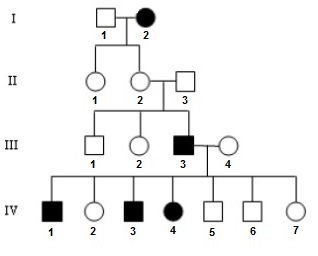
How many generations are shown in this pedigree?
a)
1
b)
2
c)
3
d)
4
21.
This pedigree represents the inheritance of hemophilia in this family. How many of the females have the hemophilia trait?
a)
8
b)
5
c)
2
d)
3
22.
The different forms of a gene are known as _____________.
a)
Codons
b)
Proteins
c)
Alleles
d)
Nucleotides
23.

The universal donor blood type in humans is

a)

O positive

b)

O negative

c)

AB positive

d)

AB negative

24.
The following picture is known as a ___________________.
a)
punnett square
b)
pedigree
c)
karyotype
d)
gamete
25.
How many chromosomes are in a normal human karyotype?
a)
23
b)
46
c)
47
d)
12
26.
The range of human skin colors is caused by a variety of genes, each of which has at least 2 alleles.  This is an example of:
a)
incomplete dominance
b)
codominance
c)
multiple alleles
d)
polygenic inheritance
27.
Testing the amniotic fluid for birth defects.
a)
Chorionic Villi Sampling 
b)
Ultrasound
c)
Amniocentesis
d)
Embryo Test
28.
A test that uses sound waves to create a sonogram.
a)
Amniocentesis 
b)
Ultrasound
c)
Germinal Sampling
d)
Chorionic Villi Sampling 
29.
Dr. Smith's parents have normal hearing. However, Dr. Smith has inherited a form of deafness. Deafness is a recessive trait that is associated with the abnormal allele (d). The allele associated with normal hearing is (D). Dr. Smith's parents could have which of the following genotypes?
a)
DD and dd
b)
dd and dd
c)
Dd and Dd
d)
DD and DD
30.

All the genetic information an organism carries in its DNA

a)

Genome

b)

Pedigree

c)

Punnett Square

31.

What blood type is IAi?

a)

A

b)

B

c)

AB

d)

O

32.

Which of the following cannot be observed in a karyotype?

a)

The number of chromosomes present

b)

An extra chromosome

c)

An allele

d)

Male or Female

33.

How is it possible for two "normal" parents to have a child with Cystic Fibrosis?

a)

CF is recessive

b)

CF is dominant

c)

The parents are both homozygous

d)

CF is a sex-linked disorder

34.

What disorder causes blood cells to be misshaped as seen in this picture?

a)

Albinism

b)

Sickle Cell Anemia

c)

Muscular Dystrophy

d)

Hemophilia

35.

What blood types cab be DONATED to type O blood? Check all that apply.

a)

A

b)

B

c)

AB

d)

O

36.
The main goal of the Human Genome Project (HGP) was to:
a)
Identify the unique parts of each person's DNA.
b)
Identify genes responsible for human diseases.
c)
Identify genes responsible for human behavior.
d)
Determine the entire sequence of human DNA.
37.

Which of the following disorders of bone formation from cartilage results in individuals that have a normal sized trunk, enlarged head, normal intelligence, and shortened arms and legs?

a)

phenylketonuria

b)

achondroplasia

c)

Tay-Sachs

d)

hemophelia

38.

Most likely pattern of inheritance?

a)

autosomal dominant

b)

autosomal recessive

c)

sex-linked recessive

d)

none of the above