
 Worksheets
Chemistry - Practicum 1
Total questions: 41
Worksheet time: 31mins
Which of the following Greek philosophers coined the term "Atomos" which is the root word for atom?
Aristotle
Plato
Democritus
Socrates
Pythagoras
Which of the following scientists organized the known elements into a chart according to their atomic weights and even left spots open for future elements that he knew would eventually be discovered?
John Newlands
Dmitri Mendeleev
Henry Moseley
John Dalton

Which of the following scientists conducted the Cathode Ray Experiment?
Robert Milikan
John Dalton
J.J. Thomson
Henry Moseley
Ernest Rutherford
Explain the significance of the Gold Foil Experiment in reference to atomic structure.
Draw an atom and label its structures and subatomic particles

If an atom had a total number of 12 protons, 13 neutrons, and 11 electrons, then what would be the atom's overall charge?
Neutral
1+
1-
Unknown

What is the name of the chemist who developed this model?
Niels Bohr
Ernest Rutherford
JJ Thomson
James Chadwick
Which subatomic particle was the first to be discovered and who was responsible for its discovery?

Which subatomic particle was discovered during this experiment and which scientist was responsible for its discovery?
Out of the four available options, which element has the LARGEST atomic radius?
Out of the available options, which element has the SMALLEST electronegativity?
Sulfur (S)
Which of the following elements is found in both Group 15 and Period 4?
Which of the following elements is a Halogen?

What element is represented by this model and is it a metal, metalloid, or nonmetal?
Manganese, Transitional Metal
Chlorine, Nonmetal
Arsenic, Metalloid
Bromine, Nonmetal
Who were the chemists known for discovering the Noble Gases?
John Dalton, and J.J. Thomson
Ernest Rutherford, and Michael Faraday
Sir William Ramsay, and Lord Rayleigh
Dmitri Mendeleev, and Robert Boyle
Which chemist is responsible for organizing elements based on their atomic number?
Stanislao Cannizzaro
Which of the following elements is NOT an alkaline earth metal?

What is the name of the atomic model attached and which chemist designed it?
Plum Pudding model, designed by J.J. Thomson
Planetary model, designed by Niels Bohr
Nuclear model, designed by Ernest Rutherford
Solid Sphere model, designed by John Dalton
The last subatomic particle discovered was the (a) .
Which family on the periodic table is full of nonreactive gases that have helped aid in the evolution of the Periodic Table?
What chemist was responsible for the discovery of the proton?
What does the mass number of an atom represent?
The total number of electrons in the atom
The number of protons in the nucleus
The total number of protons and neutrons in the nucleus
The atomic number of the element
If an atom has 17 protons and 18 neutrons, what is its mass number?
34
18
35
17
Which of the following statements about isotopes is correct?
Isotopes have the same mass number but different atomic numbers
Isotopes have the same number of protons but different numbers of neutrons
Isotopes have different chemical properties
Isotopes have different numbers of electrons but the same mass number
What is the net charge of an atom that contains 11 protons and 10 electrons?
2+
0
1-
1+
If an ion has a net charge of 2-, which of the following statements is true?
It has two more protons than electrons
It has two more electrons than protons
It has equal numbers of protons and electrons
It has two fewer neutrons than protons
Which of the following best describes the net charge of a neutral atom?
Negative
Positive
Zero
Depends on the number of neutrons


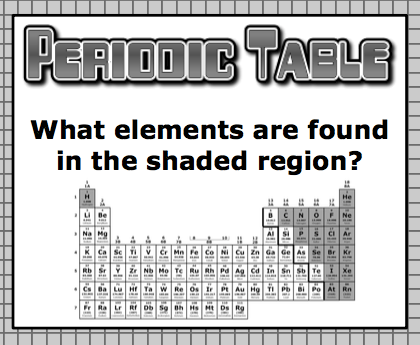


What would He (Helium) be categorized as on the periodic table?
Nonmetal
Metal
Noble gas
Transitional metal
How many periods are there in the modern periodic table?
8
7
6
5
Which of the following statements about periods on the periodic table is correct?
Elements in the same period are all metals.
Elements in the same period have the same number of valence electrons.
Elements in the same period have the same number of electron shells.
Elements in the same period have similar chemical properties.
In which period is the element potassium (K) located on the periodic table?
Period 5
Period 4
Period 3
Period 2
What element is represented by this model and is it a metal, metalloid, or nonmetal?
Manganese, Transitional Metal
Chlorine, Nonmetal
Arsenic, Metalloid
Bromine, Nonmetal
Which of the following best describes the net charge of a neutral atom?
Negative
Positive
Zero
Depends on the number of neutrons
Which of the following elements is NOT an alkaline earth metal?

