
 Worksheets
Industrial and Economic Development
Total questions: 62
Worksheet time: 31mins
Which of the following would NOT influence manufacturing location?
environmental laws
labor availability and cost
access to markets
political stability
currency floatation
Which of the following countries would one NOT associate with ecotourism?
Tanzania
Monaco
Costa Rica
Iceland
Which of the following would NOT be considered a tertiary economic activity?
teacher
lawyer
nurse
fisherman
doctor
Which of the following would NOT be considered a secondary economic activity?
steel worker
construction worker
fisherman
textile worker
Which of the following jobs would in the secondary sector?
cattle farmer
fisherman
mircochip factory worker
hydroponic vertical famer

Which country is most likely represented by this pie chart?
Japan
Mali
United States
India

Which country is represented in this pie chart based on employment sectors?
United Kingdom
Turkey
Chad
India

Based on the employment sector pie chart, what would the likely HDI for this country be?
.12
.32
.72
.92
Which of the following areas in the United States would be considered the least developed?
Appalachia
East Coast
West Coast
Sun Belt
Rust Belt
Which of the following best defines where and when the Industrial Revolution began?
USA - 1800s
China - 1500s
UK - 1700s
Belgium and the Netherlands - 1400s
Which did Weber find to be the most important factor in determining the location of factories?
skill of the labor force
local government policies
labor costs
transportation costs
Which of the following is NOT true of the European Union?
There is visa-free travel between member states.
All countries must use the Euro as their currency.
EU countries belong to a single powerful economic market.
The capital of the EU is in Brussels, Belgium.
The United Kingdom is not a member of the EU.
What is the name given to US factories that are positioned in Mexico close to the US-Mexico border?
factoridas
companiolas
maquiladoras
marcadoras
marcelinos
Nike using cheaper labor in Vietnam to manufacture their products is an example of:
New international division of labor
Tertiary economic activities
Neo-Industrialization
Post-Globalism
Mexico is part of the semi-periphery according to:
Galactic Industrial City Model
Weber's Least Cost Theory
Von Thünen Model
Wallerstein's World Systems Theory
According to Wallerstein's World Systems Theory, France is part of the:
stage 4
semi-periphery
periphery
core
Pakistan is better positioned than China for international call centers. Why is this?
Pakistan has the best telephone networks in Asia.
China has very poor internet in big cities.
Many people in Pakistan speak English due to colonialism.
Labor in Pakistan is significantly cheaper.
Financial institutions and banks are clustered together in Frankfurt, Germany to take advantage of
agglomeration
cheap labor
lower taxes in Western Germany
securities limitations in other EU markets
acculturation
Which of the following is an example of a Millennial Development Goal?
Reduce infant mortality
Switching from primary to tertiary sectors
Universal college education
Microloans available in all countries
Where does the United States land on the GII out of 162 countries?
12
2
104
46
138
Which of the following is NOT used to calculate a country's GII?
reproductive health
empowerment
finance availability
labor market
If the per capita GDP of a country is $2,451, what can be assumed?
It is in the semi-periphery.
It is an LDC.
It is an MDC
It is in the Global North.
A country with a per capita GNI of $120,000 is probably:
part of the Global Periphery
an MDC
an LDC
part of the Global South
Microfinance loans are most likely to be provided to women in LDCs by:
NGOs
MDCs
the Global South
agglomerations
The United States is currently in the "Age of Mass Consumption" according to:
Rostow's Development Model
Weber's Least Cost Theory
Von Thünen Model
Krenschaw's Consumption Model Theory
What is the general analysis of India's post-1947 economic situation?
India turned to communism
modest economic growth
rapid economic decline
rapid economic growth
Development in stage 3 DTM countries is generally uneven. In countries like Brazil and China, for instance, where would you find most of the economic development?
inland along rivers
inland deserts
on the coasts
on the borders of other countries
What is China's comparative advantage with the United States?
better infrastructure
better universities
cheap labor
more domestic natural gas
What is Germany's comparative advantage with China?
larger steel and coal industries
larger primary sector
advanced manufacturing products
cheaper labor
Which of the following countries is closest linked to ecotourism?
Monaco
Costa Rica
China
Thailand
Natural gas extraction in the Marcellus Shale formation in Pennsylvania is part of which economic sector?
primary
secondary
tertiary
quaternary sector
Why has the number of coal workers in West Virginia gone down?
increase in wind farms
increased mechanization
sharp decrease in the demand for coal
coal supplies in the ground are running low
Which of the following is NOT considered one of the "Four Dragons" of Asia?
China
Taiwan
Hong Kong
South Korea
Singapore
Which of the following is not considered one of the "Baltic Tigers", whose post-Soviet economic growth has been rapid.
Latvia
Lithuania
Estonia
Croatia
What has driven the recent economic growth of the Baltic Tigers?
Farming
Information Technology (IT)
High tech manufacturing
Mineral extraction
The reason for the concentration of industries in Pittsburgh is that steel production is a:
bulk-gaining industry
bulk-reducing industry
Which of the following would NOT be a quaternary sector job?
autonomous vehicle designer
AI scientist
quantum computing
3D printing
university lecturer
Why does industrial labor in LDCs rely so heavily on women?
female labor is cheaper
women are generally not allowed to make salaries
women are the only ones allowed to accept microloans
men are more likely to take part in the informal economy
According to Rostow's Model, which best fits for a traditional society?
An elite group initiates economic activity
Production of consumer goods
Rapid growth of some industries
Primary sector / lack of modern technology
Modern technology diffuses in / workers gain more skill
According to Rostow's Model, which best fits for preconditions for takeoff?
An elite group initiates economic activity
Production of consumer goods
Rapid growth of some industries
Primary sector / lack of modern technology
Modern technology diffuses in / workers gain more skill
According to Rostow's Model, which best fits for takeoff?
An elite group initiates economic activity
Production of consumer goods
Rapid growth of some industries
Primary sector / lack of modern technology
Modern technology diffuses in / workers gain more skill
According to Rostow's Model, which best fits for drive to maturity?
An elite group initiates economic activity
Production of consumer goods
Rapid growth of some industries
Primary sector / lack of modern technology
Modern technology diffuses in / workers gain more skill
According to Rostow's Model, which best fits for age of mass consumption?
An elite group initiates economic activity
Production of consumer goods
Rapid growth of some industries
Primary sector / lack of modern technology
Modern technology diffuses in / workers gain more skill
Why is HDI considered superior to DTM to measuring a country's development status?
Along with population statistics, healthcare and education are analyzed.
Along with population statistics, GII, GDP, GNI, and GNI per capita are analyzed.
Along with population statistics, level of democratic participation and press freedom are analyzed.
Along with population statistics, imports and exports are analyzed.
Literacy rates in a country are most closely linked with a country's:
High rank on the GII
GNI per capita
Level of suburbanization
Participation in the informal economy
What is the outcome for countries that reduce infant mortality rates that were previously high?
birth rates decrease
birth rates increase
more children die of disease
poverty increases
Which of the following countries is NOT one of the top 5 largest countries by GDP?
Japan
France
Germany
China
United States of America
Which of the following countries has the highest GDP in the world?
United States of America
Germany
Russia
China
Japan
Which of the following countries has the highest HDI value?
China
Switzerland
Mexico
United States of America
Brazil
Which of the following countries would have the lowest HDI value?
Central African Republic
South Africa
Egypt
Turkey
India
Gender inequality has been _____________ across the world over the last 30 years.
increasing
decreasing
staying roughly the same
Which of the following would NOT be considered a commodity?
oil
smartphone
coal
natural gas
coffee
Which of the following would not be considered a commodity?
soybeans
rice
batteries
cobalt
sugar
Which of the following countries has a GNI per capita of $900?
Mexico
Chile
South Africa
DRC
Switzerland
Which of the following countries has a GNI per capita of $84,000?
Bolivia
Belarus
Norway
Ghana
United States
Which country would have the most favorable rating on the GII?
Russia
United States of America
Mexico
Switzerland
South Korea
Which country ranks the lowest on the GII?
Yemen
Russia
Bangladesh
China
United States of America
Which of the following would be a core country according to Wallerstein's World Systems Theory?
Estonia
Japan
Chad
Mexico
Ukraine
Which of the following countries would be a semi-periphery country according to Wallerstein's World Systems Theory?
China
Germany
United States of America
Gabon
Madagascar
Which of the following countries would be a periphery country according to Wallerstein's World Systems Theory?
India
Iran
Canada
Angola
South Korea
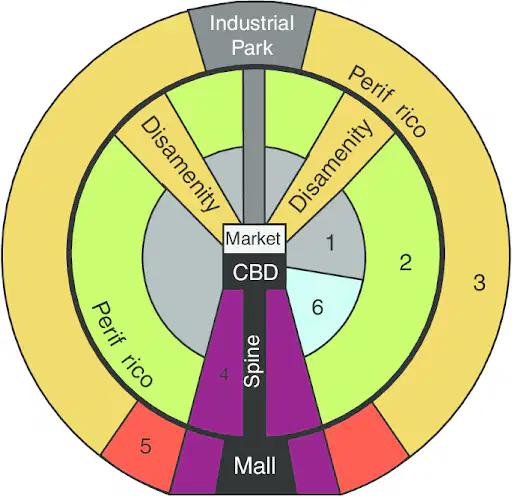
Where would you expect to find a city with this structure?
Core
Periphery
Semi-Periphery
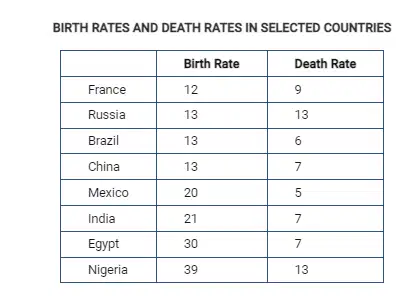
What is the natural increase rate (NIR) of Mexico?
1.5%
15%
150%
-0%
25%

