
NEW
Font size
 Worksheets
DNA, RNA & Protein Synthesis
Total questions: 40
Worksheet time: 21mins
Which of the following units are repeatedly joined together to form a strand of DNA? -Monomers (building blocks) of DNA
amino acids
nucleotides
fatty acids
polysaccharides

What is the role of mRNA in protein synthesis?
it makes the bases that makes up DNA
it copies a section of DNA and uses the information to create the appropriate protein
it helps DNA perform replication
it makes the amino acids used in protein synthesis
Where is mRNA made?
in the nucleus
in the ribosome
in the mitochondria
in the vacuole

Transfer RNA is indicated by which structure in the diagram?


The multicolor string of spheres represents
a sugar
a protein
a nitrogen base
phosphate group

The bottom of the tRNA molecule joins with the mRNA molecule because it has the _____________ to the mRNA's codon.
ribosomes
anticodon
nitrogen bases
sugars
Which nitrogen base is not a part of RNA molecules?
thymine
uracil
adenine
cytosine
guanine
In order for protein synthesis to occur, mRNA must leave the nucleus and travel to
a ribosome in the cytoplasm
a mitochondria in the cytoplasm
a vacuole in the cytoplasm
a chloroplast in the cytoplasm

Where is an anti-codon found?
on the mRNA
on the DNA
on the tRNA
There are 3 types of
DNA
RNA


Which of the following shows the complementary strand to the DNA sequence shown : ATT GTA CGA
TAA CAT GCT
ATT GTA CGA
TAA GTA TCG
UAA CAU GCU
Which of the following shows the complementary strand to the DNA sequence shown: GCT AGA TCG
CGA TCT AGC
TAG CTC GAT
ATC GAG CTA
ATG CTC CGT
DNA is shaped in a:
double helix
tightly packed swirl
twisted ladder
nucleotide

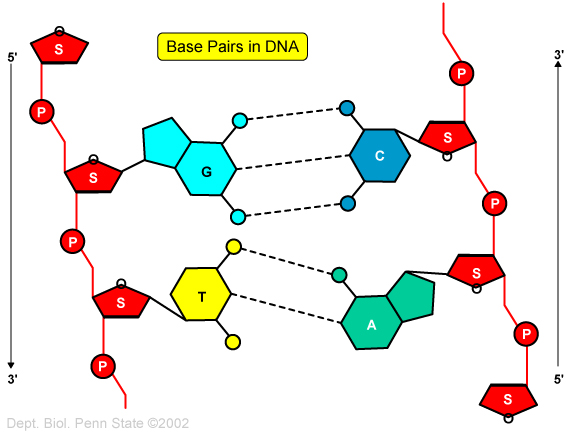
Which of the following correctly labels the nucleotide?
A: Phosphate, B: Sugar, C: Base
A: Sugar, B: Phosphate, C: Base
A: Base, B: Sugar, C: Phosphate
A: Phosphate, B: Base, C: Sugar
What is the backbone of DNA made out of?
Sugars & Phosphates
Sugars & Bases
Bases only
Sugars, Phosphates, & Bases
What are the rungs of DNA made out of?
Sugars & Phosphates
Sugars & Bases
Bases only
Sugars, Phosphates, & Bases

Look at the image of DNA, what type of bond connects the phosphate and the sugar in the backbone?
Covalent Bond
Hydrogen Bond
What is the mRNA for the following DNA strand?
TAC GTA
GCT AGC
ATG CAT
AUG CAU
What is the end product of translation?
mRNA that can leave the nucleus
Amino acid chain
monosaccharide chain
Anticodon

Which organelle is the location where protein is made?
Ribosome
Nucleus
Cytoplasm
Nucleotide
Which of the following is the complementary mRNA sequence to this DNA strand: AACTGAA
UUGACUU
TTGACTT
AACTGAA
AACUGAA

AUG-CCA-GUA-GGG-UAA

What is the correct sequence of protein synthesis?
A. tRNA brings amino acids to the ribosome
B. DNA molecules serve as the templates for mRNA.
C. mRNA molecules move to ribosomes.
D. Proteins are formed on ribosomes.
A-B-C-D
B-C-A-D
C-B-A-D
D-B-A-C

