
Font size
 Worksheets
5th grade Science Review
Total questions: 119
Worksheet time: 2hrs 41mins
What is the driving force of the water cycle?
adhesion
cohesion
the sun
the oceans


The diagram above shows four stages of the water cycle. Which change is occurring at stage 1 in the diagram?
Water is changing from a gas to a solid.
Water is absorbed by the plant through the roots, and transpiration takes place as the water exits through the ________.


Rotting bananas show a
Chemical Change
Physical Change
If enough heat it taken away or removed from a container of water, what will happen to the water?
It will begin to boil.
It will turn into a gas.
It will become a solid.
It will increase in weight.
What happens when a piece of wood burns?
A physical change takes place.
A chemical change takes place.
The wood loses its gravity.
The wood becomes a tree again.
On a hot summer day, a student dropped an ice cube onto a park bench. Within minutes, the ice cube melted. Which best describes the process the student observed?
radiation
combustion
conduction
convection

A cold metal spoon is placed in a bowl of hot soup. Which best describes how the spoon is affected?
The heat from the soup does not affect the temperature of the spoon.
The heat from the soup is conducted through the spoon, making the spoon warmer.
The cold air in the room radiates into the soup, cooling it, and keeping the spoon cool.
The cold from the spoon is conducted into the soup, causing the soup to cool to the same temperature as the spoon.T
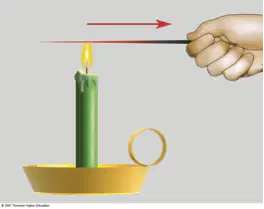
What type of heat transfer is shown in the picture?
(look carefully)
Conduction
Convection
Radiation
Transfer
Which is an example of conduction?
Steam is rising from a cup of hot coffee.
A hot biscuit is warming the plate it is on.
The sun is shining through a window and warming a table.

Tina is boiling water in a metal pot for a weather experiment. What is most likely the reason she would need to use a pot holder for moving the metal pot?
Radiation causes the pot to be hot.
Conduction causes the pot to be hot.
Convection causes the pot to be hot.
Transpiration causes the pot to be hot.
Ice cubes are placed in a glass of water that is at room temperature. Which statement best describes the temperature of the water after 10 minutes?
The temperature decreases because some of the water’s heat is lost to the ice.
The temperature decreases because some of the ice’s heat is lost to the water.
The temperature increases because some of the coolness of the water is absorbed by the ice.
The temperature increases because some of the coolness of the ice is absorbed by the water.
Which best describes the flow of heat?
from a larger object to a smaller object
from a warmer object to a cooler object
from a cooler object to a warmer object

A disease reduces the number of young salmon in a river. Which population will MOST likely increase as a result?
trout and eagle
algae and trout
sculpin and algae
Which lists animals that live in an aquatic ecosystem?
black bear, deer, vole
ducks, turtles, amphibians
panthers, monkeys, snakes
Bryson is comparing two different ecosystems and creates the following list of similarities: aquatic, diverse fish life, high salt concentration, plentiful light at the water's surface. Which two ecosystems is Bryson most likely comparing?
ocean and lake
estuary and ocean
grassland and pond
Which is a difference between abiotic and biotic factors?
Abiotic factors are plants and biotic factors are animals.
Abiotic factors are all living things and biotic factors are all nonliving things.
Abiotic factors are all nonliving things and biotic factors are all living things.
Which is most accurate in describing an estuary ecosystem?
High salt levels keep the water clear of nutrients and proteins.
Freshwater mixes with saltwater to provide a nutrient-rich environment.
Cold water mixes with saltwater to create a cooling effect that encourages growth.
What is a food chain?
The flow of energy from one thing to another
The way animals eat each other
The way the sun makes everything
How the plants grow


*Remember Humans are on the top of all food chains because we do not get hunted.
What do plants need to make their own food?
Sun, Water, and Animals
Sun, Coke, and Soil
Sun, Water, and Soil
Nothing at all
An example of a predator:
shark
mouse
rabbit
An example of prey:
lion
mouse
shark
What is a decomposer?


What is matter?
is anything that uses space
is anything that occupies spaces ony
is anything that occupies space and has mass
is anything that has mass only

What are the organisms that break down dead stuff?
Producers
Consumers
Decomposers
Organisms
How does the food chain start?
Plant life uses energy from the sun to make food.
Insects like grasshoppers eat plant life.
Animals like rats eat insects.
Humans eat large animals and plant life.
What do we call an animal that gets eaten in a food chain?
prey
predator
producer
consumer
An animal cannot be both a predator and prey.
True
False
What is the role of decomposers in the food chain?
to consume plants and animals
to produce food using energy from the sun
to eat decaying matter and return nutrients to the soil
to hunt prey
Seals eat fish. What would happen to the seal population if almost all of the fish died?
The population would grow.
The population would shrink.
Aardvarks eat termites. Aardvarks are termites' ______.
consumers
producers
prey
predators
*Remember Humans are on the top of all food chains because we do not get hunted.
A model that shows how all of the food chains in an ecosystem overlap and connect is called a
community
habitat
food chain
food web
A model that shows one direct flow of energy from the Sun to decomposers in an ecosystem is called a
food web
food chain
population
community

The Gulf Stream begins near the equator.
True
False

Which best describes how winds in the jet stream blow?
no pattern
between a boundary of cold air and warm air
between two boundaries of hot air
between two boundaries of cold air

What kind of weather would you expect if the jet stream met the gulf stream?
cirrus clouds
sunny skies
sunny skies
clouds, storms and precipitation

What will most likely result when the jet stream moves south of North Carolina?
North Carolina will experience tropical weather conditions.
North Carolina will experience cold weather.
North Carolina will experience hot, dry weather.
North Carolina will experience mild weather.

If the jet stream brought cold air south, so that the jet stream and gulf stream collide, you would expect...
Winter weather is cool and wet.
storms and rain over the ocean
There is a greater chance of rain in winter.
temperatures to be cooler because the winds are blowing from the polar regions.

The Jet Stream helps weather systems come to NC by
forcing winds to blow in the opposite direction.
decreasing inland wind speed.
moving air masses west to east across the United States.
keeping temperatures consistently warm all year round

When the Jet Stream moves south (dips low),
North Carolina's winds stop blowing.
North Carolina's weather is not impacted.
North Carolina gets WARM!
North Carolina gets COLD!

If the Jet Stream moved north of the Great Lakes, you would expect...
Colder weather in the Great lakes
Warmer weather in the Great lakes
Less humidity in the Great lakes
Less wind in the Great lakes

What kind of weather would you expect at the place marked "X" on the weather map?
warm and wet
cold and wet
cold and sunny
cold and clear

The jet stream guides this type of air into North Carolina.
Cold air comes to North Carolina because of the Jet Stream.
Warm air comes to North Carolina because of the Jet Stream.
Hot air comes to North Carolina because of the Jet Stream.
No air comes to North Carolina because of the Jet Stream.
The 3 main functions of the Circulatory System
break down food, remove waste, make blood cells
react to stimuli, grow, adapt
deliver nutrients and oxygen, removes waste, and circulate blood


Which best describes the purpose of the muscular system?
The muscular system carries messages from the brain to the bones to move the body.
The muscular system keeps the bones strong and protects them from being broken.
The muscular system produces energy the body needs to be able to move.
The muscular system allows movement of bones and helps maintain posture.
Which two body systems work together to help a person move?
skeletal system and muscular system
nervous system and digestive system
circulatory system and respiratory system
circulatory system and excretory system
What is the main job of the circulatory system?
to move only oxygen through the body
to move tissues in and out of the heart
to move blood through the body
to bring food to the blood cells
In which system are the lungs considered the main structure?
Circulatory System
Digestive System
Nervous System
Respiratory System
In which system is the stomach considered the main structure?
Circulatory System
Digestive System
Nervous System
Respiratory System
Which system is responsible for getting nutrients to cells in the body?
Circulatory System
Respiratory System
Nervous System
Skeletal/Muscular System
Melissa accidentally touches a hot surface and then quickly pulls her hand away. Which two systems in the human body were involved with her action and reaction?
nervous and muscular
skeletal and circulatory
nervous and respiratory
muscular and respiratory

A group of tissues that work together is a(n) ______________________.
cell
organ
organ system
A man has freckles on his nose is an example of a(n)
Inherited Trait
Learned Behavior
Bats have finely tuned senses that guide them to their prey is an example of a(n)
Inherited Trait
Learned Behavior
A girl fears spiders after being bitten by one is an example of a(n)
Inherited Trait
Learned Behavior
Which is Inherited Trait
Having Blue eyes
Teaching a dog to sit on command
Which is a learned Behavior
teaching a dog to sit on command
Having black eyes


wind speed

Which instrument is used to measure the amount of water vapor in the air?
hygrometer
anemometer
barometer
thermometer
A meteorologist observes high temperatures and a high-pressure system. What weather should she predict?
storms
sunny weather
hurricanes
snowstorm
What type of weather would you expect if a cold front were passing over your city?
The air pressure decreases and precipitation occurs.
The air pressure increases and there are clear, sunny skies.
The air pressure decreases and the temperature increases
The air pressure increases and the temperature decreases

