
 Worksheets
Econ Unit 2 Review
Total questions: 114
Worksheet time: 1hrs 1mins
Law of demand: A decrease in the own-price of a good will lead to a(n)
an increase in demand
a decrease in demand
a decrease in quantity demanded
an increase in quantity demanded
For most goods, called normal goods, an increase in consumer incomes causes a(n) [ ].
an increase in demand
a decrease in demand
a decrease in quantity demanded
an increase in quantity demanded
For most goods, called normal goods, an decrease in consumer incomes causes a(n) [ ].
an increase in demand
a decrease in demand
a decrease in quantity demanded
an increase in quantity demanded
For inferior goods, an increase in incomes will lead to
an increase in demand
a decrease in demand
a decrease in quantity demanded
an increase in quantity demanded
For inferior goods, a decrease in incomes will lead to
an increase in demand
a decrease in demand
a decrease in quantity demanded
an increase in quantity demanded
Law of demand: Changes in price affect [ ] demanded, not the whole demand curve.
(a)
An INCREASE in the price of Good A causes the demand curve for Good B to increase. These goods must be [ ].
complements
substitutes
An INCREASE in the price of Good A causes the demand curve for Good B to decrease. These goods must be [ ].
complements
substitutes
A DECREASE in the price of Good A causes the demand for Good B to decrease. These goods must be [ ].
complements
substitutes
A DECREASE in the price of Good A causes the demand for Good B to increase. These goods must be [ ].
complements
substitutes
A change in the number of [ ] of a good will shift the whole demand curve for the good, even if each person's individual consumption does not change.
(a)
If consumers expect their incomes to rise in the FUTURE, that will [ ] the demand for all normal goods now.
increase
decrease
If consumers expect their incomes to fall in the FUTURE, that will [ ] the demand for all normal goods now.
increase
decrease
If an increase in consumer incomes leads to a DECREASE in demand for a good, it is known as a(n) [ ] good.
(a)
If an increase in consumer incomes leads to an INCREASE in demand for a good, it is known as a(n) [ ] good.
(a)
For goods that are complements, a DECREASE in the price of one good causes demand for its complement to [ ].
increase
decrease
For goods that are complements, an INCREASE in the price of one good causes demand for its complement to [ ].
increase
decrease
For goods that are substitutes, an INCREASE in the price of one good causes demand for its substitute to [ ].
increase
decrease
For goods that are substitutes, a DECREASE in the price of one good causes demand for its complement to [ ].
increase
decrease
If consumers expect the PRICE of a good to INCREASE in the FUTURE, that will cause
an increase in demand
an increase in quantity demanded
a decrease in demand
a decrease in quantity demanded
If consumers expect the PRICE of a good to DECREASE in the FUTURE, that will cause
an increase in demand
an increase in quantity demanded
a decrease in demand
a decrease in quantity demanded
Which is caused by a decrease in price?
a movement along the demand curve
a rightward shift of the demand curve
a leftward shift of the demand curve
An increase in demand is represented by
a movement along the demand curve
a rightward shift of the demand curve
a leftward shift of the demand curve
A decrease in demand is represented by
a movement along the demand curve
a rightward shift of the demand curve
a leftward shift of the demand curve
Which of the following will increase the demand for pizza, a normal good?
An increase in the number of restaurants selling pizza
An increase in consumers’ income
An increase in the price of a complementary product
A decrease in the price of pizza
Which of the following will decrease the demand for beef?
Research showing beef is better for your health than chicken
An increase in the income levels of most consumers, if beef is a normal good
An increase in the price of potatoes, if potatoes and beef are complementary goods
An increase in the price of pork, if pork and beef are substitute goods
Which of the following will cause the demand curve for good X to shift to the right?
A decrease in the price of good X
An increase in the consumer’s income, if good X is an inferior good
An increase in the price of good Y, a substitute for good X
An increase in the price of good Z, a complement to good X
According to the law of demand, an increase in the price of grape juice will result in
a decrease in the quantity of grape juice demanded
a decrease in the demand for orange juice, a substitute
a leftward shift in the demand curve for grape juice
a rightward shift in the demand curve for grape juice
In a perfectly competitive market, a change in which of the following could cause a shift in the supply curve?
the incomes of consumers
the numbers of buyers
technology
the price of the product
Which of the following will shift the supply curve for apples to the right?
An increase in the price of apples
A decrease in the rental price for apple harvesting equipment
An increase in the wages of apple pickers
An increase in consumers’ income
Which of the following would shift the short-run supply curve for strawberries?
An announcement of a study that shows the health benefits of eating strawberries
An increase in household incomes
A strike by all farmworkers
A decrease in the consumption of strawberries
Which of the following statements relating to supply is true?
An increase in the price of a good will lead to an increase in the supply of the good.
A decrease in the price of a good will lead to a decrease in the quantity supplied of the good.
A decrease in consumers’ income will lead to a decrease in the supply of the good.
An increase in an input price will lead to an increase in supply.
If the government imposes a tax on the production of cars, which of the following will occur in the market for cars?
The supply curve will shift to the left.
The supply curve will shift to the right.
There will be a movement to the right along the demand curve.
There will be a movement to the right along the supply curve.
Demand for a good is relatively elastic if it is
more than 1
less than 1
positive
negative
Demand for a good is relatively INelastic if it is
more than 1
less than 1
positive
negative
Two goods are complements if their cross-price elasticity is
more than 1
less than 1
positive
negative
Two goods are substitutes if their cross-price elasticity is
more than 1
less than 1
positive
negative
When demand is relatively elastic, which effect is stronger on total revenue?
the price effect
the quantity effect
When demand is relatively INelastic, which effect is stronger on total revenue?
the price effect
the quantity effect
When demand for a good is relatively ELASTIC, a RISE in the price will cause total revenues to
decrease
increase
When demand for a good is relatively ELASTIC, a DROP in the price will cause total revenues to
decrease
increase
When demand for a good is relatively INELASTIC, a DROP in the price will cause total revenues to
decrease
increase
When demand for a good is relatively INELASTIC, a RISE in the price will cause total revenues to
decrease
increase
Which is the correct formula for cross-price elasticity of demand?
%ΔQD/%ΔP
%ΔP/%ΔQD
%ΔQD of Good 1/%ΔP of Good 2
%ΔP of Good 1/%ΔQD of Good 2
Which is the correct formula for price elasticity of demand?
%ΔQD/%ΔP
%ΔP/%ΔQD
%ΔQD of Good 1/%ΔP of Good 2
%ΔP of Good 1/%ΔQD of Good 2
If the cross-price elasticity of demand for two goods is NEGATIVE, the goods are
inferior
normal
substitutes
complements
If the cross-price elasticity of demand for two goods is POSITIVE, the goods are
inferior
normal
substitutes
complements
A decrease in the demand for antique lanterns, a normal good, would be caused by which of the following?
An increase in consumers’ incomes
An increase in the price of lamp oil, a complementary good
An increase in the expected price of antique lanterns in the future
An increase in the price of electric lanterns, a substitute good
Which of the following is true of the cross-price elasticity of demand?
It increases as income increases.
It is close to zero if the two goods are closely related.
It is greater than zero for two goods that are substitutes.
It can indicate if a good is a necessity or a luxury.
Assume that a 2 percent increase in the price of bologna causes a 5 percent decrease in the demand for cheese. What is the cross-price elasticity of demand between the two goods, and how are these goods related?
Cross-price elasticity of demand equals 0.4, and these goods are substitutes.
Cross-price elasticity of demand equals -0.4, and these goods are complements.
Cross-price elasticity of demand equals -2.5, and these goods are complements.
Cross-price elasticity of demand equals 2.5, and these goods are substitutes.
In relation to tacos, the cross-price elasticity of demand for Good is negative. What would be the result if the price of tacos increases?
There will be a movement up the demand curve for Good because it is a complement to tacos.
The demand for Good will increase because tacos and Good X are normal goods.
The demand for Good will increase because it is a substitute for tacos.
The demand for Good will decrease because it is a complement to tacos.
Assume the income elasticity of demand for good Z equals -5. Which of the following is true?
An increase in income will lead to an increase in demand.
An increase in income will lead to an increase in demand.
An increase in income will lead to a decrease in demand.
Good Z is a normal good.
Assume a 10 percent increase in price increased the market quantity supplied by 20 percent. Which of the following is true?
The value of the price elasticity of supply is 2.
The value of the price elasticity of supply is 0.5.
Supply is price inelastic.
Demand is price elastic.
If the value of the price elasticity of supply for a product is 0.5, which of the following statements is correct?
A 10 percent increase in the price of the product will decrease the quantity supplied by 5 percent.
A 10 percent increase in the price of the product will decrease the quantity supplied by 20 percent.
A 20 percent decrease in the price of the product will decrease the quantity supplied by 10 percent.
A 20 percent decrease in the price of the product will decrease the quantity supplied by 40 percent.
A good is a normal good if income elasticity of demand is
greater than 1
less than 1
positive
negative
A good is an inferior good if income elasticity of demand is
greater than 1
less than 1
positive
negative
On a supply and demand graph, consumer surplus is represented by the space between
the demand curve and the price
the demand curve and the supply curve
the supply curve and the price
quantity supplied and quantity demanded
On a supply and demand graph, producer surplus is represented by the space between
the demand curve and the price
the demand curve and the supply curve
the supply curve and the price
quantity supplied and quantity demanded
Brittany was willing to pay $25 for her Chipotle burrito bowl. The price was $15. What was her consumer surplus?
(a)
The minimum cost Brittany would sell her used Stanley for was $20. Someone bought it for $30. Which is true?
Her producer surplus was $10.
Her consumer surplus was $10.
Her producer surplus was .67.
Her consumer surplus was .67.
When price increases,
consumer surplus increases
consumer surplus decreases
consumer surplus does not change
When price decreases,
consumer surplus increases
consumer surplus decreases
consumer surplus does not change
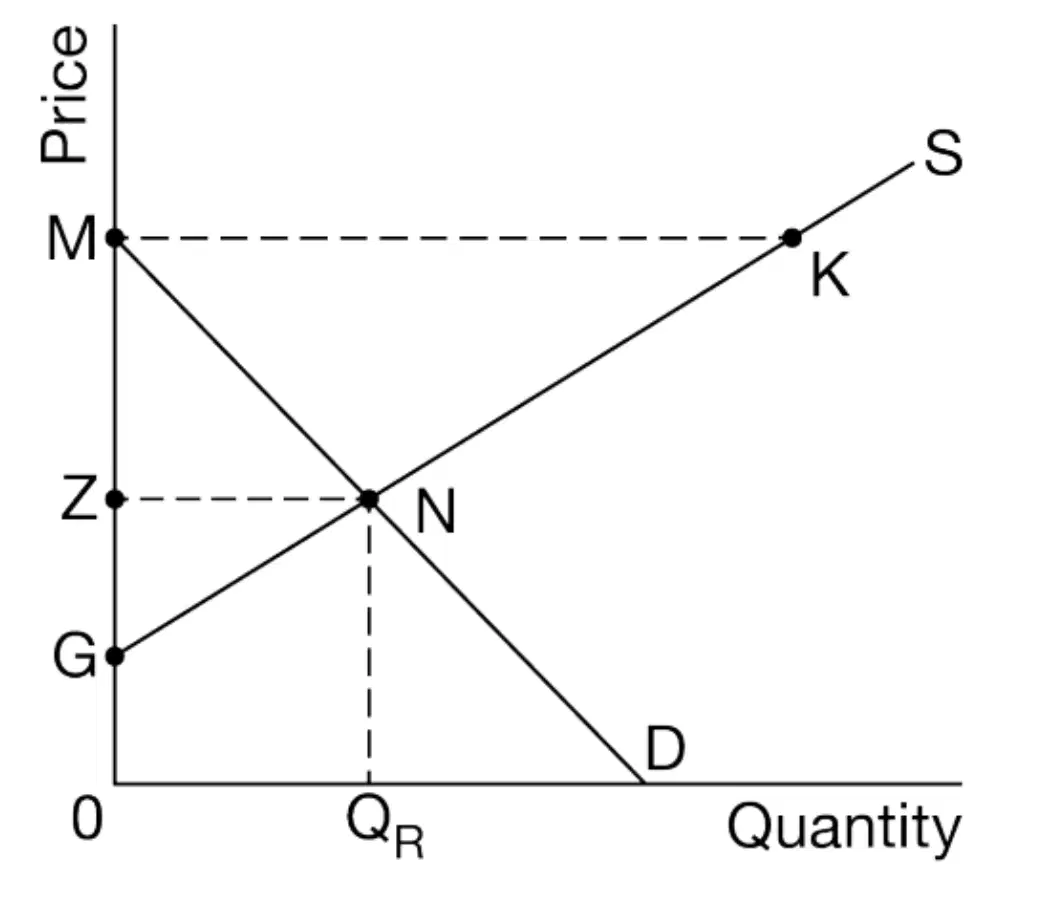
Consumer surplus is represented by
MZN
NZG
MNG
MKN
Producer surplus is represented by
MZN
NZG
MNG
MKN
Total economic surplus is represented by
MZN
NZG
MNG
MKN
If quantity supplied of tomatoes increases by 20% when price increases by 50%, the price elasticity of supply is
.4, which indicates elastic supply
.4, which indicates inelastic supply
2.5, which indicates elastic supply
2.5, which indicates inelastic supply
If the income elasticity of demand for a good is less than 0, that means it is
a complement
a substitute
inferior
normal
In order to be binding, a price floor must be [ ] the equilibrium price.
above
below
In order to be binding, a price ceiling must be [ ] the equilibrium price.
above
below
If a nation's income increases by 5% and quantity demanded for sports cars rises by 15%, income elasticity of demand for sports cars is
3
-3
0.33
-0.33
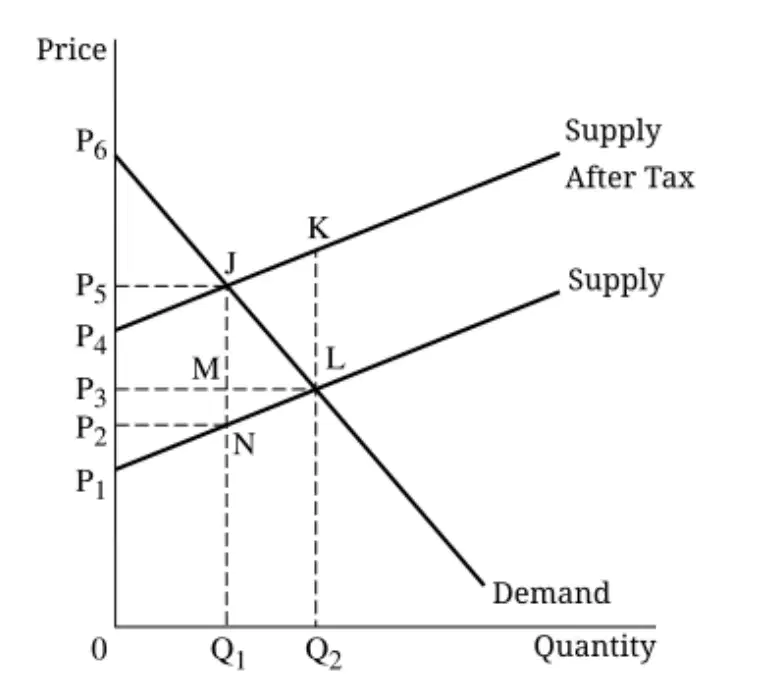
The pre-tax consumer surplus would be
P6-L-P3
P6-J-P5
P3-L-P1
P2-N-P1
The post-tax consumer surplus would be
P6-L-P3
P6-J-P5
P3-L-P1
P2-N-P1
The post-tax producer surplus would be
P6-L-P3
P6-J-P5
P3-L-P1
P2-N-P1
The tax revenue is represented by
P5-J-N-P2
P5-J-M-P3
JLN
JKL
The deadweight loss is represented by
P5-J-N-P2
P5-J-M-P3
JLN
JKL
The producer's net price (after tax) is
P1
P2
P3
P4
The cost of the tax is represented by
P6-P5
P5-P2
P3-P2
P6-P1
In this scenario, the greater portion of the tax burden is being borne by
consumers because demand is more inelastic than supply
consumers because demand is more elastic than supply
producers because demand is more inelastic than supply
producers because demand is more elastic than supply
The fresh fish market is in equilibrium, and the demand is perfectly elastic. The imposition of a per-unit tax on sellers by the government will result in which of the following?
The equilibrium price will increase by the full amount of the tax, and consumers will bear the entire burden
of the tax.
The equilibrium price will remain unchanged, and consumers will bear the entire burden of the tax.
The equilibrium price will increase by the full amount of the tax, and suppliers will bear the entire burden of
the tax.
The equilibrium price will remain unchanged, and suppliers will bear the entire burden of the tax.
Following the imposition of a $4 per-unit tax in a competitive market, the seller’s after-tax price falls from the original equilibrium price of $12 to $11. Which of the following statements relating to the imposition of the tax is true?
The seller bears 75% of the tax burden.
The new equilibrium price is $16.
The buyer bears 25% of the tax burden.
The new equilibrium price is $15.

Suppose that the government imposes a per-unit tax on the producers of a good that has a perfectly inelastic demand. After the tax, the price and quantity of the good sold would change in which of the following ways? (Hint: Look at the graph.)
P: Increase / Q: Increase
P: Increase / Q: Decrease
P: Increase / Q: No change
P: No change / Q: Increase
The government establishes a price ceiling on a good above the equilibrium price. The result would
raise the price of the good
lower the price of the good
raise the price of the good and decrease the quantity demanded
have no effect on the price of the good or quantity demanded
Which factor would NOT cause the demand curve to shift left?
the product becomes less popular
a recession reduces consumer income
researchers discover the product's health risks
a substitute product leaves the market
An effective price ceiling will
lower the price of a good but create a shortage
lower the price of a good but create a surplus
raise the price of a good but create a shortage
raise the price of a good but create a surplus
An effective price floor will
lower the price of a good but create a shortage
lower the price of a good but create a surplus
raise the price of a good but create a shortage
raise the price of a good but create a surplus
The effect of a minimum wage will be to
increase wage but decrease employment
increase wage and employment
decrease wage but increase employment
decrease wage and employment
In which situation will the tax burden fall entirely on the buyer?
perfectly elastic demand
perfectly inelastic demand
relatively elastic demand
relatively inelastic demand
In which situation will the tax burden fall entirely on the seller?
perfectly elastic demand
perfectly inelastic demand
relatively elastic demand
relatively inelastic demand
In which situation will the tax burden on the seller be higher than on the buyer?
perfectly elastic demand
perfectly inelastic demand
demand is less elastic than supply
demand is more elastic than supply
In which situation will the tax burden on the buyer be higher than on the seller?
perfectly elastic demand
perfectly inelastic demand
demand is less elastic than supply
demand is more elastic than supply
Demand tends to be [ ] at the higher price part of the demand curve.
more elastic
less elastic
Demand tends to be more elastic for goods that make up a [ ] portion of one's income.
larger
smaller
Over time, demand for a good tends to become
more elastic
less elastic

Consumer surplus at the world price is represented by
HNPw
HMK
HMPt
HLPw
What is the domestic quantity supplied at the world price+tariff?
50
100
300
350
What is the domestic quantity supplied at the world price without a tariff?
50
100
300
350
Before the tariff is imposed, [ ] units are imported in order to meet domestic demand.
(a)
After the tariff is imposed, [ ] units are imported in order to meet domestic demand.
(a)
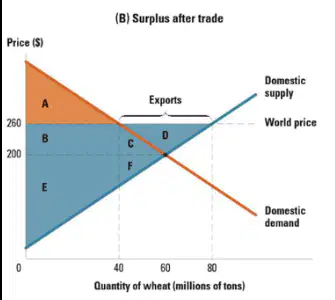
If a country is an EXPORTER of a good, then international trade causes
domestic equilibrium price to increase, reducing consumer surplus
domestic equilibrium price to increase, increasing consumer surplus
domestic equilibrium price to fall, reducing consumer surplus
domestic equilibrium price to fall, increasing consumer surplus
If a country is an IMPORTER of a good, then international trade causes
domestic equilibrium price to increase, reducing consumer surplus
domestic equilibrium price to increase, increasing consumer surplus
domestic equilibrium price to fall, reducing consumer surplus
domestic equilibrium price to fall, increasing consumer surplus
If demand for a good is elastic, then a decrease in the price will cause total revenue to
decrease because the price effect is stronger
decrease because the quantity effect is stronger
increase because the price effect is stronger
increase because the quantity effect is stronger
If demand for a good is relatively inelastic, then a decrease in the price will cause total revenue to
decrease because the price effect is stronger
decrease because the quantity effect is stronger
increase because the price effect is stronger
increase because the quantity effect is stronger
The cross-price elasticity of two goods is negative. That indicates they are
normal
inferior
substitutes
complements
A good is inferior if its income elasticity of demand is
positive
negative
greater than 1
less than 1
The number of urban residents increases, but the cost of lumber, a key input for construction, also increases. Which describes the change in price and quantity as a result?
P: Increase / Q: Indeterminate
P: Decrease / Q: Indeterminate
P: Indeterminate / Q: Increase
P: Indeterminate / Q: Decrease
Researchers announce that eating mangoes generates significant health benefits. At the same time, the wage rate for fruit pickers decreases. What will be the effect in the market for mangoes?
P: Increase / Q: Indeterminate
P: Decrease / Q: Indeterminate
P: Indeterminate / Q: Increase
P: Indeterminate / Q: Decrease
The price of tennis balls increases. At the same time, a major tennis racket company goes out of business. What will happen in the market for tennis rackets as a result?
P: Indeterminate / Q: Increase
P: Indeterminate / Q: Decrease
P: Increase / Q: Indeterminate
P: Decrease / Q: Indeterminate
German consumers experience a 30% income rise. Quantity demanded for oatmeal falls 15% in Germany. Income elasticity of demand for oatmeal is
0.3
0.5
-0.5
2
If the percent change in the quantity demanded exceeds the percent change in the price of a good, that means
the good is normal
the good is inferior
demand is elastic
demand is inelastic
If the percent change in the quantity demanded is less than the percent change in the price of a good, that means
the good is normal
the good is inferior
demand is elastic
demand is inelastic

If a price ceiling is implemented at P3, what will happen to price and quantity exchanged?
P: Increase / Q: Decrease
P: Decrease / Q: Increase
P: Increase / Q: Increase
P: Decrease / Q: Decrease
No change to either
If a price floor is implemented at P2, what will happen to price and quantity exchanged?
P: Increase / Q: Decrease
P: Decrease / Q: Increase
P: Increase / Q: Increase
P: Decrease / Q: Decrease
No change to either
If a price ceiling is implemented at P2, what will happen to price and quantity exchanged?
P: Increase / Q: Decrease
P: Decrease / Q: Increase
P: Increase / Q: Increase
P: Decrease / Q: Decrease
No change to either
If a price floor is implemented at P3, what will happen to price and quantity exchanged?
P: Increase / Q: Decrease
P: Decrease / Q: Increase
P: Increase / Q: Increase
P: Decrease / Q: Decrease
No change to either

