
Font size
 Worksheets
22-23 Microevolution & Natural Selection Review
Total questions: 54
Worksheet time: 43mins
Mutations are random while natural selection is NOT
True
False
Natural selection acts on alleles.
True
False
The unit used in studying evolution is the_______
population
individual

Charles Darwin and Alfred Wallace came up with this theory
Natural Selection
Mutation
Acquired Characteristcs
Principle of Common Descent
Which of the following means "genetic changes in a species over time"
natural selection
speciation
evolution
fitness
Evolutionary change on a small scale
macroevolution
microevolution
coevolution
parallel evolution
Natural selection is known as
family descent
survival of the fittest
convergent evolution
divergent evolution
Genetic fitness means that an organism's ability to do what is high?
lift weights really well
reproduce effectively
attract other members of their species
survive environmental disasters
Microevolution happens in
species
individuals
populations
households
Natural selection requires ______________ to happen in a population.
hundreds of years
variation
low genetic fitness
high genetic fitness
_______________ is also required for natural selection to occur.
Lack of resources
Multiple species
Competition for resources
Darwin

What type of selection is shown in the image?
Stabilising
Directional
Disruptive

What type of selection is depicted in the picture where one phenotype is favored?
stabilizing
directional
disruptive

What type of selection is shown in the image?
Stabilising
Directional
Disruptive
May result when heterozygotes are selected AGAINST.
directional selection
stabilizing selection
disruptive selection

this type of evolution happens on a small scale, typically within a single population
microevolution
macroevolution
natural selection
artificial selection

large-scale evolutionary change that takes place over long periods of time
microevolution
macroevolution

the process by which characteristics of population change over many generations as organisms with heritable traits survive and reproduce, passing their traits to offspring
natural selection
artificial selection
Genetic differences between organisms of the same species.
variation
behavior
adaptation
environment
In finches (birds), what is the biggest advantage of having different shaped beaks?
to look different from other species
to protect itself from predators
to be able to eat the food readily available in the environment
to protect itself against prey
Which of the following is a factor in natural selection?
Individuals of species compete with one another to survive.
All species are genetically diverse.
Individuals better able to adapt to changes leave more offspring.
All of the above.
Individuals that are better able to cope with the challenges of their environment tend to
Increase in population over time.
Decrease in population over time.
Leave fewer offspring than those less suited to the environment.
Both (a) and (c)
Starting in 1954, commercial fishers in the northwest Pacific were paid by weight, rather than by the individual fish, for pink salmon. The fishers increased the use of a type of net that selectively catches larger fish. Which of the following effects did this change in fishing technique most likely have on the salmon population over the next 20 years?
The average body size of the salmon population decreased significantly.
The average body size of the salmon population increased significantly.
The average body size of the males in the salmon population increased, and the females stayed the same.
None of the above.
The Asian shore crab invaded parts of the eastern coast of the United States about 15 years ago. The Asian shore crab preys on blue mussels. In the time since the Asian shore crab arrived, the average shell thickness of the blue mussel population has increased.
Which of the following is the most likely reason that this increase in shell thickness has occurred?
Blue mussels with thick shells attract more crabs that mussels without thick shells.
Blue mussels with thick shells grow in larger colonies than mussels without thick shells.
Blue mussels with thick shells catch more food per day than mussels without thick shells.
Blue mussels with thick shells survive and reproduce more successfully than mussels without thick shells.
The process in which organisms with traits well suited to an environment are more likely to survive and to produce offspring is
Natural selection.
Genetic principles.
Origin of species.
Trait mechanism.
which of the following is an example of microevolution?
a. the evolution pesticide resistance in pests
b. the increase in size, over time, of the horse species.
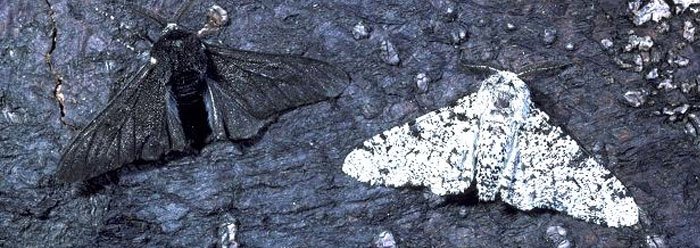
c. the change in color of the peppered moth due to pollution
Both A and C


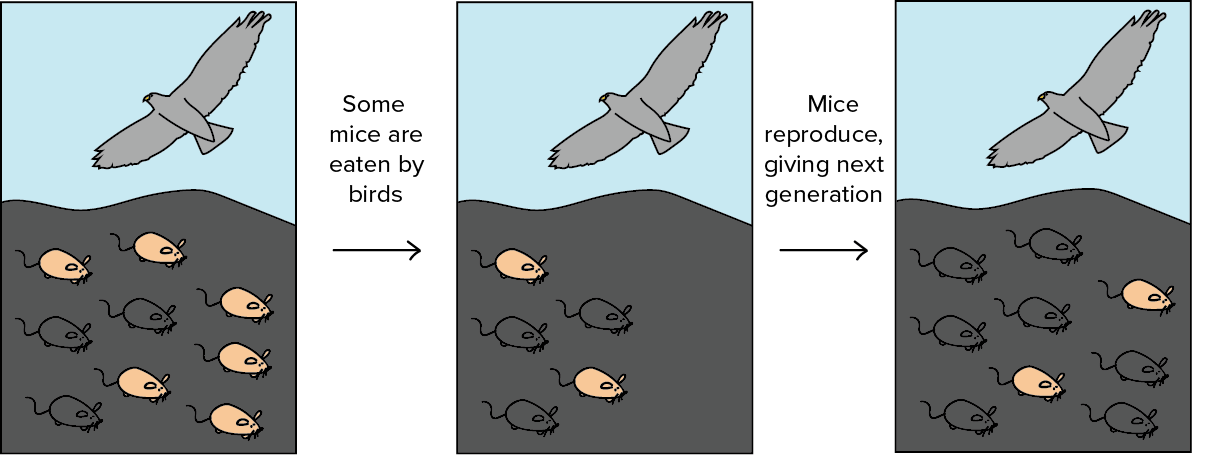
Evolution that can occur on a small scale affecting a single population
microevolution
macroevolution
Genetic Drift
Gene Flow
Evolution on a large scale affecting changes in species across populations
microevolution
macroevolution
Genetic Drift
Gene Flow
Lots of offspring and limited resources causes competition for those resources.
Overproduction of offspring
Natural selection
variation
adaptation
differences in the physical traits of organisms
overproduction of offspring
Variation
adaptation
Descent with modification
a feature that allows an organism to better survive in its environment.
Variation
Descent with modification
overproduction of offspring
adaptation
Sexual selection (selection of traits by one sex of the opposite sex) is also known as
Gene Flow
non-random mating
Genetic Equilibrium
Mutations
random change in the frequency of alleles in a population over time
Mutations
Natural Selection
Genetic Drift
Gene Flow
movement of genes into/out of a population
Mutations
Natural Selection
Genetic Drift
Gene Flow
What is the ultimate source of variation?
crossing over
gene flow
random mutations
genetic recombination
Having a large beak in an environment that needs the large beak to survive is an example of ______________.
adaptation
fitness
natural selection
variation
Natural selection is the process that passes down ____________________ traits.
Same
Old
Useless
Favorable
When there is a difference in population based on genes, it is said to be a _______________.
Mutation
Speciation
Extinction
Genetic Variation
Survival and reproduction of organisms the are best suited in their environment
natural selection
extinction
biodiversity
acquired characteristics
The process of evolution primarily results from which factors listed below (Select ALL that apply):
the potential for a species to increase in number
the high heritable genetic variation of individuals within a species due to mutation and sexual reproduction
competition between individuals for an environment's limited resources needed by those individuals to survive and reproduce
the proliferation of those organisms that are better able to survive and reproduce in the environment
the low heritable amount of genetic variation in a population gene pool due lack of random mutations
Natural selection occurs IF in a population only which TWO things are true of that population...
There is variation in the genetic information between organisms in a population
There is very little in the phenotypical variation expressed between individuals within a population
The traits that negatively affect survival are more likely to be reproduced, and thus are more common in the population
There is variation in the expression of that genetic information—that is, trait variation—that leads to differences in performance among individuals
Natural selection leads to ______________, that is, to a population dominated by organisms that are anatomically, behaviorally, and physiologically well suited to survive and reproduce in a specific environment.
artificial selection
mutations
adaptation
extinction
Differing levels of survival and reproduction between individuals within a population is due to...
having an advantageous trait (a "leg up")
always being bigger and stronger than others
the fact that they mutated faster and more frequently
being much faster than the others in their population
If an individual is expressing an advantageous and heritable trait it will lead to what change in the population overtime?
an increase in the overall population size due to the advantageous trait leading to overall higher success between all individuals with and without the trait.
a decrease in the proportion of individuals expressing the advantageous trait overtime in the future generations of the population.
an increase in the proportion of individuals expressing this advantageous trait in future generations and a decrease in the proportion of individuals that do not express the trait.
there is no way to tell because distribution of traits in a population do not predictively change when conditions of the environment change.

