wayground logo

Free Printable Worksheets

NEW

Font size

S
M
L
XL
Worksheets

U6L2: Protein Synthesis

Total questions: 57

Worksheet time: 1hrs 19mins

Name
Class
Date
1.
The central dogma of biology states that information flows in one direction from 
a)
nuclei to RNA to cytoplasm
b)
ribosomes to proteins to DNA
c)
genes to nuclei to ribosomes
d)
DNA to RNA to proteins
2.
Choose the nucleotide sequence of the RNA strand that would be complementary to the following strand: 
GTAGTCA
a)
UATUAGA
b)
ACGACTG
c)
CAUCAGU
d)
CATCAGT
3.
Choose the nucleotide sequence of the RNA strand that would be complementary to the following strand: 
GTAGTCA
a)
UATUAGA
b)
ACGACTG
c)
CAUCAGU
d)
CATCAGT
4.

In translation, the main function of tRNA is to...

a)
carry a message that, when translated, forms proteins
b)
form a portion of ribosomes
c)
string together complementary RNA and DNA strands
d)
bring amino acids from the cytoplasm to the ribosomes
5.

In transctiption, which of the following events occurs directly after RNA polymerase recognizes a gene?

a)
The polymerase strings amino acids into a polypeptide
b)

Free-floating RNA nucleotides base-pair with exposed DNA bases

c)
A complementary RNA strand detaches itself from the DNA
d)
The DNA strand begins to unwind, separating the two strands
6.

What is the term for a three-nucleotide sequence on mRNA that codes for an amino acid?

a)
base
b)
codon
c)
amine
d)
serine
7.
Which phrase best describes translation?
a)

converts the code on mRNA into a polypeptide

b)
catalyzes bonds between amino acids
c)
produces RNA from DNA molecules
d)
recycles tRNA molecules for reuse
8.
Which of the following is the site of transcription?
a)
vacuole
b)
lysosome
c)
nucleus
d)
ribosome
9.
Which of the following is the site of translation?
a)
vacuole
b)
lysosome
c)
nucleus
d)

cytoplasm

10.

Which of the following is synthesized in the nucleus and carries the genetic code to the cytoplasm?

a)
DNA
b)
tRNA
c)
mRNA
d)
rRNA
11.
A sugar, a phosphate group, and a nitrogen base form the building blocks of which organic compound?
a)
carbohydrates
b)
nucleic acids
c)
lipids
d)
proteins
12.
which process is shown?
a)
diffusion
b)
repiration
c)
recombination
d)
translation
13.
Which of the following best describes how DNA and RNA are similar?
a)
they both contain A and T
b)
They both have a double helix
c)
They are both composed of 5 different nucleotides
d)
they both have C and G
14.
The DNA sequence ATCAGCGCTGGC is part of a gene. how many amino acids are coded for by this message?
a)
4
b)
8
c)
12
d)
20
15.
A scientist puts nucleotide chains of UUUUUU in a test tube under conditions allowing protein synthesis. Soon they are only amino acids chains of phenylalinine. What does the experiment indicate?
a)
phenylalanine is composed of uracil
b)
UUU codes for phenylalanine
c)
protein synthesis malfunctions in test tubes
d)
proteins contain one kind of amino acids
16.
DNA sequence is ACAGTGC. How would this be coded on mRNA?
a)
TGTCACG
b)
UGUCACG
c)
GUGACAU
d)
CACUGUA
17.
Which process?
a)
mutation
b)
transcription
c)
respiration
d)
translation
18.
In RNA, Uracil pairs with ______. 
a)
cytosine
b)
adenine
c)
guanine
d)
thymine
19.
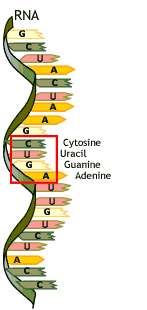
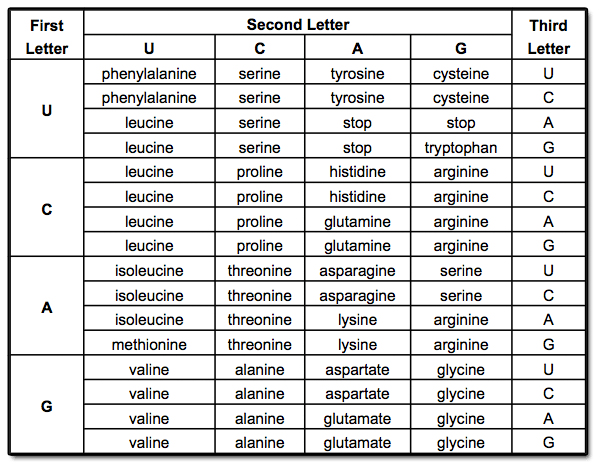
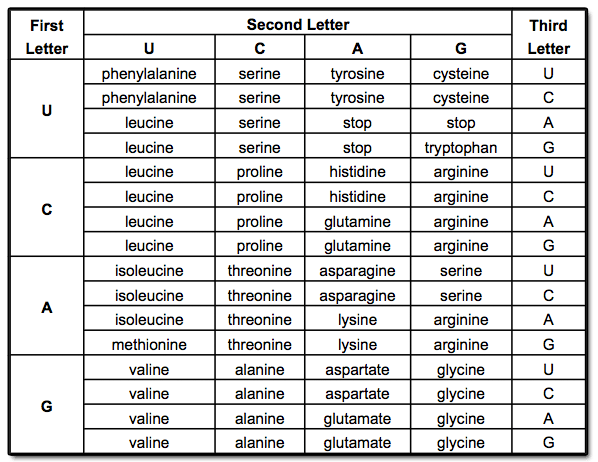
What amino acid is represented by the codon UUA?
a)
Phenylalanine
b)
Tyrosine
c)
Leucine
d)
Stop codon
20.
Which component of DNA determines the traits of an organism? 
a)
Nitrogen Bases
b)
Sugar-Phosphate Backbone
c)
Hydrogen bonds
21.

What is the location in the cell for translation?

a)

nucleus

b)

mitochondria in cytoplasm

c)

ribosome in cytoplasm

d)

chloroplast in cytoplasm

22.
Does the order of amino acids in a protein matter?
a)
YES!
b)
NO!
23.

Which of the following enzymes catalyzes the linkage together of RNA nucleotides to form RNA?

a)

RNA polymerase

b)

ligase

c)

ribozyme

d)

reverse transcriptase

24.

Experiments have demonstrated "the words" of the genetic code are

a)

single nucleotides

b)

two nucleotide sequences

c)

3 nucleotide sequences

d)

enzymes

25.

Which of the following is required for translation to occur?

a)

ATP

b)

ribosomes

c)

tRNA

d)

all of these

26.

The genetic code is carried by DNA is in

a)

an amino acid sequence

b)

the sugars and phosphates that form the backbone

c)

the order of bases in the molecule

d)

the total number of nucleotides

27.

A gene is

a)

the same as a chromosome

b)

the info for making a polypeptide

c)

made of RNA

d)

made of protein

28.

Any change in the nucleotide sequence of a gene is called

a)

a mutation

b)

a codon

c)

a translation

d)

an anticodon

29.
What is the correct amino acid sequence for the mRNA code AUGCCAGUAUGA
a)
Met-Pro-Ala-Val
b)
Met-Pro-Val
c)
Tyr-Gly-His
d)
Tyr-Gly-Arg-His
30.

Why must transcription occur in the nucleus?

a)

because DNA can't leave

b)

because ribosomes are in the nucleus

c)

because DNA polymerase is found there

d)

because helicase unzips the DNA

31.

How many codons equals 1 amino acid?

a)

1

b)

2

c)

3

d)

4

32.

How many nucleotides equal 1 amino acid?

a)

1

b)

2

c)

3

d)

4

33.

On which molecule can an anticodon be found?

a)

mRNA

b)

DNA

c)

tRNA

d)

rRNA

34.

Where is the anticodon located?

a)

at the top of the molecule it's found on

b)

at the bottom of the molecule it's found on

c)

on the right of the molecule it's found on

d)

on the left of the molecule it's found on

35.

What is the purpose for anti-codons?

a)

to ensure the correct amino acid is dropped off

b)

to match the strand of DNA

c)

to decode a sequence of 4 nucleotides into an amino acid

d)

to make me hate biology

36.

A DNA nucleotide may be made up of a phosphate group, along with

a)

deoxyribose sugar and uracil

b)

ribose sugar and cytosine

c)

deoxyribose sugar and thymine

d)

ribose sugar and adenine

37.

The important enzyme related with transcription is;

a)

gyrase

b)

DNA polymerase

c)

RNA polymerase

d)

ligase

38.
21 nucleotides will provide how many codons?
a)
3 amino acids
b)
5 amino acids
c)
7 amino acids
d)
9 amino acids
39.

One difference between DNA and RNA is that

a)

DNA= 1 strand

b)

DNA contains ribose sugar

c)

DNA has a double strand

d)

RNA is more complex

40.

Which codons code for the amino acid serine?

a)

AAA and AAG

b)

CUA and CUG

c)

UCU and AGU

d)

GAG and GAA

41.

what is the role of DNA?

a)

control the cell

b)

makes proteins

c)

store and transmit genetic information for the cell

d)

cellular respiration

42.
Name this structure
a)
double helix
b)
nucelotide
c)
twisted ladder
d)
hydrogen bond
43.
Which of these bases does not exist in RNA?
a)
C
b)
T
c)
U
d)
A
44.
What is occurring in this picture?
a)
Translation
b)
Replication
c)
Translocation
d)
Transcription
45.
In order for DNA instructions to move from the nucleus to the ribosomes in the cytoplasm of a cell, an RNA copy of a DNA strand must be made. This process, which takes place in the cell nucleus, is called
a)
translation
b)
mutation
c)
DNA replication
d)
transcription
46.
Transcribe the following piece of DNA:
ATCGTA
a)
UAGCAU
b)
TAGCAT
c)
ATCGTA
d)
AUCGUA
47.

What is this a picture of?

a)

DNA

b)

mRNA

c)

rRNA

d)

tRNA

48.
What does rRNA do?
a)
provides information from DNA to ribosomes
b)
transfers amino acids to the ribosomes
c)
makes up ribosomes
d)
builds proteins
49.
The anti-codon 
a)
contains a sequence the same as the codon
b)
contains a sequence complementary to the codon 
c)
contains the base thymine
50.
Every three letters (example: ATC) in DNA codes for what??
a)
Amino Acid
b)
Nucleotide
c)
Lipid
d)
Carbohydrate
51.
Amino acids all have the same general structure except for the:
a)
Amino Group
b)
Carboxyl Group
c)
'R' Group
d)
Carbonyl Group
52.
The number of amino acids used to produce proteins for all living things is:
a)
20
b)
c)
15
d)
42
53.
The tertiary structure folding in proteins is primary due to the interactions of....
a)
the 'R' groups
b)
the 'P' groups
c)
the 'A' groups
d)
the 'S'
54.
Which is not a use or function of protein?
a)
forms enzymes and hormones
b)
forms transport channel in cell membrane
c)
forms structural proteins in the body
d)
quick energy
55.
Which structure changes in the 20 different amino acids?
a)
#1
b)
#2
c)
#3
d)
#4
56.

The part of the amino acid in the red circle is

a)

the amino group

b)

the carboxyl group

c)

the R group

d)

the peptide bond

57.

A segment of DNA that codes for a trait

a)

gene

b)

allele

c)

chromosome

d)

chromatid