wayground logo

Free Printable Worksheets

NEW

Font size

S
M
L
XL
Worksheets

Unit #5 EOC Review

Total questions: 59

Worksheet time: 1hrs 5mins

Name
Class
Date
1.
Ostrich wings are examples of
a)
homologous structures
b)
vestigial structures
c)
adaptations
d)
traits
2.
Why do embryologist study embryos?
a)
to see if they are related
b)
to understand adaptations
c)
to determine the age
d)
to learn what parents are vestigial
3.
Change over time is
a)
evolution
b)
generation
c)
growth
d)
biogenesis
4.
What animal is Darwin known for studying?
a)
dinosaurs
b)
tunicates
c)
finches
d)
horses
5.

A group of ecosystems that have similar organisms, climates and precipitation.

a)

niche

b)

habitat

c)

community

d)

biome

6.
What characteristic did Darwin observe about the finches on the Galapagos Islands?
a)
Their feathers 
b)
Genotypes 
c)
Their beaks
d)
Their body sizes
7.
Which term refers to the process by which individuals that are better suited to the environment survive and reproduce therefore passing down their genes to their offspring? 
a)
Evolution 
b)
Variation 
c)
Adaptation
d)
Natural Selection 
8.

When plant growth returns after a forest fire, it is considered

a)

primary succession

b)

secondary succession

c)

carbon footprint

d)

nitrogen fixation

9.
The white feathers of a snowy owl allow it to blend in with its environment during the winter months (snow). This is an example of ________________
a)
Species
b)
Environmental Change
c)
Adaptation
d)
Variation
10.
The struggle for existence against other members of an organisms species is
a)
Competition
b)
Natural Selection
c)
gene flow
d)
genetic drift
11.
A well-tested concept that explains a wide range of observations is called a(an):
a)
hypothesis
b)
experiment
c)
cause and effect
d)
scientific theory
12.

Genetic mutations are the direct cause of which of the following?

a)

Aliens

b)

Super heroes

c)

Variations

d)

8th grade behaviors

13.

The peppered moth's color camouflaged it on the light colored tree bark. It's color was an example of a/n

a)

Variation

b)

Dominant trait

c)

Recessive trait

d)

Adaptation

14.

If a sick person takes an antibiotic but it doesn't kill all of the bacteria causing the sickness, what might explain this?

a)

Variations in the bacteria allowed some organisms to be less affected by the antibiotic?

b)

Bacteria cannot be killed by antibiotics

c)

You cannot cure a bacterial infection

d)

Bacteria do not cause sicknesses

15.

On the Galapagos Islands, different finches evolved on different islands to fit their environment. When a species develops unique traits because it is trapped in one area this is called:

a)

Geographic isolation

b)

Geologic separation

c)

General relocation

d)

Genetic differentiation

16.

One female salmon can lay hundreds of eggs. Why doesn't the salmon population increase dramatically?

a)

Salmon reproduce asexually

b)

Most offspring do not grow up to reproduce

c)

Salmon eggs don't hatch

d)

Salmon are extinct

17.
All food webs and food chains begin with _________________.
a)
primary consumer
b)
producers
c)
secondary consumers
d)
predators
18.
How much of the energy in each level of a ecological pyramid gets lost as heat or used by the organism so that it cannot be passed on to the next trophic level?
a)
80%
b)
90%
c)
10%
d)
20%
19.
Only about ten percent of the energy stored in an organism can be passed on to the next trophic level. Of the remaining energy, some is used for the organism’s life processes, and the rest is typically
a)
used in reproduction
b)
stored as body fat
c)
stored as body tissues
d)
converted to heat and lost
20.
The place where an organism lives is its _________.
a)
habitat
b)
abiotic
c)
ecosystem
d)
community
21.
All of the nonliving parts of an ecosystem are _______.
a)
biography
b)
biotic
c)
abiotic
d)
biology
22.
A group of different species that live together and interact in an environment are called a/an ________.
a)
community
b)
habitat
c)
population
d)
ecosystem
23.
What is the definition of Biotic factors?
a)
Dead things
b)
plants
c)
Living things or organisms
d)
soil
24.
What is another word for population of living things?
a)
Niche
b)
Habitat
c)
Species
d)
Organism 
25.
What is the role an organism plays in its ecosystem?
a)
Habitat
b)
Niche
c)
Organism
d)
Population
26.
Which type of symbiosis has both organisms benefit?
a)
Symbiosis
b)
Commensalism
c)
Parasitism
d)
Mutualism
27.
A cattle egret hanging out on top of an elephant and eating insects that fly up out of the grass as the elephant walks shows:
a)
Parasitism
b)
Commensalism
c)
Mutualism
d)
Organism
28.
What does NOT produce carbon dioxide?
a)
Photosynthesis
b)
Burning Fossil Fuels
c)
Animal respiration
d)
Plants decaying
29.
Organisms that do not decompose can be buried and become what?
a)
water
b)
nutrients
c)
air
d)
fossil fuels
30.
Which of the following removes carbon from the atmosphere?
a)
Combustion
b)
Respiration
c)
Photosynthesis
d)
Death
31.
The average temperature of the surface of Earth has increased approximately 1°C in the past century. Which reason best explains this increase in temperature?
a)
lower levels of ozone in the atmosphere
b)
lower levels of nitrogen in the atmosphere
c)
higher levels of carbon dioxide and other greenhouse gases in the atmosphere
d)
higher levels of oxygen in the atmosphere
32.

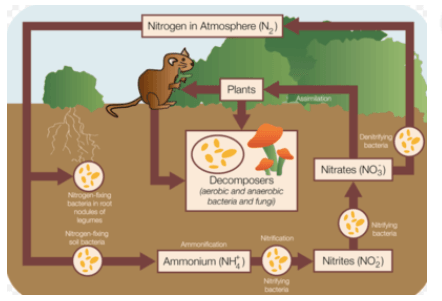
What converts nitrogen gas into a usable form for plants and animals?

a)

bacteria

b)

rain

c)

fungi

d)

car exhaust

33.

How is nitrogen "fixed" into a usable form for plants?

a)

Through action of bacteria only

b)

Through lightning only

c)

Through action of bacteria and lightning

d)

Through photosynthesis

34.

What is the formula for atmospheric nitrogen?

a)

N

b)

N2

c)

NH3

d)

NO3

35.

A correct path that nitrogen could take would be

a)

air -> animals -> plants -> bacteria

b)

animals -> air -> bacteria -> plants

c)

bacteria -> air -> plants -> animals

d)

air -> bacteria -> plants -> animals

36.

What is another name or synonym for the water cycle?

a)

Geologic cycle

b)

Hydrologic cycle

c)

Geosphere

d)

Carbon cycle

37.

What is the energy source that drives the water cycle?

a)

The moon T

b)

The heat from our home in the winter all around the world

c)

The sun

d)

he heat generated solely from the core of the earth

38.

The process where plants absorb water through the roots and then give off water vapor through pores in their leaves. __________________________

a)

Transpiration

b)

Condensation

c)

Evaporation

d)

Precipitation

39.
What is this an example of?
a)
diversity of species
b)
variation
c)
vestigial structures
d)
DNA studies
40.

If the amount of food or resources available increases, the carrying capacity for an animal:

a)

Stays the same

b)

Increases

c)

Decreases

d)

Fluctuates

41.

Anything that restricts the size of a population is a ________________________.

a)

biotic potential

b)

carrying capacity

c)

species

d)

limiting factor

42.

What is happening to the population between the 4th and 8th unit of time?

a)

It is increasing slowly.

b)

It is increasing rapidly.

c)

It is constant.

d)

It is decreasing.

43.

I pour two cups of Lucky Charms into a bowl. I pick out fifteen marshmallows. Fifteen marshmallows per two cups of Lucky Charms is an example of which of the following?

a)

Limiting factor

b)

Biotic potential

c)

Ecosystem

d)

Population density

44.

What occurs when a population becomes larger than the carrying capacity of the ecosystem?

a)

overpopulation

b)

carrying capacity

c)

population density

d)

nothing, everything stays the same

45.

Which of the following is not part of the biosphere?

a)

The polar ice caps

b)

The Atlantic Ocean

c)

The Kalahari Desert

d)

The moon

46.

An ecosystem is classified into a biome by its

a)

climate

b)

environment

c)

climax community

d)

geriatric population

47.

Hardy species such as moss or lichens that are the first to establish an area are called

a)

homologous species

b)

pioneer speices

c)

secondary species

d)

keystone species

48.
a)

exponential growth curve

b)

logistic growth curve

49.

A massive tornado

a)

density dependent limiting factor

b)

density independent limiting factor

50.

No two species can occupy the same niche in the same ecosystem

a)

niche divergence

b)

competitive exclusion

c)

competitive inclusion

d)

participation trophy

51.
An organism at the second trophic level would be considered a...
a)
Top carnivore
b)
Producer
c)
Herbivore
d)
Carnivore
52.
What type of selection is depicted in the picture? 
a)
stabilizing 
b)
directional 
c)
disruptive 
d)
the answer is not here
53.
Robins typically lay fours eggs. If more then four eggs are produced then the baby chicks are malnourished while smaller egg numbers result in no viable (able to live) baby chicks. This is an example of
a)
stabalizing
b)
disruptive
c)
direction
d)
none of the above
54.
What type of selection?
a)
Directional 
b)
Stabilizing
c)
Disruptive
55.
Only populations can evolve.
Individuals can not evolve.
a)
True
b)
False
56.
What type of natural selection is this?
a)
Disruptive Selection
b)
Directional Selection
c)
Stabilizing Selection
d)
Sexy Selection
57.
Scientists find that most feral cats in a neighborhood have whiskers about 12 cm long. After about 15 generations of stabilizing selection, what would you expect to see?
a)
even more cats with 12 cm long whiskers
b)
most cats with less than 12 cm long whiskers
c)
most cats with more than 12 cm long whiskers
d)
most cats with whiskers either less than or more than 12 cm long, very few with whiskers 12 cms 
58.
What is the correct explanation for what is happening in this graph?
a)
There are a lot of average-sized beaks
b)
There are no beaks
c)
There are a lot of small beaks only
d)
There are a lot of small and large beaks, but not average-sized ones
59.

Two populations of the same species do not have the same mating rituals or signals.

a)

geographical isolation

b)

temporal isolation

c)

adaptive ratiation

d)

behavioral isolaton