wayground logo

Free Printable Worksheets

NEW

Font size

S
M
L
XL
Worksheets

Our Planet 1 - 4 Spheres, Lat and Long, our trip around the sun

Total questions: 40

Worksheet time: 33mins

Name
Class
Date
1.

The ______________ is the highest level of the atmosphere.

a)

Troposphere

b)

Stratosphere

c)

Mesosphere

d)

Exosphere

2.

The lowest level of the atmosphere is the _______________.

a)

Troposphere

b)

Stratosphere

c)

Mesosphere

d)

Exosphere

3.

This layer of the atmosphere contains the ozone layer.

a)

Troposphere

b)

Stratosphere

c)

Thermosphere

d)

Exosphere

4.

This layer of the atmosphere is where weather occurs.

a)

Troposphere

b)

Stratosphere

c)

Mesosphere

d)

Thermosphere

5.

The _______________ protects us from meteoroids, because in this layer they burn up.

a)

Troposphere

b)

Stratosphere

c)

Mesosphere

d)

Thermosphere

6.

Atmo- in the word atmosphere means ___________.

a)

Earth

b)

Water

c)

Air

d)

Life

7.

_________________ is the short term changes in the atmosphere.

a)

Weather

b)

Climate

c)

Climate change

d)

Troposphere

8.

_________________ is how the atmosphere behaves over relatively long periods of time.

a)

Weather

b)

Climate

c)

Climate change

d)

Latitude

9.

What is the second most abundant gas in the atmosphere?

a)

Oxygen

b)

Carbon dioxide

c)

Water vapor

d)

Nitrogen

10.
This layer is directly below the crust.
a)
Crust
b)
Mantle
c)
Outer Core
d)
Inner Core
11.
This layer is the thinnest layer and is made of solid rock.
a)
Crust
b)
Mantle
c)
Outer Core
d)
Inner Core
12.
This layer is a solid ball of metal.
a)
Crust
b)
Mantle
c)
Outer Core
d)
Inner Core
13.
This layer surrounds the inner core.
a)
Crust
b)
Mantle
c)
Outer Core
d)
Inner Core
14.

To reduce your carbon footprint, you should eat food that is....

a)

grown in other countries

b)

yummy

c)

grown locally

15.

Sustainability is making sure that the planet and its resources can continue to provide life.

a)

True

b)

False

16.
The average temperature of earth is rising. 
a)
True
b)
False 
c)
I don't know
17.

What releases oxygen?

a)

Tress and computers

b)

Plants and trees

c)

plants and cars

d)

cars and trees

18.
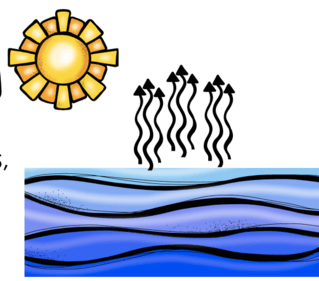
What part of the water cycle does this picture show?
a)
condensation
b)
precipitation
c)
evaporation
19.
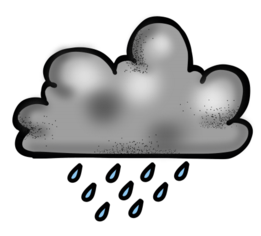
What part of the water cycle does this picture show?
a)
condensation
b)
precipitation
c)
evaporation
20.
What is evaporation?
a)
The part of the water cycle when the sun heats up water, turning it from a liquid into water vapor or steam. It rises from the ground into the air.
b)
The part of the water cycle when the water vapor in the air gets cold. The water turns back into a liquid and forms clouds.
c)
The part of the water cycle when clouds get heavy and can no longer hold the liquid water. This causes the water to fall from the sky to the earth as rain, snow, sleet, or hail.
21.
What is condensation?
a)
The part of the water cycle when the sun heats up water, turning it from a liquid into water vapor or steam. It rises from the ground into the air.
b)
The part of the water cycle when the water vapor in the air gets cold. The water turns back into a liquid and forms clouds.
c)
The part of the water cycle when clouds get heavy and can no longer hold the liquid water. This causes the water to fall from the sky to the earth as rain, snow, sleet, or hail.
22.
What is precipitation?
a)
The part of the water cycle when the sun heats up water, turning it from a liquid into water vapor or steam. It rises from the ground into the air.
b)
The part of the water cycle when the water vapor in the air gets cold. The water turns back into a liquid and forms clouds.
c)
The part of the water cycle when clouds get heavy and can no longer hold the liquid water. This causes the water to fall from the sky to the earth as rain, snow, sleet, or hail.
23.
How much of our planet is estimated to be covered with water?
a)
68%
b)
50%
c)
97%
d)
75%
24.

The image shows various stages in the water cycle. During which stage does water flow back towards the sea as runoff?

a)

W

b)

X

c)

Y

d)

Z

25.

The process when plants release water vapor from their leaves is called _____________.

a)

precipitation

b)

evaporation

c)

transpiration

d)

condensation

26.
The water cycle has
a)
a beginning and an end. 
b)
no beginning an no end. 
c)
only a beginning. 
d)
only an end. 
27.
What source of energy evaporates the most water from Earth’s surface?
a)
volcanoes
b)
the sun
c)
lightning
d)
wind
28.

When water changes from a liquid to a solid it is known as...

a)

melting.

b)

condensation.

c)

freezing.

d)

evaporation.

29.

What is a rotation?

a)

When one object orbits around another object.

b)

When one object spins around on its axis

30.
In what direction does the Sun appear to rise every morning?
a)
North
b)
East
c)
West
d)
South
31.

In which direction does the Sun set?

a)

North

b)

South

c)

East

d)

West

32.
How long does earth's rotation last? 
a)
90 hours
b)
about 1 hour
c)
24 hours
d)
48 hours
33.

what is the cause of occurence of day and night?

a)

The movement of the moon around the Earth

b)

The movement of the moon nearer to the Sun

c)

The rotation of Earth on its axis

d)

The Earth orbits round the Sun

34.

At what position will it be spring in the southern hemisphere

a)

1

b)

2

c)

3

d)

4

35.

Tilted 23.5 degrees from the perpendicular to its orbit.

a)

Earths Tilt

b)

Hemisphere

c)

Axis

d)

Angles

36.

The objects orbital motion around another object.

a)

Axis

b)

Rotation

c)

Hemisphere

d)

Revolution

37.
What divides the world into the
Eastern and Western Hemispheres?
a)
Equator
b)
Prime Meridian
c)
International Date Line
d)
Northern Hemisphere
38.
_____ lines run the same way on
a map as the Equator.
a)
Latitude
b)
Hemisphere
c)
Longitude
d)
Prime Meridian
39.
This line of longitude is directly
opposite the Prime Meridian.
a)
Equator
b)
Arctic Circle
c)
International Date Line
d)
Antarctic Circle
40.
This line of latitude is just below
the Equator.
a)
Tropic of Capricorn
b)
Arctic Circle
c)
International Date Line
d)
Tropic of Cancer