
 Worksheets
Math 2 Ultimate Midterm
Total questions: 238
Worksheet time: 10hrs 28mins
are two angles that share a common vertex and share a common side.
Adjacent Angles
Linear Pair
Supplementary Angles
Supplementary Angles
angles are two adjacent angles where the non-shared sides forms a line
Adjacent Angles
Linear Pair
Supplementary Angles
Supplementary Angles
Supplementary Angles
Supplementary Angles are two angles that add to 180°.
Supplementary Angles are two angles that add to 80°.
Supplementary Angles are two angles that add to 190°.
Supplementary Angles are two angles that add to 10°.
Complementary Angles
are two angles that add to 180°.
are two angles that add to 0
are two angles that add to 90°.
are two angles that add to 80°.
Vertical Angles
Vertical angles are two angles that do not share a side and are formed by 2 intersecting lines. (not next to each other)
Also, vertical angles are congruent, meaning their measures are equal.
Also, vertical angles are congruent, meaning their measures are equal.
lol
Transversal
is a line that intersects one coplanar lines at two different points
is a line that intersects two coplanar lines at two different points
is a line that intersects three coplanar lines at two different points
is a line that intersects four coplanar lines at two different points
Angles in the same position at each intersection, like both the top right angles or both the bottom right angles, etc.
Corresponding Angles Postulate
Corresponding Angles
Alternate Interior Angles
Alternate Interior Angles Theorem
Corresponding Angles Postulate
If the two lines are parallel,
then Corresponding Angles are Congruent.
Angles in the same position at each intersection, like both the top right angles or both the bottom right angles, etc.
Alternate Interior Angles
Angles that are in the interior (between the two lines) and are on opposite sides of the transversal, but are not adjacent.
If the two lines are parallel,
then Corresponding Angles are Congruent.
If the two lines are parallel,
then Alternate Interior Angles are .
(a)
Angles that lie on the same side of the transversal between the two lines
Same-Side Interior Angles
Alternate Interior Angles Theorem
If the two lines are --- ,
then Same-Side Interior Angles are Supplementary.
(a)
Alternate Exterior Angles
Angles outside the two lines and
on opposite sides of the transversal.
If the two lines are parallel,
then Alternate Exterior Angles are Congruent.
If the two lines are parallel,
then Alternate Exterior Angles are .
(a)
Triangle Sum Theorem
The sum of the measures of the interior angles of a triangle is equal to 180°.
The sum of the measures of the interior angles of a triangle is equal to 80°.
The sum of the measures of the interior angles of a triangle is equal to 70°.
The sum of the measures of the interior angles of a triangle is equal to 170°.
The measure of an ------ of a triangle is equal to the sum of the measures of the two remote interior angles.
exterior angle
interior angle


∠QRT and ∠TRS are supplementary. Solve for x.
12
15
9
3


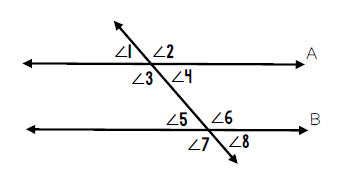
Angle 3 and Angle 6 are examples of which type of angle pair?
Alternate exterior angles
Alternate interior angles
Vertical angles
Corresponding angles
Angle 1 and Angle 5 are examples of which type of angle pair?
Alternate exterior angles
Alternate interior angles
Vertical angles
Corresponding angles
Angle 6 and Angle 7 are examples of which type of angle pair?
Alternate exterior angles
Alternate interior angles
Vertical angles
Corresponding angles
Which of the following angles would NOT be congruent to the measure of ∠7 ?
∠2
∠3
∠6
∠8
Which of the following is an example of corresponding angles?
∠8 and ∠4
∠5 and ∠7
∠1 and ∠7
∠3 and ∠5
Which of the following is NOT an example of supplementary angles?
∠7 and ∠8
∠2 and ∠3
∠1 and ∠7
∠6 and ∠4
If the m∠7 = 115°, find the measure of ∠2.
115°
65°
180°
Cannot be determined
If the m∠5 = 63°, find the measure of ∠3.
63°
117°
180°
Cannot be determined
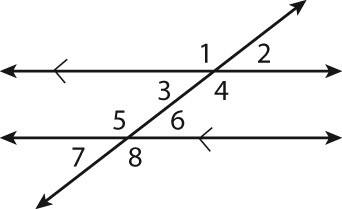

Angles 4 and 6 are...
supplementary
congruent

The Triangle Sum Theorem states that...
90
180
4
congruent angles

The Exterior Angle Theorem states that...
< 4
90
< 3
180

95
85
35
45

26
36
85
144

145
113
102
78

89
211
81
119

Find the measurement of the unknown angle, x.
142
38
180
90


Find <S
A
B
C
D


Which two angles are the remote interior angles to Angle W?
Angle X and Angle Y
Angle X and Angle Z
Angle Y and Angle Z
Angle Z and Angle W

What is the measure of x?
101°
111°
121°
131°

Set up an equation to find x.
52 + 5x + 16 + 10x + 8 = 180
52 - 5x + 16
52 + 5x + 16 = 10x + 8
52 + 10x + 8 = 5x +16

What is a right triangle?
A triangle where all sides equal 90 degrees
A triangle where every angle is 90 degrees
A triangle where all three sides are equal
A triangle where there is a 90 degree angle
What letter represents the hypotenuse?
a
b
a and b
c
Hypotenuse
Vertical side in a right triangle
Longest side in a right triangle
Horizontal side in a right triangle
a2 + b2 = c2
Which choice represents the legs?
a and b
a
b
c
Define the term 'right angle'
Three angles in a right triangle
When two angles in a triangle are 90 degrees
Any angle less than 90 degrees
A 90 degree angle
The Pythagorean Theorem is _________
a + b = c
a2 + b2 = c2
a2 + b2 + c2
A = LW

Which equation can be used to solve for "x"?
152 – x2 = 212
x2 – 152 = 212
152 + 212 = x2
212 – 152 = x2

Determine the length of the missing side.
7
8
17
23
Does the set of numbers represent a right triangle?
20, 25, 15
Yes
No
How is the distance formula correctly written:
d = (y1 − y2)2 −(x2 − x1)2
d = (x2 − x1)2 + (y2 − y1 )2
d = (y1 − y 2)2 + (x2 − x1)2
d = (x)2− (y)2
A(3,1) B(-2,-1) written correctly is:
(−2−3)2 + (−1−1)2
(1−3)2 + (−1−2)2
(−2−3)2 − (−1−1)2
(−2−3)2 − (−1−1)2
A(2,0) B(-2,4) is written as
d = (4−2)2 − (0−2)2
d = (4−0)2 − (−2−2)2
d = (−2 +0)2 + (4+2)2
d = (−2−2)2 + (4−0)2

What is the slope of the following graph?
m = 4
m = 3
m = 31
m = −3

What is the slope of the following graph?
m =−41
m = 4
m = −4
m = −31

What is the distance between AB
0
8
9
7

What is the slope between AB?
0
8
undefined
81

What is the distance between AB?
0
undefined
5
4

What is the slope between AB
0
5
undefined
-5

How is AB written in the distance formula?
d = (5−3)2 + (0−−2)2
d = (2−5)2 + (3 −0)2
d = (5−3)2 − (0−−2)2
d = (4−3)2 − (2−4)2
Angle-Angle Similarity Theorem
If two angles of one triangle are congruent to two angles of another triangle, then the triangles are similar.
(a)
Side-Side-Side Similarity Theorem
If all three corresponding sides of two triangles are proportional, then the triangles are similar.
(a)
Side-Angle-Side Similarity Theorem
If two of the corresponding sides of two triangles are proportional and the included angles are congruent, then the triangles are similar.
(a)

Which property states that ∠R≅∠R ?
Triangle Sum Theorem
Corresponding Angle Postulate
Reflexive Property
Embedded Triangles Property
Which statement shows these triangles are similar by AA~?
ΔTRS∼ΔQPR
ΔRST∼ΔRPQ
∠STR≅∠PQR

Are these triangles similar?
No, they are not similar
Not Enough Information
Yes, similar by AA~

Are these triangles similar?
No, they are not similar
Not Enough Information
Yes, similar by AA~

Are these triangles similar?
No, they are not similar
Not Enough Information
Yes, similar by AA~

Are these triangles similar?
No, they are not similar
Not Enough Information
Yes, similar by AA~

Are these triangles similar?
No, they are not similar
Not Enough Information
Yes, similar by AA~

Are these triangles similar?
No, they are not similar
Not Enough Information
Yes, similar by AA~

Determine if the two triangles are similar by the side-side-side similarity theorem. If they are similar, complete the similarity statement.
similar, ΔFTU
similar, ΔUFT
similar, ΔTUF
Not similar

Determine if the two triangles are similar by the side-side-side similarity theorem. If they are similar, complete the similarity statement.
similar, ΔGMN
similar, ΔMNG
similar, ΔNGM
not similar

Determine if the two triangles are similar by the side-side-side similarity theorem. If they are similar, complete the similarity statement.
similar, ΔBCU
similar, ΔCUB
similar, ΔUBC
not similar

Determine if the two triangles are similar by the side-side-side similarity theorem. If they are similar, complete the similarity statement.
similar, ΔHUT
similar, ΔTUH
similar, ΔUTH
not similar

Determine if the two triangles are similar by the side-side-side similarity theorem. If they are similar, complete the similarity statement.
similar, ΔKLM
similar, ΔMLK
similar, ΔLKM
not similar

Determine if the two triangles are similar by the side-side-side similarity theorem. If they are similar, complete the similarity statement.
similar, ΔRSC
similar, ΔSCR
similar, ΔCRS
not similar

Determine if the two triangles are similar by the side-side-side similarity theorem. If they are similar, complete the similarity statement.
similar, ΔAMN
similar, ΔMNA
similar, ΔANM
not similar

Determine if the two triangles are similar by the side-side-side similarity theorem. If they are similar, complete the similarity statement.
similar, ΔCTD
similar, ΔTDC
similar, ΔTCD
not similar

Determine if the two triangles are similar by the side-side-side similarity theorem. If they are similar, complete the similarity statement.
similar, ΔEST
similar, ΔETS
similar, ΔTSE
not similar

Determine if the two triangles are similar by the side-side-side similarity theorem. If they are similar, complete the similarity statement.
similar, ΔSTU
similar, ΔUTS
similar, ΔTSU
not similar
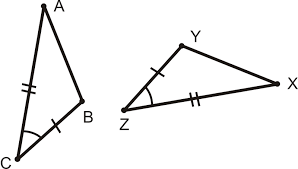
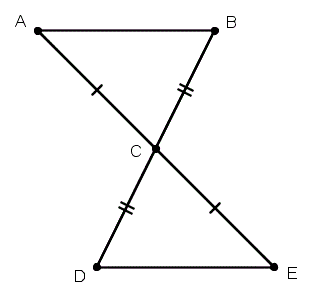


Which Angle is included between AB and AC?
Angle A
Angle B
Angle C

Which angle is included between sides BC and AC
Angle A
Angle B
Angle C

Which two sides include angle B (choose both)
Side AC
Side AB
Side BC

True or False: Angle A is included between sides BC and CA
True
False
Side AB
Angle C

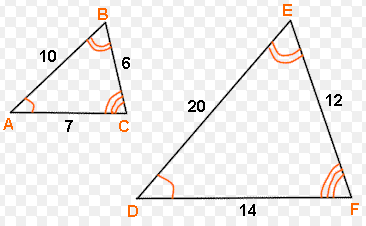
Calculate the value of the scale factor between the 2 triangles
2.5
3
3.5
4




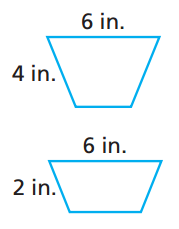


44°
88°
132°
176°

32.5°
65°
130°
145°

(a)

(a)

30°
60°
90°
120°

35°
70°
140°
270°

(a)

Acute
Right
Obtuse
Straight

Minor Arc
Semi-Circle
Major Arc

Minor Arc
Semi-Circle
Major Arc

Minor Arc
Semi-Circle
Major Arc

Minor Arc
Semi-Circle
Major Arc

Acute
Right
Obtuse
Straight

Acute
Right
Obtuse
Straight


Use the 45-45-90 theorem to solve for the hypotenuse.
16
8
8√2
√16


In this isosceles triangle, what is the length of x?
8√2
28
16
8


Find a.
5
√2
5√2
2

Find a.
4
2
4√2
2√4

Find x.
4√3
4√6
4
4√8

Find y.
11√2
11
22
(11√2)/2

Find x.
2
18
2√9
9√2

Find y.
8√2
4√2
4
8


Find the value of x and y.
x = 6, y = 123
x = 32, y = 62
x = 63, y = 12
x = 32, y = 32
x = 32, y = 6
2952
295
190 2
A square has diagonal length 13 m. What is the side length of the square?
2132
132
213

In relation to the angle θ, label the side marked a in this right-angled triangle.
Hypotenuse
Adjacent
Opposite
In relation to the angle θ, label the side marked b in this right-angled triangle.
Hypotenuse
Adjacent
Opposite
In relation to the angle θ, label the side marked c in this right-angled triangle.
Hypotenuse
Adjacent
Opposite

In relation to the angle θ, label the side marked c in this right-angled triangle.
Hypotenuse
Adjacent
Opposite
In relation to the angle θ, label the side marked b in this right-angled triangle.
Hypotenuse
Adjacent
Opposite
In relation to the angle θ, label the side marked a in this right-angled triangle.
Hypotenuse
Adjacent
Opposite

Which side of the triangle is opposite of angle R?
QP
QR
RP
Which side of the triangle is the hypotenuse?
QP
QR
RP
Which side of the triangle is adjacent to angle R?
QP
QR
RP
Which side of the triangle is adjacent to angle R?
QP
QR
RP
Which is the correct ratio for the sine ratio?
hypotenuseadjacent
hypotenuseopposite
opposite adjacent
adjacent opposite
Which is the correct ratio for the cosine ratio?
hypotenuseadjacent
hypotenuseopposite
opposite adjacent
adjacent opposite
Which is the correct ratio for the tangent ratio?
hypotenuseadjacent
hypotenuseopposite
opposite adjacent
adjacent opposite
What is a common way to remember the definitions of the trig ratios?
SAH COH TOA
SOA COH TOA
SOH CAH TOA
ADJ OPP HYP


HINT: Assume this is a right triangle.

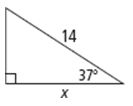


In a 30°-60°-90° triangle:
Long leg is across from the 60⁰
Short Leg is across from the 30⁰
Hypotenuse = 2 (short leg)
Long leg = (short leg) square root 3
30°-60°-90° Triangle Theorem
40 - 60 - 90 triangle theorem
In a 45°-45°-90° triangle:
Hypotenuse is across from the 90⁰
Legs are across from each 45⁰
Both legs are congruent.
Hypotenuse = (leg)
45°-45°-90° Triangle Theorem
30-60-90 Triangles
The reference angle is the angle that we will use in the problem.
In Math 2, we won’t be using the 90 right angle as our reference angle.
Reference Angle
Sine Ratio
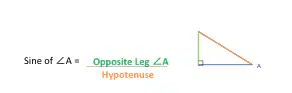
Sine Ratio
Line Ratio
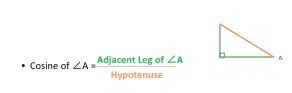
Cosine Ratio
Sine Ratio
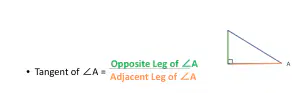
Tangent Ratio
Sine Ratio
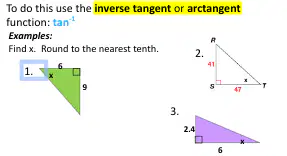
inverse tangent or arctangent
oh, I won a dog fight!
Inverse Sine
sin-1
cos-1
Angle of Elevation
the angle above a horizontal line
the angle below a horizontal line
Angle of Depression
the angle below a horizontal line
the angle above a horizontal line

