
 Worksheets
APPC F24 Review Units 1 + 2
Total questions: 237
Worksheet time: 59hrs 15mins

How many extrema (maxes and mins) are in the picture?
2
3
4
5

Check ALL the intervals where this graph is decreasing.
(-∞, -1)
(-1, 0)
(0, 1)
(1, ∞)

On what intervals is f(x) increasing?
(- ∞, 0) & (2, ∞ )
(-1, 0) & (2,4)
(0,2) & (-3, -7)
(-8, -3) & (-7, 8)

What interval is f(x) < 0 ?
(1, 3)
(-∞, -2) U (-0.3, 2.2)
(-2, 1)
(-1, 1)

Where is the average rate of change negative?
(-∞, -1.5) U (2, 4)
(0.3, 3)
(-1, 4)
(-3, 5)

The blue dot on this graph represents a(n)...
Absolute Maximum
Absolute Minimum
Local Maximum
Local Minimum

What do we call the point where concavity changes?
Maximum Point
Minimum Point
Inflection Point

The graph of a quadratic function is shown. For what domain is is CONCAVE UP?
Never
(0, ∞)
(−∞,∞)
(−∞, 0)

On what interval is the average rate of change positive?
(-3, 0) U (2, 4)
(-1, 1) U ( 3, 4)

On what interval is the f(x) positive and increasing?
(-5, 0) U (2, ∞)
(-5, -3) U (2, ∞)
(-1, 0) U (2, ∞)
(-1, ∞)

Find the point(s) of inflection (if it exists) of the graphed function.
No point of inflection
Points 3 and 5
Points 1, 3, 5 and 7
Points 1, 2, 3, 4, 5, 6 and 7
Points 2, 4 and 6

Over what intervals is the average rate of change decreasing?
(-∞, 1)
(0, 2)
(-1, ∞)
(-∞, 2)

What is the horizontal asymptote?
y=6
y=-6
x=-2
x=2

What is the vertical asymptote?
y=6
y=-6
x=2
x=-2

What is the y-intercept?
(0, 5.5)
(0, -5.5)
(5.5, 0)
(-5.5, 0)
Identify the vertical and horizontal asymptotes of the function.
f(x)=x+25xHorizontal asymptote: y= -5
Vertical Asymptote: x= 2
Horizontal asymptote: y= 2
Vertical Asymptote: x= 5
Horizontal asymptote: y= 5
Vertical Asymptote: x= -2
(5, 2)

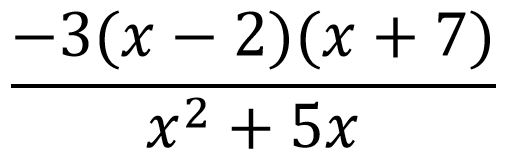


R: All real number y≠ 1
R: All real number y≠ -3
R: All real number y≠ 1
R: All real number y≠ 3

If f(x)=4x3−28x3−8 , find the value of the following limit.
2
4
8
+∞


What is the oblique(slant) asymptote for the function?
y = 12
y = x - 5
y = x-5 + 12/(x+2)
y = 12/(x+2)

Find the horizontal or oblique (slant) asymptote.
What is the solution set of the inequality? Remember to draw a sign analysis chart first.
x+ 2x −3≤0 ?
{x:−2<x<3}
{x:−2<x≤3}
{x:−2≤x≤3}
{x:−2≤x<3}
A polynomial function p is given by p(x)=−x(x−4)(x+2) . What are all intervals on which p(x) ≥0? Hint!! Remember to draw a sign analysis chart first.
[−2,4]
[2,4]∪[4,+∞)
(−∞,−4] ∪[0,2]
(−∞,−2]∪[0,4]
The function f is given by f(x)=−2x7+5x4+6x2−3 . Which of the following correctly describes the end behavior of f as the input values increase without bound?
x→∞limf(x)=∞
x→∞limf(x)=−∞
x→−∞limf(x)=∞
x→−∞limf(x)=−∞
Which of the following would be the correct factored form with roots 2, 5i, and 6?
(x−6)(x−2)(x+5i)(x−5i)
(x+6)(x+2)(x+5i)
(x−6)(x−2)(x−5i)
(x+6)(x+2)(x−5i)

Which choice is correct?
This function has an even degree
This function has a negative leading coefficient
This function has a zero at 1.
The zero at −2 has even multiplicity.
If f(x) = 3x-1 and g(x) = x2+2,
what is (f ° g)(x) ?
3x2 +5
x2 +1
3x2 +1
3x2 +6
If f(x) = 5x and g(x) = 2x-1,
what is the composition f(g(x)) ?
10x-1
10x-5
5x2-1
5x2-5
If f(x) = x-1 and g(x) = 2x,
what is and g(f(x)) ?
2x2-1
2x-1
2x-2
x-2
g(x) = x - 2
Find f(g(5))

Find g(- 2).
12
-2
-24
18
For f(x) = 2x2-1, what is and (f ° f)(-2) ?
7
97
13
6

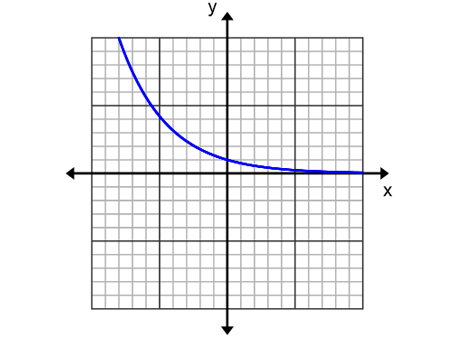

What is the 9th term in a geometric sequence with a common ratio of 2 and a first term of 3?
384
768
1,536
27

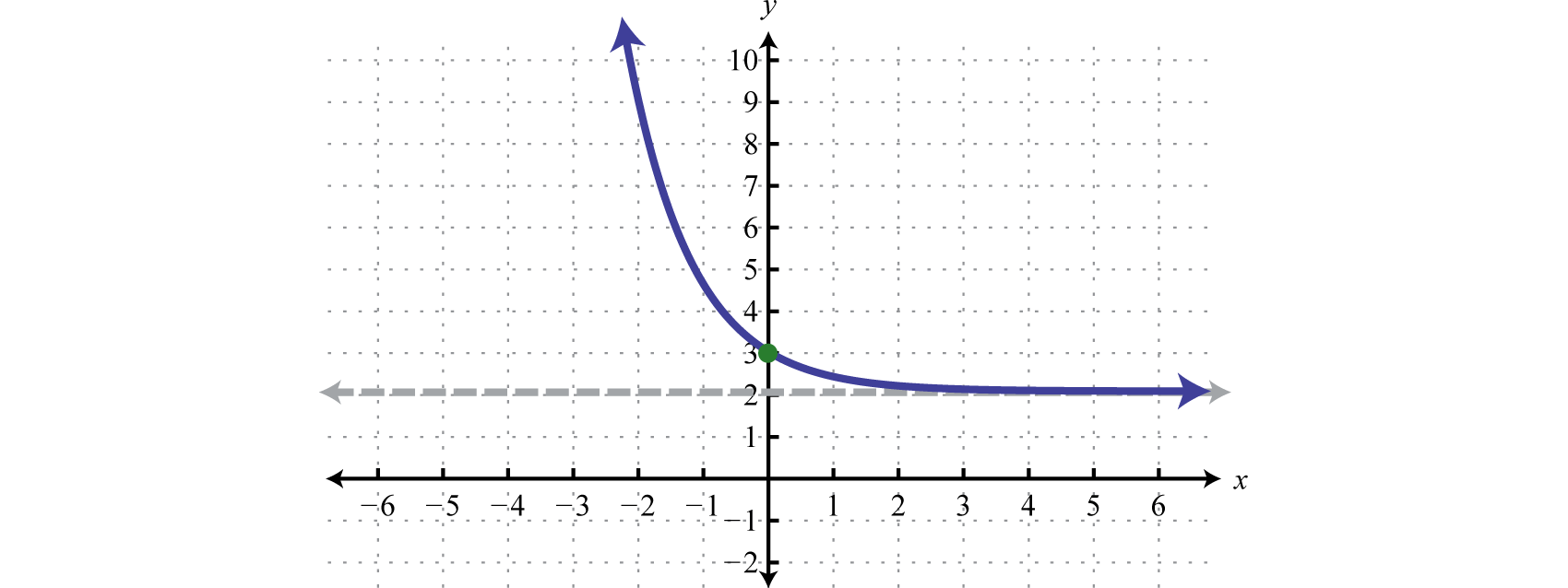
f(x) = 1/4x - 7

Inverse Functions
Not Inverse Functions
What is the basic formula for an exponential function?
f(x)=bx
f(x)=bx
f(x)=xb
f(x)=bx
What is the domain and range of function f(x)=bx
D=(∞,-∞)
R=(0,∞)
D=(0,∞)
R=(-∞,∞)
D=(0,∞)
R=(∞,-∞)
D=(-∞,∞)
R=(0,∞)
Evaluate 82810
812
88
816
84
x3x6
(xy)7
a10b6*a2b11
(m8k3)/(m6k2)
1/w-5
(4ab)2

Which of the following is an exponential function?
y = x2
f(x) = 3x3
y = x3
f(x) = 3x
What is the initial value in y=4(2)x
4
2
x
What is the y-intercept in y=4(2)x
(4,0)
(0,2)
x
(0,4)
(4,2)

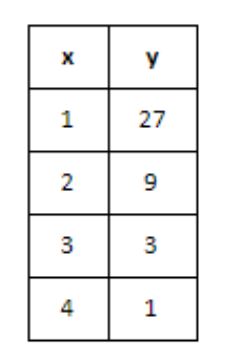
True or False: This is an exponential function.
True
False

Which function models this table?
f(x)=2⋅4x
f(x)=4x
f(x)=4⋅2x
f(x)=8x
solve for x.
2x=23x−4
2
-2
1/2
4/3
Solve the following exponential equation:
98−x=27x−3
x=5
x=−5
x=51
x=−51
Describe the sequence, find the 5th term, and write the rule
-8, -6, -4, -2...
geometric, a5 = 2, an = 2n - 10
geometric, a5 = 0, an = -10n + 2
arithmetic, a5 = 2, an = -10n + 2
arithmetic, a5 = 0, an = 2n - 10
-21, -16, -11, -6, ...
Is this sequence arithmetic, geometric, or neither?
arithmetic (common difference d = 5)
geometric (common ratio r = 5)
neither
Write the explicit formula for the sequence shown below.
3, -3, -9, -15
an=3+6(n-1)
an=3−6(n-1)
an=6−3(n-1)
an=6+3(n-1)
Write a formula for the following sequence:
4, 12, 36, 108...
an = 4(3n-1)
an = 4(3n)
an = 4+3n
an = 4(3n)

Does the table show an exponential function pattern?
Yes, there is a constant factor of 3
Yes, there is a constant factor of 4
No, it is linear there is a constant rate of change of 4
No, there is no pattern

Find the growth factor for Species X.
5
15
3
10
Check all the tables that show exponential DECAY.


The graph of the piecewise defined function f is shown above and consists of two line segments. The function g is the inverse of f, that is g=f−1 . Which of the following is the graph of g, the inverse of f?


The graph of the piecewise defined function f is shown above and consists of two line segments. The function g is the inverse of f, that is g=f−1 . What is the domain of g?
[-5, 4]
[-4, 5]
[-2, 3]
[-1/4, 5]

The graph of the piecewise defined function h is shown above and consists of two line segments. The function k is the inverse of h, that is k=h−1 . What is the minimum value of k? This is the minimum x-value of h.
-4
-3
4
1/3

The table gives values of the increasing function f for selected values of x. What is the value of f−1(4) ?
-5
-2
3
6

What is the value of f−1(g(4)) ?
A) 2
B) 3
C) 5
D) 7

What is the value of g−1(f(2)) ?
A) 2
B) 4
C) 5
D) 7

What is the value of g−1(f−1(7)) ?
1
4
5
7

What is the value of f(g−1(2)) ?
1
2
4
5
The function h is increasing for all values of x, and the graph of h is concave up for all values of x. Let the function k be the inverse of h. Which of the following statements about k is true?
k is increasing, and the graph of k is concave up.
k is increasing, and the graph of k is concave down.
k is decreasing, and the graph of k is concave up.
k is decreasing, and the graph of k is concave down.

The graph of the piecewise defined function f is shown above and consists of three line segments. What is the value of f−1(3) ?
-4
-2
2
4
The graph of h is a transformation of the function g, where h(x) = 2g(x) + 3. If the point (3, -2) is on the graph of g, which of the following points is on the graph of h−1 , the inverse of h?
(-1, 3)
(1, 6)
(2, 3)
(3, -1)
The rational function f is given by f(x)=x+42x−3 . Which of the following gives an expression for f−1(x) , the inverse of f(x)?
2x−3x+4
x−42x+3
x−2−4x−3
x−2−7
The function g is given by g(x)=log3(x−4) . Which of the following statements about the construction of the inverse of g is true?
The inverse of g cannot be constructed because the graph of g is not defined for all real values of x.
The inverse of g can be constructed, and the graph of g−1 has domain of all real values of x.
The inverse of g can be constructed, and the graph of g−1 has domain x > 4.
The inverse of g can be constructed, and the graph of g−1 has range of real values of y.
The function f is given by f(x)=log8x . What is the value of f(2)?
-3
1/4
1/3
3
The function g is given by g(x)=log3x . What is the value of g(1/9)?
-2
-1/2
1/2
2
The function h is given by h(x)=log4x . What input value in the domain of h yields an output value of 1/2?
-2
-1/2
1/2
2
The function P is given by P(x)=log10x , and the function r is given by r(x) = 1. For which values of x will the graphs of P and r intersect?
0
1/10
1
10
The function is given by g(x)=log4x Which of the following statements about the inverse of g is true?
The inverse of g is given by g−1(x)=x4 and is defined for all real values of x.
The inverse of g is given by g−1(x)=4x and is defined only for x > 4.
The inverse of g is given by g−1(x)=4x and is defined for all real values of x.
g does not have an inverse because the graph of g is undefined for x ≤ 0.
The points (-3 , 1/8) and (4 , 16) are on the graph of the exponential function h given by h(x)= bx where b > 1. Which of the following statements about the graph of k(x)=logbx is true?
The points (-3, 1/8) and (4, 16) are both on the graph of h because k=h−1 .
The points (1/8, -3) and (16, 4) are both on the graph of h because k=h−1
The points (1/3, 1/8) and (4, 16) are both on the graph of h because k=h−1
The point (16, 4) is on the graph of h but the point (1/8, -3) is not on the graph of h because the domain of h is restricted to x > 0, thus the range of k is restricted to y > 0.

Which of the following claim and explanation statements best fits these data?
f is best modeled by an exponential function, because the input values change proportionately as output values increase in equal-length intervals.
f is best modeled by an exponential function, because the output values change proportionately as input values increase in equal-length intervals.
f is best modeled by a logarithmic function, because the input values change proportionately as output values increase in equal-length intervals.
f is best modeled by a logarithmic function, because the output values change proportionately as input values increase in equal-length intervals.

The table shows values for a function h at selected values of X. Which of the following claim and explanation statements best fits these data?
h is best modeled by an exponential function, because the input values change proportionately as output values increase in equal-length intervals.
h is best modeled by an exponential function, because the output values change proportionately as input values increase in equal-length intervals.
h is best modeled by a logarithmic function, because the input values change proportionately as output values increase in equal-length intervals.
h is best modeled by a logarithmic function, because the output values change proportionately as input values increase in equal-length intervals.

The table shows values for a function k at selected values of X. Which of the following claim and explanation statements best fits these data?
k is best modeled by an exponential function, because the input values change proportionately as output values increase in equal-length intervals.
k is best modeled by an exponential function, because the output values change proportionately as input values increase in equal-length intervals.
k is best modeled by a logarithmic function, because the input values change proportionately as output values increase in equal-length intervals.
k is best modeled by a logarithmic function, because the output values change proportionately as input values increase in equal-length intervals.
Let f be the logarithmic function given by f(x)=3log10x . Which of the following statements about f is true?
f is increasing, and the graph of f is concave up.
f is increasing, and the graph of f is concave down.
f is decreasing, and the graph of f is concave up.
f is decreasing, and the graph of f is concave down.
Let g be the logarithmic function given by g(x)=−2log3x . Which of the following statements about g is true?
g is increasing, and the graph of g is concave up.
g is increasing, and the graph of g is concave down.
g is decreasing, and the graph of g is concave up.
g is decreasing, and the graph of g is concave down.
Let h be the logarithmic function given by h(x)=3−2log6x . Which of the following statements about h is true?
h is increasing, and the graph of h is concave up.
h is increasing, and the graph of h is concave down.
h is decreasing, and the graph of h is concave up.
h is decreasing, and the graph of h is concave down.
Let k be the logarithmic function given by k(x)=41log10x . Which of the following limit statements about the graph of k is true?
x→∞limk(x)=0
x→∞limk(x)=∞
x→∞limk(x)=−∞
x→0+limk(x)=∞
Let P be the logarithmic function given by p(x)=−3log2x Which of the following limit statements about the graph of P is true?
x→∞limp(x)=0
x→∞limp(x)=∞
x→∞limp(x)=−∞
x→0+limk(x)=−∞
Let f be the logarithmic function given by f(x)=5−4log7x . Which of the following statements about the end behavior of f is true?
As the input values of f increase without bound, the output values increase without bound.
As the input values of f increase without bound, the output values get arbitrarily close to 0.
As the input values of f decrease arbitrarily close to 0, the output values decrease without bound.
As the input values of f decrease arbitrarily close to 0, the output values increase without bound.
Let g be the logarithmic function given by g(x)=3log2x . Which of the following statements about the end behavior of g is true?
As the input values of g increase without bound, the output values decrease without bound.
As the input values of g increase without bound, the output values get arbitrarily close to 0.
As the input values of g decrease arbitrarily close to 0, the output values decrease without bound.
As the input values of g decrease arbitrarily close to 0, the output values increase without bound.
Let h be a function such that the output values of h increase without bound as the input values increase without bound, and the output values of h decrease without bound as the input values decrease arbitrarily close to 0. Which of the following could be the graph of h?

Graph 1

Graph 2


Which of the following expressions is equivalent to ln(4x3) ?
4 + ln 3 + ln x
3(ln 4 + ln x)
ln 4 + 3ln x
ln 4 + ln 3 · ln x
Let X be a positive constant. Which of the following is equivalent to log10x−2log2(x+1) ?
log10((x+1)2x)
log10(2(x+1)x)
log10(x(x+1)2)
log10(x+1x)
Which of the following expressions is equivalent to log2(z35y2) , where y and z are positive constants?
log25+log2(2y)−log2(3z)
5+2log2(y)−3log2(z)
log25+2log2(y)−3log2(z)
3log2(z)log25(2log2(y))
Which of the following expressions is equivalent to ln(x32e4) , where x is a positive constant?
4 + ln 2 - 3ln X
4 + ln 2 + 3ln X
ln 2 + ln e^4 - ln X^3
ln X^3 - ln 2 - ln e^4
Which of the following is equivalent to (2 log x - 3 log y), where x and y are positive constants?
log(x2−y3)
log(y3x2)
log(x2y3)
log(3y2x)
Which of the following expressions is equivalent to log7x , where x is a positive constant?
7 log x
log 7/log x
log x / log 7
log x - log 7
Which of the following expressions is equivalent to log49 ?
ln 9 - ln 4
log410log910
log 4 / log 9
ln 9 / ln4
Let f(x) = ln x. Which of the following is equivalent to 2f(w)−f(z) , where w and z are positive constants?
ln(w2 z)
ln(zw2 )
ln(z2w)
ln(w2 −z)
Let f(x)=log2x and let g(x)=log2(6x) . Which of the following statements about the graphs of f and g is true?
The graph of g is a horizontal translation of the graph f of by −log26 units.
The graph of g is a horizontal dilation of the graph of f by a factor of 6.
The graph of g is a vertical translation of the graph of f by log26 units.
The graph of g is a vertical dilation of the graph of f by a factor of 6.
Let h(x) =ln x and let k(x)=ln(2x) . Which of the following statements about the graphs of h and k is correct?
The graph of k is a horizontal dilation of the graph of h by a factor of 1/2 .
The graph of h is a horizontal dilation of the graph of k by a factor of 1/2.
The graph of k is a vertical translation of the graph of h by -2 units.
The graph of h is a vertical translation of the graph of k by -2 units.
Let x and y be positive constants. Which of the following is equivalent to log2(y8x3) ?
log28+log2(3x)−log2(2y1)
3+3log2(x)−21log2(y)
3+3log2(3x)−2log2(y)
8+3log2(x)−21log2(y)
Let w, y, and z be positive constants. Which of the following is equivalent to 2 ln w - ln y - 3 ln z?
ln(y⋅3z2w)
ln(y⋅z3w2)
ln(yw2z3)
ln(w2⋅y⋅z3)
Consider the functions f and g given by f(x)=log10(x+3)−log10(x) and g(x) = 1. In the xy-plane, what is the x-coordinate of the point of intersection of the graphs of f and g?
-10/3
1/3
2
3
Consider the functions f and g given by f(x) = ln (2x + 1) and g(x) = 2 ln 3. In the xy-plane, what is the x-coordinate of the point of intersection of the graphs of f and g?
-5
5/2
7/2
4
Consider the functions f and g given by f(x)=log2(3x−1)−log2(x+1) and g(x)=log22 . In the xy-plane, what is the x-coordinate of the point of intersection of the graphs of f and g?
-5
2
3
There is no such value of x
Consider the functions f and g given by f(x)=log3x−log34 and g(x) = 2. In the xy-plane, what is the x-coordinate of the point of intersection of the graphs of f and g?
9/4
8
32
36
In the xy-plane, what are all x-coordinates of the points of intersection of the graphs of f and g given by f(x)=log10(x+3)+log10(x−5) and g(x)=log10(3x−1) ?
-2 and 7
- 2 only
2 only
7 only
In the xy-plane, what are all of the points of intersection of the graphs of f and g given by f(x)=ln(2x+3)+ln(x−1) and g(x)=ln(x2+6x−9) ?
2 and 3
6 only
6 and -1
2−3+53
What are all values of x for which log2x2−log24=3 ?
x=2 and x=−2
x=7 and x=−7
x=23 and x=−23
x=42 and x=−42
What are all values of x for which ln(3x) + ln(2) = 4?
x=2/3
x=6e4
x=32e4
x=3e4−2
What are all values of x for which log7(x−1)+2=log7(4x+6) ?
x = -5/3
x = -4
x = 11/9
There are no such values of x
What are all values of x for which 4(2x+6)=23x ?
x = -12
x = -6
x = 3/2
x = 6
Consider the functions h and k given by h(x)=9(3x−1) and k(x)=81(x+3) . In the xy-plane, what is the x-coordinate of the point of intersection of the graphs of h and k?
-14/3
6/13
1
7
Consider the functions m and p given by m(x)=4(x2−2x) and p(x)=(161)(x−2) . In the xy-plane, what are all x-coordinates of the points of intersection of the graphs of m and p?
2 only
2 and -2
2 and -1/2
2 and 1
Consider the functions h and k given by h(x)=3x and k(x)=9(x−1) . In the xy-plane, what is the x-coordinate of the point of intersection of the graphs of h and k?
-1
0
1
2
Consider the functions g and h given by g(x)=4x and h(x)=(21)(x+3) . In the xy-plane, what is the x-coordinate of the point of intersection of the graphs of g and h?
-6
-2
-1
3
For the function f given by f(x)=3+2e−x , for which of the following values of x is f(x) = 11?
x = 1 + ln 4
x=−2ln8
x = -ln 4
x=23−ln11
For the function g given by g(x)=3(x+1) , for which of the following values of x is g(x) = 27?
x =- 2/3
x = 2
x = 3
x = 4
For the function h given by h(x)=2(3x+1) , for which of the following values of x is h(x) = 1/16?
x = -4
x = -1
x = 1/4
x = 5/3
For the function k given by k(x)=3⋅8x , for which of the following values of x is k(x) = 12?
x = -2/3
x = 0
x = 1/2
x = 2/3
If g(x)=4(x+1) , h(x)=23x , and f(x)=h(x)g(x) In the xy-plane what is the of the point where f(x)=1?
1/5
1/2
1
2
If f(x)=9(x−1) , g(x)=log3x . Let h be the function given by h(x) = g(f(x)).
In the xy-plane, on which intervals is h(x) > 3?
(23,∞)
(25,∞)
(4,∞)
(27,∞)

The graph of a polynomial function y=p(x) is shown. Which of the following expressions could define p(x) ?
(x−2)(x+3)
(x+3)(x−2)
(x−3)2(x+2)2
(x+3)2(x−2)2
Which of the following would be the correct factored form with roots 2, 5i, and 6?
(x−6)(x−2)(x+5i)(x−5i)
(x+6)(x+2)(x+5i)
(x−6)(x−2)(x−5i)
(x+6)(x+2)(x−5i)
The function f is given by f(x)=−2x7+5x4+6x2−3 . Which of the following correctly describes the end behavior of f as the input values increase without bound?
x→∞limf(x)=∞
x→∞limf(x)=−∞
x→−∞limf(x)=∞
x→−∞limf(x)=−∞
A polynomial function p is given by p(x)=−x(x−4)(x+2) . What are all intervals on which p(x) ≥0? Hint!! Remember to draw a sign analysis chart first.
[−2,4]
[2,4]∪[4,+∞)
(−∞,−4] ∪[0,2]
(−∞,−2]∪[0,4]
Which choice is correct?
This function has an even degree
This function has a negative leading coefficient
This function has a zero at 1.
The zero at −2 has even multiplicity.
Which function has zeros: x=0 , x=5 (multiplicity of 3) and x=−6 .
f(x)=9x(x+5)3(x−6)
f(x)=3(x−5)3(x+6)
f(x)=−7x(x−5)3(x+6)
f(x)=(x−3)(x−5)(x+6)
On what interval is the average rate of change positive?
(−1,1)∪(3,4)
(−3,−2)
(−3,0)∪(2,4)
(−1,1)∪(3,4)
On which interval is the function increasing at a decreasing rate?
(−∞,−1.5)
(0,2)
(−1.5,0)
(2,4)

Calculate the average rate of change from 20 to 40 minutes.
-2 minutes per gallon
-20 minutes per gallon
-2 gallons per minute
-20 gallons per minute

The graph of the function f is given for −3≤x≤6 Which of the following statements about the rate of change of f over the interval −2<x<2 is true?
The rate of change is positive.
The rate of change is negative.
The rate of change is increasing.
The rate of change is decreasing.

The figure shows a swimming pool filled with water. A pump is used to remove water from the pool until the pool is empty. When the pump is running, the rate at which the volume of water in the pool decreases is constant. During the first two hours, the pump works slower than usual due to a broken piece. Then the pump stops working. The broken piece is replaced, and the pump works at its usual rate until the pool is completely emptied of water. The entire process of emptying the pool takes six hours. Which of the following graphs could depict this situation, where time, in hours, is the independent variable, and the volume of water in the pool, in gallons, is the dependent variable?


The figure shows the graph of a function f . The zero and extrema for f are labeled, and the point of inflection of the graph of f is labeled. Let A , B , C , D , and E represent the x -coordinates at those points. Of the following, on which interval is f decreasing and the graph of f concave up?
from A to B
from B to C
from C to D
from D to E
For a polynomial function f , x→∞limf(x)=−∞ and x→−∞limf(x)=∞ .
Which of the following must be true about f ?
The degree of f is even, and the leading coefficient is negative.
The degree of f is even, and the leading coefficient is positive.
The degree of f is odd, and the leading coefficient is negative.
The degree of f is odd, and the leading coefficient is positive.
The function f is given by f(x)=−3x8+7x5−3x4+2x−4 . Which of the following correctly describes the end behavior of f as the input values decrease without bound?
x→∞limf(x)=∞
x→−∞limf(x)=∞
x→∞limf(x)=−∞
x→−∞limf(x)=−∞

The figure shown is the graph of a polynomial function g . Which of the following could be an expression for g(x) ?
0.25(x−5)(x−1)(x+8)
0.25(x+5)(x+1)(x−8)
0.25(x−5)2(x−1)(x+8)
0.25(x+5)2(x+1)(x−8)
A polynomial function p is given by p(x)=−x(x−4)(x+2) . What are all intervals on which p(x)≤0 ?
[−2,4]
[−2,0]∪[4,∞)
(−∞,−4]∪[0,2]
(−∞,−2]∪[0,4]
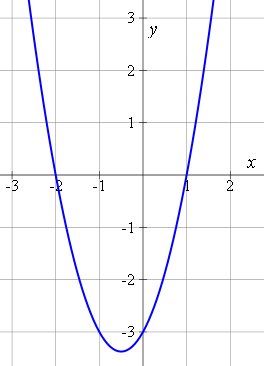
What interval is f(x) < 0 ?
(1, 3)
(-∞, -2) U (-0.3, 2.2)
(-2, 1)
(-1, 1)
The blue dot on this graph represents a(n)...
Absolute Maximum
Absolute Minimum
Local Maximum
Local Minimum
Find the point(s) of inflection (if it exists) of the graphed function.
No point of inflection
Points 3 and 5
Points 1, 3, 5 and 7
Points 1, 2, 3, 4, 5, 6 and 7
Points 2, 4 and 6

x = 4
x = -1
x = 3
x = 1
x = -2
x = -5
x = -3
x = -1
x = 2
x = 5
x = -2
x = 4

Which root has a multiplicity of 2?
-1
2
4
-4
g(x)=x2−2x + 3
Even
Odd
Neither
Which one of these are not a zero of f(x)=x2(x−1)2(x+5) ?
0
1
-5
-1
How many extrema (maxes and mins) are in the picture?
2
3
4
5
Check ALL the intervals where this graph is decreasing.
(-∞, -1)
(-1, 0)
(0, 1)
(1, ∞)
The blue dot on this graph represents a(n)...
Absolute Maximum
Absolute Minimum
Local Maximum
Local Minimum
What do we call the point where concavity changes?
Maximum Point
Minimum Point
Inflection Point
Zero of the Function
Which of the following graphs has the largest average rate of change from -1 to 2?


The table describes rates of change of a function for selected intervals of x. The function f is defined for 0≤x≤4 . On which of the following intervals is the graph f of concave down?
0<x<1
1<x<2
2<x<3
3<x<4

The table gives values for a polynomial function h at selected values of x. It is known that h is increasing on the interval 0 < x < 4. Which of the following could be true about the graph of h on the interval 0 < x < 4?
The graph of h is concave down because the average rate of change over equal-length input-value intervals is increasing.
The graph of h is concave up because the average rate of change over equal-length input-value intervals is increasing.
The graph of h is concave down because the average rate of change over equal-length input-value intervals is decreasing.
The graph of h is concave up because the average rate of change over equal-length input-value intervals is decreasing.

The table shows values for a function f at selected values of x. Which of the following claim and explanation statements best fit these data?
The graph of f could be concave up because the average rates of change over consecutive equal-length input-value intervals are positive.
The graph of f could be concave up because the average rates of change over consecutive equal-length input-value intervals are increasing.
The graph of f could be concave down because the average rates of change over consecutive equal-length input-value intervals are negative.
The graph of f could be concave down because the average rates of change over consecutive equal-length input-value intervals are decreasing.

The table shows values for a function k at selected values of x. Which of the following claim and explanation statements best fit these data?
The graph of k could be concave up because the average rates of change over consecutive equal-length input-value intervals are positive.
The graph of k could be concave up because the average rates of change over consecutive equal-length input-value intervals are increasing.
The graph of k could be concave down because the average rates of change over consecutive equal-length input-value intervals are negative.
The graph of k could be concave down because the average rates of change over consecutive equal-length input-value intervals are decreasing.

The table shows values for a function g at selected values of x. Which of the following claim and explanation statements best fit these data?
g is best modeled by a linear function, because the rate of change over consecutive equal-length input-value intervals is constant.
g is best modeled by a linear function, because the change in the average rates of change over consecutive equal-length input-value intervals is constant.
g is best modeled by a quadratic function, because the rate of change over consecutive equal-length input-value intervals is constant.
g is best modeled by a quadratic function, because the change in the average rates of change over consecutive equal-length input-value intervals is constant.

The table shows values for a function k at selected values of x. Which of the following claim and explanation statements best fit these data?
k is best modeled by a linear function, because the rate of change over consecutive equal-length input-value intervals is constant.
k is best modeled by a linear function, because the change in the average rates of change over consecutive equal-length input-value intervals is constant.
k is best modeled by a quadratic function, because the rate of change over consecutive equal-length input-value intervals is constant.
k is best modeled by a quadratic function, because the change in the average rates of change over consecutive equal-length input-value intervals is constant.

Which of the following claim and explanation statements best fit these data?
f is best modeled by a linear function, because the rate of change over consecutive equal-length input-value intervals is constant.
f is best modeled by a linear function, because the average rates of change over consecutive equal-length input-value intervals can be given by a linear function.
f is best modeled by a quadratic function, because the rate of change over consecutive equal-length input-value intervals is constant.
f is best modeled by a quadratic function, because the average rates of change over consecutive equal-length input-value intervals can be given by a linear function.

Which of the following claim and explanation statements best fit these data?
g is best modeled by a linear function, because the rate of change over consecutive equal-length input-value intervals is constant.
g is best modeled by a linear function, because the average rates of change over consecutive equal-length input-value intervals can be given by a linear function.
g is best modeled by a quadratic function, because the rate of change over consecutive equal-length input-value intervals is constant.
g is best modeled by a quadratic function, because the average rates of change over consecutive equal-length input-value intervals can be given by a linear function.

Which of the following claim and explanation statements best fit these data?
p is best modeled by a linear function, because the rate of change over consecutive equal-length input-value intervals is constant.
p is best modeled by a linear function, because the average rates of change over consecutive equal-length input-value intervals can be given by a linear function.
p is best modeled by a quadratic function, because the rate of change over consecutive equal-length input-value intervals is constant.
p is best modeled by a quadratic function, because the average rates of change over consecutive equal-length input-value intervals can be given by a linear function.
The graph of the polynomial function f is concave up on the interval 0 ≤ x ≤ 10. Which of the following could be a table of values containing points on the function f?


The graph of the polynomial function g is concave down on the interval 0 ≤ x ≤ 10. Which of the following could be a table of values containing points on the function g?


The table shows values for a function k at selected values of x. Which of the following statements about k could be true?
The function k is decreasing and the graph of k is concave up.
The function k is decreasing and the graph of k is concave down.
The function k is increasing and the graph of k is concave up.
The function k is increasing and the graph of k is concave down.

The table shows values for a function h at selected values of x. Which of the following statements about h could be true?
The function h is decreasing and the graph of h is concave up.
The function h is decreasing and the graph of h is concave down.
The function h is increasing and the graph of h is concave up.
The function h is increasing and the graph of h is concave down.

The table shows values for a function g at selected values of x. Which of the following statements about g could be true?
The function g is decreasing and the graph of g is concave up.
The function g is decreasing and the graph of g is concave down.
The function g is increasing and the graph of g is concave up.
The function g is increasing and the graph of g is concave down.

The table shows values for a function f at selected values of x. Which of the following statements about f could be true?
The function f is decreasing and the graph of f is concave up.
The function f is decreasing and the graph of f is concave down.
The function f is increasing and the graph of f is concave up.
The function f is increasing and the graph of f is concave down.

The figure shows the graph of the quartic polynomial function j. How many points of inflection does the graph of j have?
One
Two
Three
Four

The figure shows the graph of the cubic polynomial function f. How many points of inflection does the graph of f have?
Zero
One
Two
Three

The figure shows the graph of the function h with four points labeled, where h represents the rate of change of the function g (not shown). Which of the four labeled points on the graph of h has the same x-coordinate as a point of inflection on the graph of g?
A
B
C
D

The figure shown is the graph of a polynomial function f. Which of the following could be an expression for f(x)?
−3(x+4)(x−2)2
−3(x+4)(x−2)
3(x+4)(x−1)2
3(x+4)(x−1)

The figure shown is the graph of a polynomial function g. Which of the following could be an expression for g(x)?
(x+3)(x−2)2
(x+3)2(x−2)2
(x+3)(x−2)3
(x+3)3(x−2)

The figure shown is the graph of a quartic polynomial function h. Which of the following could be an expression for h(x)?
−5x2(x−2)(x−4)
−5x2(x+4)(x−2)
−5x2(x+2)(x−4)
.5x2(x+2)(x−4)

The table gives values of the polynomial function g at selected values of x. Which of the following statements about g could be true?
(A) g is an odd function and g(-1) = -6
(B) g is an odd function and g(-1) = 6
(C) g is an even function and g(-1) = -6
(D) g is an even function and g(-1) = 6

The table gives values of the polynomial function h at selected values of x. Which of the following statements about h could be true?
(A) h is an odd function and h(-4) = -7
(B) h is an odd function and h(-4) = 7
(C) h is an even function and h(-4) = -7
(D) h is an even function and h(-4) = 7

The polynomial function f is an odd function. The table gives values of f(x) at selected values of x, where a and b are constants. What is the value of a + b?
(A) -6
(B) -14
(C) -3
(D) 18
A polynomial function f is given by f(x)=x(x+3)(x−2)2 . What are all intervals on which f(x) ≤ 0?
(-∞, -3] only
(-∞, -3] ∪ [0, 2]
[-3, 0]
[0, 3]
A polynomial function g is given by g(x)=−2x(x−4)(x+1) . What are all intervals on which g(x) < 0?
(-∞, -1] ∪ (0, 4)
(-∞, -1] ∪ (4, ∞)
(-4, 0) ∪ (1, ∞)
(-1, 0) ∪ (4, ∞)
A polynomial function h is given by h(x)=x2(x4−4)(x−1) . What are all intervals on which h(x) > 0?
(1, 4) ∪ (4, ∞)
(-∞, -4) ∪ (-4, -1)
(-∞, 0) ∪ (1, 4)
(-∞, 0) ∪ (4, ∞)
A polynomial function k is given by k(x)=−x2(x−4)(x+3) . What are all intervals on which k(x) ≥ 0?
(-∞, -3] ∪ [0, 4]
(-∞, -3] ∪ [4, ∞]
[4, 3]
[-3, 4]
A polynomial function p is given by p(x)=x(x+3)(x2−9) . What are all intervals on which p(x) < 0?
(-∞, -3) ∪ (0, 3)
(-3, 0) only
(-3, 0) ∪ (0, 3)
(0, 3) only
Let f(x)=2x2+x−4 and g(x)=x2+4x+6 . What are all the intervals for which f(x) < g(x)?
(-∞, -5) ∪ (2, ∞)
(-∞, -2) ∪ (5, ∞)
(-5, 2)
(-2, 5)
Let f(x)=x2−5x+10 and g(x)=2x2−3x−14 . What are all the intervals for which f(x) > g(x)?
(-∞, -6) ∪ (4, ∞)
(-∞, -4) ∪ (6, ∞)
(-6, 4)
(-4, 6)
Let f(x)=x2−3x and g(x)=3x−9 . What are all the intervals for which f(x) > g(x)?
(-∞, 0) ∪ (0, ∞)
(-∞, 3) ∪ (3, ∞)
(-3, 3)
(0, 3) ∪ (3, ∞)
The polynomial function p is given by p(x)=(x2+4)(x2−9) . Which of the following describes the zeros of p?
p has exactly two distinct real zeros and no non-real zeros.
p has exactly three distinct real zeros.
p has exactly four distinct real zeros.
p has exactly two distinct real zeros and two non-real zeros.
The polynomial function f is given by f(x)=(x+1)(x2−3x−4) . Which of the following describes the zeros of f?
f has exactly two distinct real zeros.
f has exactly three distinct real zeros.
f has exactly one distinct real zero and no non-real zeros.
f has exactly one distinct real zero and two non-real zeros.
The polynomial function g is given by g(x)=(x−3)(x2−6x+9) . Which of the following describes the zeros of g?
g has exactly two distinct real zeros.
g has exactly three distinct real zeros.
g has exactly one distinct real zero and no non-real zeros.
g has exactly one distinct real zero and two non-real zeros.
The polynomial function k is given by k(x)=(x−4)(x2+2x+7) . Which of the following describes the zeros of k?
k has exactly three distinct real zeros.
k has exactly two distinct real zeros and one non-real zero.
k has exactly one distinct real zero and no non-real zeros.
k has exactly one distinct real zero and two non-real zeros.

The table gives values of the polynomial function g at selected values of x. What is the least possible degree of g?
A) 1
B) 2
C) 3
D) 4

The table gives values of the polynomial function f at selected values of x. What is the least possible degree of f?
A) 1
B) 2
C) 3
D) 4

The table gives values of the polynomial function p at selected values of x. What is the least possible degree of p?
A) 1
B) 2
C) 3
D) 4

The table gives values of the function h at selected values of x. Which of the following statements is true?
h is best modeled by a linear function, because the average rate of change over any length input-value interval is constant.
h is best modeled by a quadratic function, because the average rates of change over any length input-value interval are constant.
h is best modeled by a linear function, because the successive 2nd differences of the output values over equal-interval input values are constant.
h is best modeled by a quadratic function, because the successive 2nd differences of the output values over equal-interval input values are constant.

The table gives values of the function k at selected values of x. Which of the following statements is true?
k is best modeled by a linear function, because the average rate of change over any length input-value interval is constant.
k is best modeled by a quadratic function, because the average rates of change over any length input-value interval are constant.
k is best modeled by a linear function, because the successive 2nd differences of the output values over equal-interval input values are constant.
k is best modeled by a quadratic function, because the successive 2nd differences of the output values over equal-interval input values are constant.

The figure shows the graph of the polynomial function p. A zero of p is 2 - 3i. What is the least possible degree of p?
Two
Three
Four
Five
The function f is given by f(x)=4x3−2x+7 . Which of the following describes the end behavior of f?
lim x to -∞ f(x) = -∞ and lim x to ∞ f(x) = -∞
lim x to -∞ f(x) = ∞ and lim x to ∞ f(x) = ∞
lim x to -∞ f(x) = -∞ and lim x to ∞ f(x) = ∞
lim x to -∞ f(x) = ∞ and lim x to ∞ f(x) = -∞
The function k is given by k(x)=−2x6+x3−x2−1 . Which of the following describes the end behavior of k?
lim x to -∞ k(x) = -∞ and lim x to ∞ k(x) = -∞
lim x to -∞ k(x) = ∞ and lim x to ∞ k(x) = ∞
lim x to -∞ k(x) = -∞ and lim x to ∞ k(x) = ∞
lim x to -∞ k(x) = ∞ and lim x to ∞ k(x) = -∞
The function h is given by h(x)=x4−x3−2x+1 . Which of the following describes the end behavior of h?


The function g is given by g(x)=−4x3+5x−2 . Which of the following describes the end behavior of g?


The function p is given by p(x)=(x2+3)(1−6x3) . Which of the following describes the end behavior of p?


The function p is given by p(x)=2x5+3x4−1 . Which of the following statements about the end behavior of p is true?

The sign of the leading term of p is positive, and the degree of the leading term of p is odd; therefore,

The sign of the leading term of p is negative, and the degree of the leading term of p is even; therefore,

The sign of the leading term of p is positive, and the degree of the leading term of p is odd; therefore,

The sign of the leading term of p is negative, and the degree of the leading term of p is odd; therefore,
The function g is given by g(x)=3x4−2x3+9 . Which of the following statements about the end behavior of g is true?

The sign of the leading term of g is positive, and the degree of the leading term of g is odd; therefore,

The sign of the leading term of g is negative, and the degree of the leading term of g is even; therefore,

The sign of the leading term of g is positive, and the degree of the leading term of g is even; therefore,

The sign of the leading term of g is positive, and the degree of the leading term of g is even; therefore,

Let k be a polynomial function with the following end behavior: Which of the following could be an expression for k(x)?
4x5+x3+3
3x4−x3+5
−2x3+4x2−1
−5x6+x3+6

Let p be a polynomial function with the following end behavior: Which of the following could be an expression for p(x)?
4x3−5x−1
x6+x4+2x
−4x5−3x4+9
−2x4+3x+5

The polynomial function p is given by p(x)=axn+x4−4 , where a and n are integers and n>1 . If the end behavior of p is given by the statements which of the following could be the values of a and n?
a = -3 and n = 5
a = -3 and n = 4
a = 3 and n = 5
a = 3 and n = 4

The polynomial function p is given by p(x)=axn−2x+5 , where a and n are integers and n>1 . If the end behavior of p is given by the statements which of the following could be the values of a and n?
a = -3 and n = 5
a = -3 and n = 4
a = 3 and n = 5
a = 3 and n = 4

The polynomial function p is given by p(x)=axn+x2+3 , where a and n are integers and n>2 . If the end behavior of p is given by the statements which of the following could be the values of a and n?
a = -3 and n = 5
a = -3 and n = 4
a = 3 and n = 5
a = 3 and n = 4

The polynomial function p is given by p(x)=axn−3x2+4 , where a and n are integers and n>2 . If the end behavior of p is given by the statements which of the following could be the values of a and n?
a = -3 and n = 5
a = -3 and n = 4
a = 3 and n = 5
a = 3 and n = 4
The rational function r is given by r(x)=(−3x2+7)(x5+4) . Which of the following describes the end behavior of r?
(A) lim x->-∞ r(x) = -∞ and lim x->∞ r(x) = -∞
(B) lim x->-∞ r(x) = 0 and lim x->∞ r(x) = ∞
(C) lim x->-∞ r(x) = -∞ and lim x->∞ r(x) = ∞
(D) lim x->-∞ r(x) = 0 and lim x->∞ r(x) = -∞
The rational function r is given by r(x)=(4−x3)(2x3−9) . Which of the following describes the end behavior of r?
(A) lim x->-∞ r(x) = -∞ and lim x->∞ r(x) = ∞
(B) lim x->-∞ r(x) = ∞ and lim x->∞ r(x) = -∞
(C) lim x->-∞ r(x) = 1/2 and lim x->∞ r(x) = 1/2
(D) lim x->-∞ r(x) = -2 and lim x->∞ r(x) = -2
The rational function r is given by r(x)=(x3+2x+7)(x4+x2+3) . Which of the following statements about the end behavior of r is true?
Since the polynomial in the numerator dominates the polynomial in the denominator for input values of large magnitude, r has the end behavior of y = x and lim x->∞ r(x) = -∞
Since the polynomial in the numerator dominates the polynomial in the denominator for input values of large magnitude, r has the end behavior of y = x and lim x->∞ r(x) = ∞
Since the polynomial in the denominator dominates the polynomial in the numerator for input values of large magnitude, r has the end behavior of y = x and lim x->∞ r(x) = -∞
Since the polynomial in the denominator dominates the polynomial in the numerator for input values of large magnitude, r has the end behavior lim x->∞ r(x) = 0
The rational function r is given by r(x)=(x−3)(x+2) . What are all intervals on which r(x) > 0?
(-2, 3) only
(-2, 0)
(-∞, -3) ∪ (2, ∞)
(−∞,−2)∪(3,∞)
The rational function k is given by k(x)=(x−5)−2(x−3)(x+2) . What are all intervals on which k(x) >= 0?
[-2, 5]
(-∞, -5)∪[2, ∞)
(-∞, -2)∪[3, 5)
(-∞, -2)∪(3, ∞)
The rational function r is given by r(x)=x(x−3)3x2(x−2)(x−3)2 . What are the zeros of the function r?
x = 2 only
x = 0 and x = 2 only
x = 0 and x = 3 only
x = 0, x = 2, and x = 3
The rational function r has zeros at x = -3 and x = 4. Which of the following could be an expression for r?
(x−3)(x+4)(x+3)(x−4)2
(x+3)(x−4)(x−3)(x+4)2
(x+1)(x−4)2(x+3)(x−4)3
(x+3)2(x+4)3(x+3)(x+4)2
In the xy-plane, the graph of a rational function g has a vertical asymptote at x = 3. Which of the following could be an expression for g(x)?
(x−3)(x+4)(x−3)2(x+2)
(x+3)2(x+4)(x−3)(x+2)
(x−3)(x+4)(x−3)(x+2)
(x−3)2(x+4)(x−3)3(x+4)
The rational function f is given by f(x)=(x−1)−2(x+3) . Which of the following statements describe the output values of f as the input values of f get arbitrarily close 1 where x > 1?
The output values of f decrease without bound.
The output values of f increase without bound.
The output values of f get arbitrarily close to -8.
The output values of f get arbitrarily close to -2.

