
 Worksheets
Tri 2 Biology Final Review (3T)
Total questions: 60
Worksheet time: 30mins
Why is an organism’s niche like a person’s occupation?
An organism makes “money” by working in its niche.
A niche is a “company” that the organism has to work in.
A niche is a “factory” where organisms build things.
An organism can “make a living” and survive in its niche.
Several species of warblers can live in the same spruce tree ONLY because they
have different habitats within the tree.
don’t eat food from the tree.
occupy different niches within the tree.
can find different temperatures within the tree.
No two species can occupy the same niche in the same habitat at the same time
because of the interactions that shape the ecosystem.
unless the species require different abiotic factors.
because of the competitive exclusion principle.
unless the species require different biotic factors.
An interaction in which an animal feeds on plants is called
Carnivory
Herbivory
Predation
Symbiosis
A symbiotic relationship in which both species benefit is
Commensalism
Mutualism
Predation
Parasitism
A symbiotic relationship in which one organism is harmed and the other benefits is
Mutualism
Parasitism
Commensalism
Predation
Which of the following is NOT one of the factors that play a role in population growth rate?
Immigration
Death rate
Emigration
Demography
Which one of the following is NOT a part of an ATP molecule?
adenine
ribose
chlorophyll
phosphate
Energy is released from ATP when
a phosphate group is added.
adenine bonds to ribose.
ATP is exposed to sunlight.
a phosphate group is removed.
Which of the following is NOT a true statement about ATP?
ATP consists of ribose, adenine, and three phosphate groups.
ADP is produced when ATP releases energy.
ATP provides energy for the mechanical functions of cells.
Used ATP is discarded by the cell as waste.
Organisms, such as plants, that make their own food are called
autotrophs
heterotrophs
thylakoids
pigments
Organisms that cannot make their own food and must obtain energy from external sources are called:
autotrophs
heterotrophs
thylakoids
plants
What happens during photosynthesis?
Heterotrophs consume ATP.
Heterotrophs produce ATP.
Autotrophs consume carbohydrates.
Autotrophs produce carbohydrates.
Plants get the energy they need for photosynthesis by absorbing
High-energy sugars
Chlorophyll a
Chlorophyll b
Sunlight
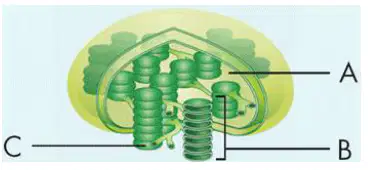
Which structure in the picture represents a single thylakoid?
Structure A
Structure B
Structure C
The stroma is the region outside the
Thylakoids
Chloroplasts
Plant cells
Mitochondria
Photosynthesis uses sunlight to convert water and carbon dioxide into
Oxygen and carbon
High-energy sugars and proteins
ATP and oxygen
Oxygen and high-energy sugars
What are the products of the light-dependent reactions?
Oxygen gas and glucose
ATP, NADPH & oxygen gas
ATP, carbon dioxide gas, and NADPH
carbon dioxide gas, oxygen gas and NADPH
The Calvin cycle is another name for the
Light-independent reactions.
light-dependent reactions.
Photosynthesis reaction.
Electron transport chain.
What is the product of the Calvin cycle?
Oxygen gas
ATP
High energy sugars
Carbon dioxide gas
Cellular respiration releases energy by breaking down
food molecules.
ATP.
carbon dioxide.
water.
What are the reactants in the equation for cellular respiration?
oxygen and lactic acid
carbon dioxide and water
glucose and oxygen
water and glucose
Which of these is a product of cellular respiration?
oxygen
water
glucose
lactic acid
Cellular respiration is called an aerobic process because it requires
light.
exercise.
oxygen.
glucose.
Which organism is NOT likely to carry out cellular respiration?
cypress tree
button mushroom
anaerobic bacteria
Siberian tiger
Unlike photosynthesis, cellular respiration occurs in ____________?
Animal cells only
Plant cells only
Prokaryotic cells only
All eukaryotic cells
Which of these processes takes place in the cytoplasm of a cell?
Glycolysis
Electron transport chain
Krebs cycle
Photosynthesis
The starting molecule for glycolysis is ____________?
ADP
Pyruvic acid
Citric acid
Glucose
The starting molecule for the Krebs cycle is _____________?
Glucose
NADH
Pyruvic acid
Coenzyme A
The Krebs cycle DOES NOT occur if __________?
Oxygen is present
Oxygen is not present
Glycolysis occurs
Carbon dioxide is present
The Krebs Cycle produces __________?
Oxygen
Lactic acid
Carbon Dioxide
Glucose
Cellular respiration uses 1 molecule of glucose to produce approximately ___________?
2 ATP molecules
4 ATP molecules
18 ATP molecules
36 ATP molecules
Lactic acid fermentation occurs in:
Bread dough
Any environment containing oxygen
Muscle cells
Mitochondria
The two main types of fermentation are called
Alcoholic and aerobic
Aerobic and anaerobic
Alcoholic and lactic acid
Lactic acid and anaerobic
The air bubbles and spongy texture of bread are due to which process?
Lactic acid fermentation
Glycolysis
Alcoholic fermentation
The Krebs cycle
When the body needs to exercise longer than 90 seconds, it generates ATP by carrying out
Lactic acid fermentation
Alcoholic fermentation
Cellular respiration
Glycolysis
If you want to control your weight, how long should you exercise aerobically each time you exercise?
At least 90 seconds
Less than 15 minutes
15-20 minutes
More than 20 minutes
The energy needed to win a 1 minute foot race is produced mostly by
Lactic acid fermentation
Cellular respiration
Using up store of ATP
Breaking down fats
Which statement mainly explains why even well-conditioned athletes have to pace themselves for athletic events that last several hours?
Lactic acid fermentation can cause muscle soreness.
Heavy breathing is needed to get rid of lactic acid.
Cellular respiration releases energy more slowly than fermentation does.
Alcohol fermentation produces carbon dioxide.
All of the following are sources of energy for humans during exercise EXCEPT:
Stored ATP
Alcoholic fermentation
Lactic acid fermentation
Cellular respiration
As a cell becomes larger, its
volume increases faster than its surface area.
surface area increases faster than its volume.
volume increases, but its surface area stays the same.
surface area stays the same, but its volume increases.
Which of the following is NOT a cell growth problem?
more demands on DNA.
excess oxygen.
obtaining enough food.
expelling wastes.
The process by which a cell divides into two daughter cells is called
cell division
metaphase
interphase
mitosis
An advantage of sexual reproduction over asexual reproduction is that sexual reproduction
takes less time.
requires more time.
provides genetic diversity.
produces identical offspring.
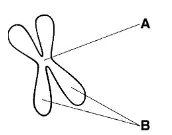
The structure labeled A in picture is called the
Centromere
Centriole
Sister chromatid
Spindle
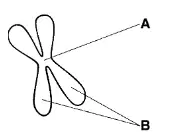
The structures labeled B in the picture are called
Centromeres
Centrioles
Sister chromatids
Spindles
The first phase of mitosis is called
prophase
anaphase
metaphase
Interphase
During which phase of mitosis do the chromosomes line up along the middle of the dividing cell?
prophase
telophase
metaphase
anaphase
Which of the following represent the phases of mitosis in their proper sequence?
prophase, metaphase, anaphase, telophase
interphase, prophase, metaphase, anaphase, telophase
interphase, prophase, metaphase, telophase
prophase, anaphase, metaphase, telophase
Each pea-plant gamete has how many alleles for the height gene?
1
2
3
4
When Gregor Mendel crossed a tall plant with a short plant, the F1 plants inherited
one allele from each parent.
two alleles from each parent.
three alleles from each parent.
four alleles from each parent.
When Gregor Mendel crossed true-breeding tall plants with true-breeding short plants, why was it impossible to observe segregation?
Alleles for height do not segregate in F2.
Alleles segregate only in the F2 generation.
Alleles segregate best when two tall plants are crossed.
Alleles in the F1 must be “Tt” to have height variety in the F2.
A tall plant (TT) is crossed with a short plant (tt). If the tall F1 pea plants are allowed to self-pollinate,
the offspring will be of medium height.
all of the offspring will be tall.
all of the offspring will be short.
the offspring can be tall or short.
When you flip a coin, what is the probability that it will come up tails?
1
1/2
1/4
1/8
The principles of probability can be used to:
predict the traits of the offspring of genetic crosses.
determine the actual outcomes of genetic crosses.
determine which species should be used in genetic crosses.
decide which organisms are best to use in genetic crosses.
A heterozygous tall pea plant is crossed with a short plant. The probability that an F1 plant will be tall is
25%
50%
75%
100%
Organisms that have two identical alleles for a particular trait are said to be
hybrid
homozygous
heterozygous
dominant
Gametes have
homologous chromosomes.
twice the number of chromosomes found in body cells.
two sets of chromosomes.
one allele for each gene.
Gametes are produced by the process of
mitosis
meiosis
crossing-over
replication
What is formed at the end of meiosis?
two genetically identical cells.
four genetically different cells.
four genetically identical cells.
two genetically different cells.

