
 Worksheets
Climate Change LC2 - Carbon Cycle
Total questions: 28
Worksheet time: 44mins
The Carbon Cycle has the greatest impact on ______________ on Earth
Living organisms
Climate change
Plants
The sun
The process of breaking down living organisms.
Decomposition
Photosynthesis
Combustion
Respiration
When humans burn fossil fuels, most of the carbon quickly enters the _______________________ as carbon dioxide.
Water
Atmosphere
Sun
Ground
The trapping of heat from solar radiation by the Earth's atmosphere.
Greenhouse effect
Carbonaro effect
Sound effect
Birth defect

Which process is represented by letter G?
decomposition
death
feeding
photosynthesis

1?

Which process is represented by letter B?
fossilization
combustion
photosynthesis
decomposition
Carbon enters the soil through dead plant or animal matter.
Decomposition
Respiration
Photosynthesis
Diffusion
The circulation of the element Carbon among Earth's atmosphere, land, oceans, and organisms is called _____________.
the Carbon Cycle
the Oxygen Cycle
the Carbon dioxide Cycle
the Water Cycle

In the carbon cycle, plants take in the gas __
carbon dioxide
oxygen
nitrogen
carbon monoxide
Which of the following are steps in the carbon cycle?
Photosynthesis
Decomposition
Respiration
Combustion
Which of the following removes carbon from the atmosphere?
Combustion
Cellular Respiration
Photosynthesis
What process occurs when coal (fossil fuel) is used for energy?
Decomposition
Combustion

Combustion is another word for __________.
Combustión es otra palabra para __________.

If the plant population decreased, the amount of carbon in the atmosphere would _________.
Si la población de plantas disminuyera, la cantidad de carbono en la atmósfera _________.
Stay the same
Increase
Decrease
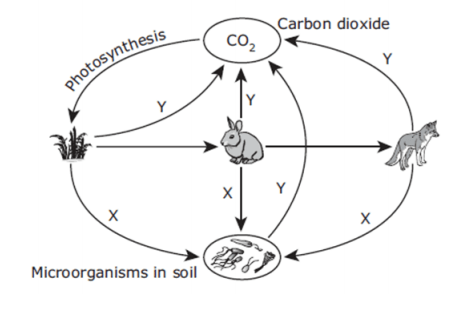
Y : Predation
Y : Decomposition
Y : Nitrogen Fixation
Y : Respiration
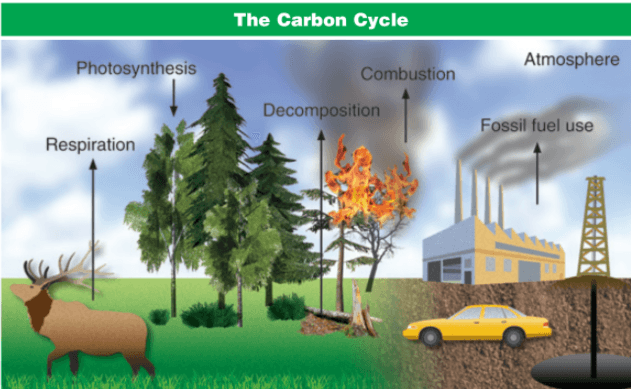
Which is an example of a carbon sink?


How can carbon get from the Geosphere to the Hydrosphere?
Diffusion
Respiration
Weathering and Erosion
Burial and Sedimentation
How can carbon get from the Biosphere to the Atmosphere?
Diffusion
Respiration
Weathering and Erosion
Burial and Sedimentation
Eruptions of Gases
How can carbon get from the Atmosphere to the Hydrosphere?
Diffusion
Respiration
Weathering and Erosion
Burial and Sedimentation
Eruptions of Gases

What "sphere" contains soil and rocks?
Biosphere
Hydrosphere
Geosphere
Atmosphere

What process converts chemical energy (sugars) to usable energy for organisms and releases CO2?
Photosynthesis
Respiration
Sedimentation
Diffusion

Respiration is ....
1
2
3
4
5

Step two represents what process?
Photosynthesis; plants take in carbon dioxide from the atmosphere
Animals are decomposing and releasing carbon into the soil.
Animals are converting carbon dioxide from the atmosphere to oxygen.
Animals are breaking down organic molecules and releasing carbon dioxide into the atmosphere.
Step three represents what process?
Photosynthesis; plants take in carbon dioxide from the atmosphere
Animals are decomposing and releasing carbon into the soil.
Combustion; a factory burns fossil fuels (carbon) that transforms into carbon dioxide
Animals are breaking down organic molecules and releasing carbon dioxide into the atmosphere.
Step four represents what process?
Photosynthesis; plants take in carbon dioxide from the atmosphere
Animals are decomposing and releasing carbon into the soil.
Combustion; a factory burns fossil fuels (carbon) that transforms into carbon dioxide
Animals are breaking down organic molecules and releasing carbon dioxide into the atmosphere.

