
Font size
 Worksheets
Year 9 Test 4 States of matter and Atoms
Total questions: 50
Worksheet time: 36mins
How many subatomic particles are there in an Atom?
1
2
3
Infinite

What is Group 8 referred as?
Halogens
Alkaline
Alkali
Noble Gases
Where will you find electrons in an atom?
Nucleus
Moving around the nucleus
Directly next to a proton
Atoms don't have electrons, only protons and neutrons
Which particles contribute to the mass of an atom?
How much space they take up
Protons and Neutrons
Electrons and Quarks
Protons and Electrons
Which of the following are found in the nucleus?
protons and electrons
protons ONLY
protons and neutrons
Electrons only
________________ have a positive charge, ___________________ have NO charge, and _____________________ have a negative charge.
Protons, Electrons, Neutrons
Neutrons, Electrons, Protons
Protons, Neutrons, Electrons
Electrons, Neutrons, Protons
Which of the following are found on the left side of the zig zag line on the periodic table?
Non-metals
metalloids
metals
compounds
_________________________ are the horizontal rows on the periodic table while _______________________ are the vertical columns.
periods/ groups(families)
groups(families)/periods
metals/non-metals
non-metals/metals

Which of the following elements is in (period 4 , group 2)
Carbon
Potassium
Calcium
Sodium

Which of the following has similar properties to potassium (K) because they are in the same group(family)
Sodium (Na)
Magnesium (Mg)
Calcium (Ca)
Gold (Au)
The element Zinc (Zn) has an atomic number of 30 and an atomic mass of 65 therefor each atom of zinc contains ___________protons, ______________neutrons, and _____________electrons.
30,30,35
30, 30, 25
30, 35, 30
35, 30, 30


What group and period does this element belong in? *
period 1 and group 3
period 3 and group 1
period 2 and group 3
period 3 and group 2
Which period is Oxygen found in?
Period 1
Period 2
Period 3
Group 16
Contains two or more atoms chemically combined
Elements
Compounds
Mixtures
Examples are Neon (Ne) and Uranium (U)
elements
mixtures
compounds

This picture represents which of the following?
element
compound
mixture

Rubidium is a soft, silvery-white metal that has two common isotopes, 85-Rb and 87-Rb.
If the abundance of 85-Rb is 72.2% and the abundance of 87-Rb is 27.8%
What is the average atomic mass of rubidium?
(Do not include units)
(a)
The __________ has the same number of Protons but different number of Neutrons.
Ion
Element
Isotopes
Atom

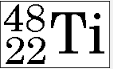
Isotopes of an element have a different number of...
Protons
Neutrons
Electrons
Mass

What will happen when heat turns a frozen solid into a liquid.
Evaporate
Liquid
Gas
Melting

a. The steam makes window cloudy. What is the process involved?
Evaporation
Melting
Freezing
Condensation
The particles in a matter always colliding with one another. When heat energy is supplied, the particles will move ________________
slower
randomly
faster
static
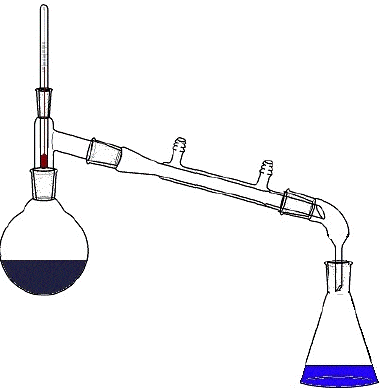
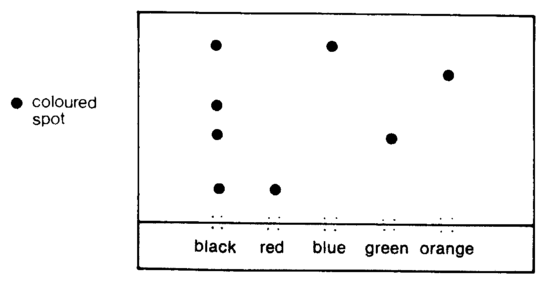

Ink can be separated by a method of -----------------------------------------------
distillation
filtration
chromatography
sedimentation
Which if the following is the correct arrangement of electrons in different shells for an element with atomic number 17 ?
2,8,7
8,8,1
2,8,1,6
2,8,2,5
An atom has atomic number 4 the number of electrons in its outermost orbit will be ?
2
6
4
1
When MgO is dissolved in water, Mg(OH)2 is obtained. The solution thus obtained is _______________ in nature.
Amphoteric
Alkaline
Neutral
Acidic
Metal react with oxygen to produce _________ oxides and non-metal react with oxygen to produce_________ oxides.
Acidic, Basic
Basic, Acidic
Basic, Basic
Acidic, Acidic
Which of the following metal exist in liquid state in room temperature?
Mercury
Bromine
Aluminium
Sodium
Calculate the average atomic mass of the element iron (Fe) using the following data:
[Isotope / % abundance]
[Iron 54 / 6% ] [Iron 56 / 92% ] [ Iron 57 / 2% ]
53.7 amu
54.9 amu
5592.0 amu
55.9 amu

Calculate the Rf value of the yellow ink in the picture.
0.5
1.3
3
0.33

