
 Worksheets
Unit 3 Exam 2 & 1
Total questions: 85
Worksheet time: 54mins
When two samples of ideal gases have the same
______, their molecules must have the same ______.
(a)
KMT
Gases are all hard spheres
They are small relative to size of system volume
They undergo elastic collisions and don’t stick or react
They have a T equal system T that gives all of them the same Ek
They all have the same Ek, but Ek = 1⁄2 mv2 so they have different velocity as inverse square of mass
m1v12=m2v22
(a)
Ideal conditions:
P is low so don't collide
V is large so don't collide
n is small so don’t collide
T is large so don’t stick
gases are small and nonpolar so don’t stick
Van der Whalls equation for non-ideality
(no spaces inbetween)
(a)
Gas X has a larger value than gas Y for the Van der
Waals constant "a". This indicates that
1. The molecules of X have stronger
intermolecular attractions for each other than
the molecules of Y have for each other
2. The molecules of X are larger than the
molecules of Y
3. The molecules of gas X have a higher velocity
than the molecules of gas Y
4. The molecules of has X repel other X
molecules
a corrects
stickiness
size
polarity
b corrects
stickiness
size
polarity
Ideal Gases
He
H2
H2O
NH3
Ideal Gases
nonpolar
small
large
polar
Non-Ideal Gases
He
H2O
NH3
H
Non-Ideal Gases
large IMF (like H-bonding)
non-polar
large gases
small
Which of the following molecules would have the
largest a and b terms, respectively, in the Van der
Waals equation?
Kr, CCl4, C2H4 C3H8, C4H10
1. CCl4 , C4H10
2. C4H10, CCl4
3. C4H10, Kr
4. Kr, C3H8,
5. CCl4, CCl4
Inter-Molecular Forces
dispersion
covalent single
dipole
h-bonding
covalent triple
Intra-Molecular Forces
dispersion
covalent single
dipole
h-bonding
covalent triple
Which of the following molecules have
the largest intermolecular and
intramolecular forces, respectively?
C2H5OH, C2H4, C2H2, CHCl3
1. C2H2, C2H2
2. CHCl3, C2H4
3. C2H5OH, CHCl3
4. C2H5OH, C2H2
Dispersion Force
1
5
20
400
Dipole-Dipole
1
5
20
400
H-Bond
1
5
20
400
Single Covalent
400
600
800
20
Double Covalent
200
400
500
600
Triple Covalent
800
300
600
200
occur from the instantaneous dipoles formed by
asymmetrically distributed electrons.
Dipole-Dipole
Dispersion
occurs in all compounds but is the dominant force in
non-polar (symmetrical) molecules.
dispersion
h-bond
dipole-dipole
As molecules increase in size,
(a) forces can grow to allow liquids and solids to be formed.
occur in molecules that have permanent
dipoles (polar compounds). The magnitude of these forces is related to the size of the permanent dipole ∑ ΔEN.
Dispersion
dipole-dipole
h-bond
ionic bond
Dispersion (London) forces result from...
1. The formation of a loose covalent linkage
between a hydrogen atom connected to a
very electronegative atom in a neighboring
molecule.
2. Distortion of the electron cloud of an atom
or molecule by the presence of nearby
atoms or molecules
3. Attraction between molecules in a liquid
and molecules or atoms in a solid surface
with which the liquid is in contact.
4. Attractive forces between a molecule at the
surface of the liquid and those beneath it
which are not balanced by corresponding
forces from above.
5. The balance of attractive and repulsive
forces between two polar molecules.
In ranking : NH3, H2O, HF, the order is:
NH3 < HF < H2O
HF < NH3 < H2O
H2O < HF < NH3
NH3 < H2O < HF
___ is the only __ bond. In contrast, OH shows up as multiple H-bonds in sugars which is why they are so sticky
(a)
Down periodic table, larger compounds and more (a)
Identify the dominant intermolecular force in the following species,
respectively: RbCl, C6H6 (benzene), HI, Fe2O3, CH2NH.
a) ionic forced
b) hydrogen bonding
c) dipole-dipole
d) instantaneous dipoles
1. a, c, c, d, b
2. c, d, a, a, b
3. a, b, c, b, a
4. a, b, d, a, c
5. a, d, c, a, b

(a)

(a)

(a)

(a)
Surface tension describes
1. The inward forces that must be overcome in order to expand the surface area of a liquid.
2. The forces of attraction between surface molecules of a solvent and the solute molecules.
3. Adhesive forces between molecules.
4. The forces of attraction between the surface of a liquid and the air above it
A bulk phenomenon in which gas bubbles from
the vapor of the liquid form and the escape became the vapor
pressure of bubble > atm. pressure
Boiling Point
Surface Tension
viscosity
Vapor pressure
Evaporation rate
A surface phenomenon in which an inward
force reduces the surface area of liquid. This is why liquids like
H2O bead up on windrows in the rain.
Boiling Point
Surface Tension
viscosity
Vapor pressure
Evaporation rate
Surface phenomenon in which the liquid
climbs the walls of the container because of IMF.
Capillary Action
Surface Tension
viscosity
Vapor pressure
Evaporation rate
The tendency of a liquid to resist pouring because of
IMF attraction to bulk solution.
Capillary Action
Surface Tension
viscosity
Vapor pressure
Evaporation rate
The energy in IMF that must be overcome for a liquid on
the surface to vaporize.
Capillary Action
Surface Tension
ΔHvap
Vapor pressure
Evaporation rate
The pressure of the vapor above the surface
and is inversely related to IMF
Capillary Action
Surface Tension
ΔHvap
Vapor pressure
Evaporation rate
How quickly a liquid will vaporize. Increases
at IMF decreases.
Boiling Point
Surface Tension
viscosity
Vapor pressure
Evaporation rate
Rank the following compounds by boiling point, from lowest
to highest: HF, CH3F, H2O, NH3.
1. CH3F < NH3 < HF < H2O
2. HF < H2O < CH3F < NH3
3. H2O < CH3F < NH3 < HF
4. H2O < NH3 < CH3F < HF
as MW increases, (a) increases
ΔEN increases, IMF increases (ranking within buckets)
(a)
follow charge density rules: NaCl < CaO < MgO (within bucket rankings)
(a)

Increases with IMF
Decreases with IMF
Decreases with IMF
evaporation rate
viscosity
vapor pressure
non-ideality
Arrange
Al2O3, Nb, I2, C (s) (diamond)
In the order metallic solid, covalent network, covalent solid, ionic solid.
1. Nb; C (s) diamond; I2; Al2O3
2. Al2O3; C (s) (diamond); I2; Nb
3. C (s) (diamond); Nb; Al2O3; I2
4. Nb; I2; C (s) (diamond); Al2O3
Cation
positively charged
negatively charged
Anion
positively charged
negatively charged
Elements found down and to the left on
table.
Metal Solids
Ionic Solids
Covalent Network Solids
Molecular Solids
Combination of metal cation and nonmetal
anion to make a salt.
Metal Solids
Ionic Solids
Covalent Network Solids
Molecular Solids
Found on right side of table. Long
chains of covalent bonded atoms:
Metal Solids
Ionic Solids
Covalent Network Solids
Molecular Solids
Solids from IMF forming at low temperature.
These are the molecules you drew in unit 2
Metal Solids
Ionic Solids
Covalent Network Solids
Molecular Solids
Solid Metals
Fe
Pb
Na
NaCl
H2O
Solid Ionic
Fe
CaO
Na
NaCl
H2O
Solid Covalent Network
graphite
cellouse
Na
Diamond
H2O
Solid Covalent Molecular
graphite
cellouse
Frozen CO2
Frozen H2O
Pb
Put the following compounds
LiF, HF, F2, NF3
In order of increasing melting points.
F2, HF, NF3, LiF
LiF, HF, NF3 , F2
NF3 HF, F2 , LiF
F2, NF3, HF, LiF
LiF , NF3 HF, F2
At a temperature of 300 K, all gases (like He, Ar, Kr)have ? average kinetic energies and they have ?
different; the same diffusion rates
different; different average velocities
the same; the same diffusion rates 𝜈
the same; the same average velocities
the same; different average velocities
At ___, gas molecules don't get to their speed invacuum because of ______.
(a)
Typical values for gas _____ in a vacuum atroom temperature are ___ s of m/s
(a)
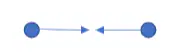
Will collide and result in small velocities
Will collide and result in high velocity
Will not collide
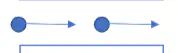
Will collide and result in small velocities
Will collide and result in high velocity
Will not collide
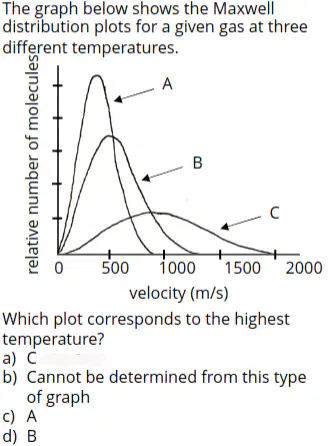
a) C
b) Cannot be determined
c) A
d) B

Which has the greatest mass?
A
B
C
Which has the smallest mass?
A
B
C
Inversely Related To Size
speed
effusion rate
diffusion rate
polarity
Calculate the ratio of the rate of effusion of He to that of CO2 (at the same temperatures).
1: 11
11: 1
11 : 1
1: 112
1:1
The ratio of the rate is (a) to the masses.
If the ratio is A to B
(AB)21
(BA)21
If the ratio is B to A
(AB)21
(BA)21
A gas has a volume of 9.0 L at a pressure of 1520 torr. If the pressure is decreases to 380 torr, what will be the new volume? (Assume the temperature remains constant.)
2.3 L
4.6 L
0.28 L
36 L
Boyles Law
T1V1=T2V2
P1+P2+P3....
Charles Law
T1V1=T2V2
P1+P2+P3....
Daltons Law
T1V1=T2V2
P1+P2+P3....
A gas mixture is found to be 4 parts nitrogen, 1 part carbon dioxide, and 1 part oxygen. If the total system pressure is 2 atm, what is the partial pressure of nitrogen?
4 atm
0.33 atm
0.66 atm
1.33 atm
Combined Gas Law
T1V1=T2V2
P1+P2+P3....
T1P1V1=T2P2V2
What volume will 40.0 L of Heat 50.00°C and 1201 torr occupy at STP?
2) 12.8 L
3) 53.4 L
4) 26.7 L
5) 31.1 L
1) 18.6
Ideal Gas Law
T1V1=T2V2
P1+P2+P3....
T1P1V1=T2P2V2
RTPMW
Molecular Weight
T1V1=T2V2
T1P1V1=T2P2V2
RTPMW
PVgRT
The balanced reaction for the combustion of ethanol (MW = 46 g/mol) is: C2H5OH(g) + 3O2 (g) --> 2CO2 (g) + 3H2O(g) 92 grams of ethanol reacts to completion with 96 grams of oxygen at STP. What is the volume of the system after reaction?
200 L
66 L
134 L
112 L

a) 90 atm
b) 6 atm
c) 30 atm
d) 3 atm

