
 Worksheets
6.15 Separating mixtures – fractional distillation
Total questions: 35
Worksheet time: 18mins
A process that separates mixtures of miscible liquids with a difference in boiling points of less than 25 ° C.
Fractional distillation
Simple distillation
Fractional condensation
............................................. is a substance that exists in a gaseous state at room temperature.
Gas
Vapour
............................................. is a substance that is produced when a liquid or solid turn into gas due to heat (it exists in a solid or liquid state at room temperature).
Gas
Vapour
Hydrocarbons are compounds made up of atoms of ...............................................................
hydroxide and carbon only.
hydrogen and carbon only.
hydrogen and carbon dioxide only.
A mixture of hundreds of hydrocarbons.
Petrol
Diesel
Crude oil
A mixture of hydrocarbons made up of atoms between 14 and 19 carbon atoms, used as a fuel in lorries, buses, and some cars.
Petrol
Diesel
Crude oil
A mixture of hydrocarbons made up of atoms between 5 and 10 carbon atoms, sometimes called gasoline or gas.
Petrol
Diesel
Crude oil
Crude oil is heated to more than .................., all the compounds become gases.
540 ºC
1450 ºC
450 ºC
In industrial fractionating columns, compounds that have high boiling points condense near the ...............................
bottom
top
The compounds that make up diesel have low boiling
True
False
Crude oil is used for............................................................................................................................................
Making plastics.
Making paints.
Making medicines.
Making toothpaste
Simple distillation can be used to separate..............................
different colored solids
metals from non metals
dissolved solids and liquid
Blood cells
Water and oil make a mixtures but not a solution, because they are
Miscible into each other
immiscible into each other
Soluble into each other
insoluble into each other
A students sets the apparatus for fractional distillation, which part of the apparatus the particles will lose energy
condenser
flask
fractionating column
thermometer
Different fractions of crude oil can be separated using fractional distillation as the liquids separate due to
difference in their masses
difference in their sizes
the difference in their colors
the difference in their boiling points

Identify the method of separation shown in the picture
simple distillation
fractional distillation
crystallization
chromatography

Where do short chain hydrocarbons collect?
At the top
In the middle
At the bottom

Where do long chain hydrocarbons collect?
At the top
In the middle
At the bottom
Shorter hydrocarbons have:
Higher boiling points
Lower boiling points
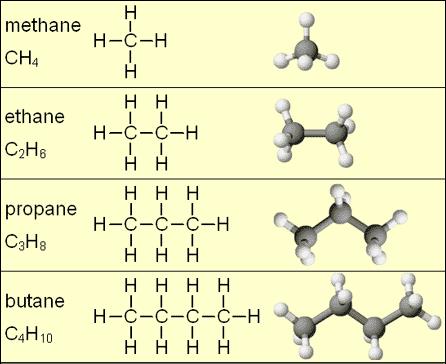
Which of these substances is not a hydrocarbon?
methane (CH4)
ethane(C2H6)
propane(C3H8)
butane(C4H10)
ammonia(NH3)
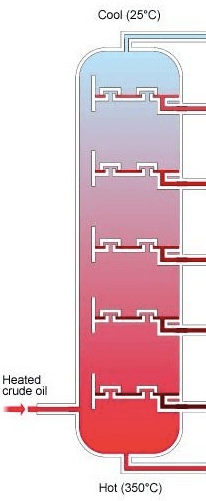
What process happens at each level in the fractionating column?
Evaporation
Condensation
Combustion
What process happens as the crude oil enters the fractionating column?
Evaporation
Condensation
Combustion
Petrol is used for:
Fuel in cars
Fuel in aircraft
Domestic heating and cooking
Road surfacing
Kerosene (paraffin) is used for:
Fuel for cars
Domestic heating and cooking
Fuel in aircraft
Fuel for large ships and in power stations
Diesel oil is used for:
Fuel in aircraft
Road and roof surfacing
Fuel in some larger vehicles
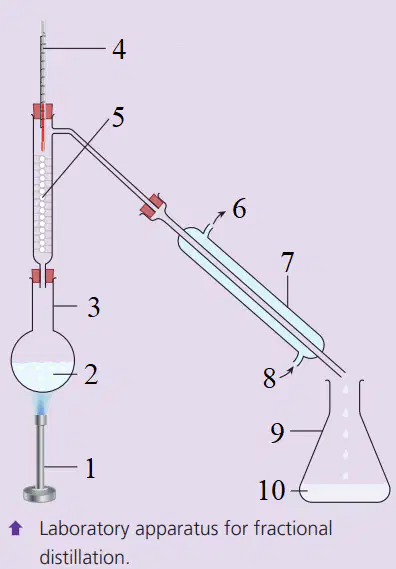
Which of these numbers represent Bunsen Burner?
#1
#2
#5
#8
#3
Which of these numbers represent the supply of water out?
#6
#2
#5
#8
#3
Which of these numbers represent the supply of water in?
#6
#2
#5
#8
#3
Which of these numbers represent the condenser?
#6
#7
#5
#8
#3
Which of these numbers represent the conical flask?
#2
#7
#5
#4
#9
Which of these numbers represent mixture of ethanol and water?
#10
#2
#5
#8
#7
Which of these numbers represent round bottomed flask?
#7
#3
#5
#4
#9
Which of these numbers represent fractionating column?
#7
#3
#5
#4
#9
Which of these numbers represent thermometer?
#7
#3
#5
#4
#9
Which of these numbers represent the pure ethanol?
#7
#4
#5
#10
#2

