
 Worksheets
HW#9: States of Matter Review
Total questions: 40
Worksheet time: 40mins
liquid
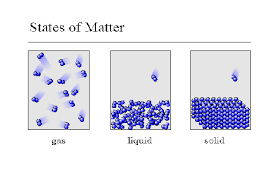
Matter is made up of particles. Which of the following statements is true about these particles?
The particles that make up solids do not move
The particles that make up liquids do not move
The particles that make up all matter are constantly in motion
Only the particles that make up gases are constantly in motion
When we boil water, we change water into a
liquid
solid
gas
ice
Ice is an example of a
solid
liquid
gas
phase change
When we freeze water, we are changing it from a liquid to a ___________ state of matter.
solid
vapor
ice
boiling
To make water turn into vapor (steam), we need to:
Make it colder
Take away energy
Add energy
make the particles slow down
When water vapor comes out of the air and becomes a liquid, we call this phase change:
Freezing
Boiling
Melting
Condensation
If I take away energy from a liquid, what is the next state of matter it will become?
vapor
ice
liquid
solid
Which state of matter has the most kinetic energy?
gas
liquid
solid
fire
If water has gone from a liquid to a gas, it has probably reached its:
melting point
freezing point
dew point
boiling point
If evaporation is the phase change of water changing from a liquid to a gas, what is the exact opposite?
melting
freezing
condensation
dew point
How do particles act in a liquid?
Every particle stays in one spot.
Particles spread far apart from one another.
Particles slide past one another
Particles squeeze together to fit into small spaces.

Which state of matter is shown in the image?
solid
liquid
gas
none

Which state of matter is shown in the image?
solid
liquid
gas
none

Which state of matter is shown in the image?
solid
liquid
gas
none
Particles in this state of matter are moving the fastest.
solid
liquid
gas
water
Particles in this state of matter are moving the slowest.
solid
gas
liquid
plasma

Has a definite/fixed shape and definite/fixed volume. It holds its shape.
solid
liquid
gas
plasma

Has an indefinite shape. It takes the shape of its container.
Has a definite/fixed volume.
solid
liquid
gas
plasma

Has an indefinite shape and volume. It takes the shape of its container.
It has the volume of its container.
solid
liquid
gas
plasma

Particles are packed tightly together. Particles are held together by strong attractive forces (bonds). Particles vibrate in fixed positions.
solid
liquid
gas
plasma

Particles move more rapidly in a small area. Particles are still close to each other but are spread a little away from each other.
solid
liquid
gas
plasma

Particles move very rapidly in all directions. Particles are at great distances from one another. Attractive forces have less effect.
solid
liquid
gas
plasma

Examples - rock, ice, salt, wood, glass, concrete, metal
solid
liquid
gas
plasma

Examples - water, milk, blood, Mercury (element), oil
solid
liquid
gas
plasma

Examples - oxygen, carbon dioxide, helium, steam/water vapor, ozone, hydrogen, air
solid
liquid
gas
plasma

_______ is anything that has mass and takes up space
matter
solid
liquid
gas

When heat is added -- Ice changes into water
melting
freezing
deposition
sublimation

When heat is added -- Dry ice changes into Carbon Dioxide Gas -- skipping the liquid phase
melting
freezing
deposition
sublimation

When heat is added -- water changes into steam or water vapor
evaporation
freezing
deposition
condensation

