wayground logo

Free Printable Worksheets

NEW

Font size

S
M
L
XL
Worksheets

Motion CUA 2 Review

Total questions: 64

Worksheet time: 5hrs 20mins

Name
Class
Date
1.
If a force of 26 N is exerted on two balls, one with a mass of 0.52 kg and the other with a mass of 0.78 kg, which ball will have the greater acceleration?  (F=ma)
a)
The one with a mass of .78 kg will have the greatest acceleration.
b)
The one with a mass of .52 kg will have the greatest acceleration.
c)
They will both accelerate at the same rate.
2.
A 20 kg bike accelerates at 10 m/s2.  what was the force?
a)
25 Newtons
b)
20 Newtons
c)
200 Newtons
d)
10 Newtons
3.
Unit of mass
a)
m/s 2
b)
m/s
c)
newtons
d)
kg
4.
The mass of a car is 1000 kg.  How much force would be required to accelerate the car at a rate of 3 m/s2? 
a)
1000 ÷ 3
b)
3 ÷ 1000
c)
1000 x 3
5.
A force of 250 N is applied to an object that accelerates at a rate of 5 m/s2.  What is the mass of the object? To solve this problem you must do - 
a)
250 ÷ 5
b)
5 ÷ 250
c)
250 x 5
6.
A 5 kg block is pulled across a table by a net force of 32 N. Calculate the acceleration of the object. To solve this problem you must do - 
a)
32 ÷ 5
b)
5 ÷ 32
c)
32 x 5
7.
A skier needs to apply a force of 132 N to accelerate at a rate of 2 m/s2. What is the mass of the skier? The answer to this question is most likely (HINT: Look at the units!!!) - 
a)
66 N
b)
66 m/s2
c)
66 kg
8.
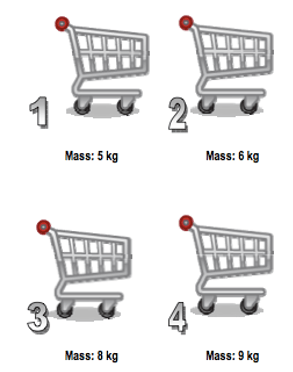
A force of 90N is applied to each cart below, which one will accelerate the fastest?
a)
Cart 1
b)
Cart 2
c)
Cart 3 
d)
Cart 4
9.

To calculate Force

a)

Force = m x a

b)

Force = m ÷ a

c)

Force = a ÷ m

d)

Force = m + a

10.

To calculate m

a)

m = Force × a

b)

m = Force ÷ a

c)

m = Force + a

d)

m = a ÷ Force

11.

To calculate a

a)

a = Force × m

b)

a = Force ÷ m

c)

a = Force + m

d)

a = m ÷ Force

12.

Mass = 10 kg. a = 10 ms2. Calculate the force.

a)

10N

b)

100N

c)

1 N

d)

1000N

13.

Mass = 4 kg and a = 0.2 ms2. Calculate the force.

a)

8N

b)

80 N

c)

2 N

d)

0.8N

14.

Force = 20 N and Mass = 4 kg. Calculate the acceleration.

a)

80 N

b)

80 ms-2

c)

5 ms-2

d)

0.2 ms-2

15.

Force = 25 N and Mass = 5 kg. Calculate the acceleration.

a)

5 ms-2

b)

125 ms-2

c)

30 ms-2

d)

4 ms-2

16.

Why does a car accelerate faster with just the driver, compared to driver + 3 passengers?

a)

Car and driver has less mass than car, driver + 3 passengers

b)

Car and driver has more mass than car, driver + 3 passengers

c)

Car has less friction (drag)

d)

Car is accelerating faster

17.

When a student runs and kicks a ball, they have applied an ___________ force to move the ball.

a)

Balanced

b)

Magnetic

c)

Spring

d)

Unbalanced

18.

When the teacher rearranges the desks in the classroom, she must apply ____________ to push and pull the desks around.

a)

acceleration

b)

force

c)

weight

d)

magnets

19.

Which law of motion says that you must push or pull objects harder if they have more mass?

a)

1st

b)

2nd

c)

3rd

d)

4th

20.

Walking down the hall and speeding up when you turn and go down the stairs is an example of ____________.

a)

acceleration

b)

weight

c)

gravity

d)

friction

21.

Letting go of a balloon full of air is demonstrating Newton's ______ _______ ________ _________ because the air comes out of the back and the balloon moves forward.

a)

1st law of motion

b)

2nd law of motion

c)

3rd law of motion

d)

13th law of motion

22.

What law is best described by inertia?

a)

1st

b)

2nd

c)

3rd

d)

law of conservation of mass

23.

A person not paying attention while skateboarding hits a rock. The skateboard stops...they don't.

a)

The Law of Inertia (1st law)

b)

The Law of Acceleration (2nd law)

c)

The Law of Conservation of Momentum

d)

Action Reaction Law (3rd law)

24.

What Unit do we Measure Force in?

a)

Newtons

b)

Joules

c)

Force

d)

Kilograms

25.

What is Newton's First Law

a)

F=ma

b)

Every action has an equal and opposite reaction

c)

An object at rest stays at rest, an object in motion stays in motion.

d)

Friction

26.

A 20 kg bike accelerates at 10 m/s2. what was the force

F = m x a

a)

25 Newtons

b)

20 Newtons

c)

200 Newtons

d)

10 Newtons

27.

Newton's third law states that any action will have a(n) _______ and ______ reaction

a)

Equal and similar

b)

Equal and opposite

c)

Equal and different

d)

Greater and opposite

28.

8 N to the left , and 4 N to the right. Find the net force. Is this balanced

a)

12 N Right No

b)

4 N Left No

c)

12 N Right Yes

d)

4 N Left Yes

29.

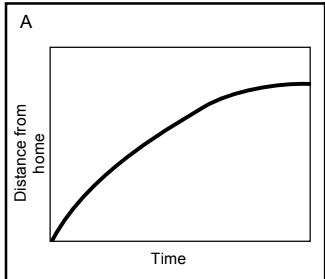
What is this graph representing?

a)

Constant Speed

b)

Acceleration (speeding up)

c)

Deceleration (slowing down)

d)

No motion

30.

What equation do I use to calculate speed?

a)

S = D/T

b)

T = D/S

c)

D = S x T

31.

What equation do I use to calculate time?

a)

S = D/T

b)

T = D/S

c)

D = S x T

32.

What equation do I use to calculate distance?

a)

S = D/T

b)

T = D/S

c)

D = S x T

33.
What key word tells me I'm measuring speed?
a)
how fast
b)
how far
c)
how long
34.
What key word tells me I'm measuring time?
a)
how fast
b)
how far
c)
how long
35.
What key word tells me I'm measuring distance?
a)
how fast
b)
how far
c)
how long
36.
What unit would I use when measuring speed?
a)
m/sec
b)
meters
c)
seconds
37.
What unit would I use when measuring time?
a)
m/sec
b)
meters
c)
seconds
38.
What unit would I use when measuring distance?
a)
m/sec
b)
meters
c)
seconds
39.

What is the speed of a car that travels 400 m in 20 minutes?

a)

20 miles/hr

b)

20 m/min

c)

800 m/min

d)

200 miles/hr

40.
A train travels 25 km in .5 hrs. How fast is the train going?
a)
25 miles/hr
b)
5 miles/hr
c)
125 km/hr
d)
50 km/hr
41.

What is the speed of a man who runs 20 miles in 2 hr?

a)

20 miles

b)

1 m/min

c)

10 miles/hr

d)

40 hrs

42.
A car travels 30 miles/hr for 3 hours, calculate the distance it will travel
a)
90 miles
b)
10 miles
c)
600 miles
d)
90 km
43.

A boat travels at 22 km/hr for 10 hrs, what distance will it travel?

a)

220 miles

b)

2.2 km

c)

220 km

d)

2.2 miles

44.

A man runs at 10 m/min for 5 min, what distance will he run?

a)

10 m

b)

10 m

c)

5 m

d)

50 m

45.

A speed boat travels 200 miles at a speed of 20 miles/hr. How much time will it take to travel?

a)

10 hrs

b)

4000 hrs

c)

400 hrs

d)

100 km

46.
Determine if the object was accelerating between 40 seconds and 60 seconds. 
SPEED = DISTANCE/TIME
a)
No, the speed stayed the same
b)
Yes, the speed increased
c)
Yes, the speed decreased
d)
Yes. the speed stayed same
47.
At 60 seconds, how far had this object traveled? 
a)
0 m
b)
10 m
c)
20 m
d)
40 m
48.
How many times does this object STOP moving?
a)
None
b)
Once
c)
Twice
d)
Three times
49.
Which of the graphs shows that one of runners started 10 yards further ahead of the other (note that graph c is the bottom right and graph d is the bottom left)? 
a)
Graph A
b)
Graph B
c)
Graph C
d)
Graph D
50.
What does this graph represent?
a)
Constant Speed
b)
Acceleration
c)
Deacceleration
d)
Not moving
51.
Which runner won the race?
a)
A
b)
B
c)
C
d)
It was a tie
52.
According to the graph how far does the person travel in the first 5 seconds?
a)
2 m
b)
10 m
c)
0 m
d)
5 m
53.
What is the person doing from 5 seconds to 10 seconds?
a)
Walking 
b)
Running
c)
Standing Still 
d)
Walking Fast
54.
What is happening at A?
a)
Stationary
b)
Accelerating
c)
Slower steady speed; moving away from the starting position
d)
Steady speed; returning to start position
55.

Sandra and Joey are bicycling across town along a flat road. A portion of their trip is graphed below.

Based on the graph, which of the following is true?

a)

Sandra traveled a greater distance than Joey.

b)

Sandra and Joey both traveled at the same speed.

c)

Joey traveled for a shorter time compared to Sandra.

d)

Joey was traveling with a negative acceleration compared to Sandra.

56.

A battery powered car is guided through an obstacle course. The graph shows how the car traveled over a period of time.


Between which two points was the speed of the car the fastest?

a)

P and Q

b)

Q and R

c)

R and S

d)

S and T

57.

The graph shows the movement of an object at several points in time.


What is the average speed of the object?

a)

1 m/minute

b)

5 m/minute

c)

10 m/minute

d)

15 m/minute

58.
a)
b)
c)
d)
59.
Which runner had a head start?
a)
A
b)
B
c)
C
60.
How long did it take this object to travel 10 m?
a)
0 s
b)
10 s
c)
15 s
d)
20 s
61.
What is happening at C?
a)
Stationary
b)
Accelerating
c)
Fast steady speed; moving away from the starting position
d)
Slower steady speed; moving away from the starting position
62.
What does this graph represent?
a)
Constant speed
b)
Acceleration
c)
Not moving
63.
During what segments is the object returning to the reference point?
a)
A to B
b)
B to C
c)
C to D
d)
D to E
64.
What does the flat line mean for Charlie?
a)
He stayed at the same speed
b)
He slowed down
c)
He stopped running 
d)
He stayed at the same speed but at a slower rate