
 Worksheets
Physiology Midterm Review
Total questions: 60
Worksheet time: 30mins
Hormone that promotes bone deposition
aldosterone
parathyroid hormone
calcitonin
A, B
Refers to changes in physical and functional properties of cells as they proliferate in the embryo to form the different bodily structures and organs.
Cell Differentiation
Biodiversity
Telomeres
Senescent
Programmed Cell Death
Apoptosis
Phagocytosis
Pinocytosis
Endocytosis
Which thin filament protein bind to Ca during muscle contraction?
Actin
Myosin
Troponin
Tropomyosin
Click all that apply. Which of these make up a motor unit?
Motor neuron
Motor fiber
Muscle
Nerve
Which muscle characteristic allows the muscle to return to resting length after contraction?
Contractility
Excitability
Extensibility
Tension
What is the name of the plasma membrane surrounding each muscle fiber?
T Tubule
Sarcolemma
Sarcoplasm
Nucleus
What is the contractile unit of the muscle?
Z disk
Sarcomere
Muscle fiber
Muscle cell
What protein makes up the thick filaments?
Troponin
Tropomyosin
Myosin
Actin
What is the name of the location where the neuron and muscle fiber meet?
Sarcoplasm
Sacolemma
Neuromuscular junction
Axon terminal
What is the name of the neurotransmitter that is released from the neuron to the sarcolemma?
Acetylcholine
Acetone
ATP
Calcium
Which of these occurs first during a muscle contraction?
The nerve signal reaches the neuromuscular junction
Ach is released and opens Na ion channels
The sarcomere shortens
The myosin binds to the actin
Which of these occurs last during a muscle contraction?
The nerve signal reaches the neuromuscular junction
Ach is released and opens Na ion channels
The sarcomere shortens
The myosin binds to the actin
Produce red blood cells
Periosteum
Red Bone Marrow
Medullary Cavity
Compact Bone
Epiphyseal plate
Covers the external surface of the epiphyses and decreases friction at joint surfaces
Periosteum
Red Bone Marrow
Medullary Cavity
Articular Cartilage
Epiphyseal plate
Causes lengthwise growth of a long bone
Periosteum
Red Bone Marrow
Medullary Cavity
Compact bone
Epiphyseal plate
Separates the Nucleus from the Cytoplasm
Nuclear Sheath
Nucleoli
Nuclear Membrane
Nuclear Folder
The jelly-like fluid portion of the cytoplasm
Cytosol
Endoplasmic Reticulum
Nucleolus
Sarcoplasm
Powerhouse of the cell
Mitochondria
Golgi Apparatus
Nucleus
Plasma Membrane
ATP is a nucleotide composed of (1) the nitrogenous base adenine, (2) the pentose sugar ribose, and (3) ___ phosphate radicals.
2
3
4
1
Energy Currency of the Cell
ATP
ADP
Mitochondria
Glycogen
The enzyme cholinesterase causes acetylcholine to
be secreted from the motor end plate.
form cross bridges.
bind to actin.
decompose.
The study of the function of body parts
(a)
The basic unit of structure and function in the body
(a)
All the chemical reactions inside of a cell are called (a) .


Which of the following is NOT a main function of epithelial tissues?
covering exposed surfaces
lining internal passageways
producing glandular secretions
contracting to produce movement
This type of tissue makes up glands like your salivary glands.
Epithelial
Nervous
Connective
Muscle

Check off each characteristic that pertains to the Cardiac muscle
voluntary
involuntary
striated
non-striated
multinucleated per cell
This is a neuron's ability to carry a nerve impulse (message)
irritability
transference
conductivity
synaptic cleft messaging
Group of cells that have a similar structure and act together to perform a spesific function. This statement defines
tissue
animal tissue
epithelial tissue
muscle tissue
connective tissue
Melanocytes lie within the _________________ of the skin
stratum corneum and top layers
deepest dermis
stratum spinosum and stratum lucidum
stratum basale and upper dermis

The protective dead layer of cells of the outer epidermis is called the:
stratum spinosum
stratum granulosum
stratum corneum
stratum basale

What is one important function for melanin?
cause the skin to be cooler
increase the amount of blood vessels
strengthen the skin or eyes
absorb harmful radiation
Who would be most at risk of developing rickets, a bone disease caused by insufficient calcium absorption?
Children born to mothers with dark skin living far from the equator.
Adults with dark skin who live close to the equator.
Children born to mothers with light skin, living close to the equator.
Adults with light skin who live close to the equator.
Anyone who eats a diet that includes a lot of fish

Folate is:
a B-Vitamin
used to make DNA and other genetic material
important for pregnancy
all of the above

What's in the picture?
synaptic vesicles
neurotransmitters
presynaptic neuron
postsynaptic neuron
synaptic cleft
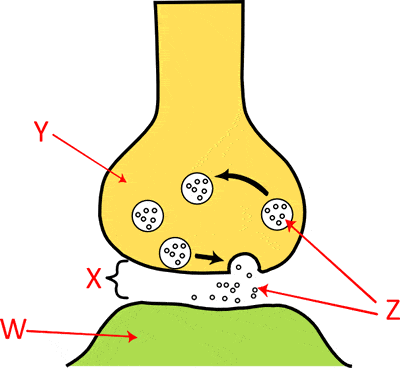
X
Axon Terminal Button
Neurotransmitters
Dendrite
Synapse
An action potential is
A positive charge that moves along the neurons
A negative charge that moves along the neurons
The neutral charge of cells at rest
a cell that has the most potential, able to become any type of cell.
Totipotent
Pluripotent
Multipotent
Which of the following chemicals make capillaries more permeable?
Histamine
Heparine
Which of the following is an inflammatory response?
Redness
Swelling
Increased mobility
Heat

What is the name of the incomplete fracture usually seen in children?
Linear
Transverse
Fibial
Greenstick
If a fracture is comminuted, that means the bone is in _______ pieces.
Multiple
One
Which type of cellular junction form a "quilted seal" between cells?
Tight junctions
Desmosomes
Gap Junctions
The difference between endocrine and exocrine glands can best be described by which of the following?
exocrine secretions are released into surrounding tissues and blood whereas endocrine secretions are discharged onto the surface of the skin or other epithelial surfaces
endocrine secretions are released into the surrounding tissues and blood whereas exocrine secretions are discharged onto the surface of the skin or other epithelial surfaces
exocrine secretions and endocrine secretions are both released directly into the blood at all times
exocrine secretions and endocrine secretions are both released directly onto the surface of the skin at all times

Name the type of secretion
merocrine
apocrine
holocrine
berocrine

