
 Worksheets
Understanding Plasma Membrane Transport
Total questions: 57
Worksheet time: 47mins
What is the primary structural component of the plasma membrane?
Proteins
Phospholipids
Carbohydrates
Nucleic acids
Explain how the structure of the plasma membrane contributes to its function as a selective barrier.
The rigid structure prevents all substances from passing through.
The phospholipid bilayer allows only water to pass through.
The fluid mosaic model allows for selective permeability, enabling certain molecules to pass while blocking others.
The carbohydrate chains block all foreign substances.
Which of the following best describes diffusion?
Movement of molecules from an area of low concentration to high concentration.
Movement of molecules from an area of high concentration to low concentration.
Movement of water molecules only.
Movement of molecules against the concentration gradient.
How does osmosis differ from simple diffusion?
Osmosis involves the movement of solutes, while diffusion involves the movement of water.
Osmosis requires energy, while diffusion does not.
Osmosis is the diffusion of water across a selectively permeable membrane, while diffusion involves the movement of solutes.
Osmosis occurs only in plant cells, while diffusion occurs in all cells.
Which of the following is an example of active transport?
Osmosis
Facilitated diffusion
Sodium-potassium pump
Simple diffusion
Describe the role of ATP in active transport.
ATP provides the energy needed to move substances against their concentration gradient.
ATP is used to create a concentration gradient.
ATP is not involved in active transport.
ATP is used to facilitate the movement of water molecules.
What is facilitated diffusion and how does it differ from simple diffusion?
Facilitated diffusion requires energy, while simple diffusion does not.
Facilitated diffusion involves the use of transport proteins, while simple diffusion does not.
Facilitated diffusion moves molecules against the concentration gradient, while simple diffusion moves them along the gradient.
Facilitated diffusion occurs only in plant cells, while simple diffusion occurs in all cells.
Which of the following processes involves the engulfing of large particles by the cell?
Exocytosis
Endocytosis
Osmosis
Facilitated diffusion
Explain the process of exocytosis and its importance to the cell.
Exocytosis is the process of taking in large particles, which is important for nutrient intake.
Exocytosis is the process of expelling materials from the cell, which is important for removing waste and releasing substances like hormones.
Exocytosis is the process of water movement, which is important for maintaining cell turgor.
Exocytosis is the process of protein synthesis, which is important for cell growth.
Compare and contrast passive and active transport in terms of energy usage and direction of movement.
Both require energy and move substances against the concentration gradient.
Passive transport requires energy and moves substances against the gradient, while active transport does not require energy and moves substances along the gradient.
Passive transport does not require energy and moves substances along the gradient, while active transport requires energy and moves substances against the gradient.
Both do not require energy and move substances along the concentration gradient.
Which of the following is a characteristic of the sodium-potassium pump?
It moves sodium ions into the cell and potassium ions out of the cell.
It moves sodium ions out of the cell and potassium ions into the cell.
It moves both sodium and potassium ions into the cell.
It moves both sodium and potassium ions out of the cell.
How does the structure of transport proteins facilitate their function in the plasma membrane?
Their rigid structure allows them to block all substances.
Their flexible structure allows them to change shape and transport specific molecules across the membrane.
Their structure allows them to dissolve in the lipid bilayer.
Their structure allows them to transport only water molecules.
Why is the plasma membrane described as a "fluid mosaic model"?
Because it is a rigid structure with fixed components.
Because it is composed of a single type of molecule.
Because it is flexible and composed of various molecules like lipids, proteins, and carbohydrates that move laterally within the layer.
Because it is a solid structure that does not allow movement.
What is the main difference between endocytosis and exocytosis?
Endocytosis involves the expulsion of materials, while exocytosis involves the intake of materials.
Endocytosis involves the intake of materials, while exocytosis involves the expulsion of materials.
Both involve the intake of materials.
Both involve the expulsion of materials.
In what way does facilitated diffusion differ from active transport?
Facilitated diffusion requires energy, while active transport does not.
Facilitated diffusion moves substances against the concentration gradient, while active transport moves them along the gradient.
Facilitated diffusion does not require energy and moves substances along the gradient, while active transport requires energy and moves substances against the gradient.
Both facilitated diffusion and active transport require energy.
Why is cholesterol important in the plasma membrane?
It has no impact on the fluidity and stability of the membrane.
It causes the membrane to become rigid and inflexible.
It helps maintain the structure and stability of the membrane.
It is only important for the color of the membrane.

This image is an example of a phospholipid. Which part of a phospholipid is HYDROPHILIC?
the phosphate "head"
the lipid "tails"
The process by which living things try to keep their internal conditions relatively stable (or balanced) is called -
homeostasis.
cellular respiration.
osmosis.
diffusion.

What is the function of "B"?
Help transport certain materials across the cell membrane
Makes up bilayer
Involved in cell-to-cell recognition
Repels Water
Which of the following molecules can easily pass through the plasma membrane without the help of membrane proteins?
Glucose
Sodium ions
Oxygen
Proteins
What is the function of channel proteins in the plasma membrane?
To provide structural support
To facilitate the diffusion of specific molecules
To store energy
To synthesize lipids

. Which characteristic of a phospholipid, shown here, increases the fluidity of the membrane?
cholesterol
its head
saturated fatty acid tail
unsaturated fatty acid tail

In the diagram, what is letter A?
Phospholipid
Phospholipid bilayer
Cholesterol
Carbohydrate
Carrier or transport protein
Active transport is the movement of large materials across a cell membrane from ______ to ______ concentration
high to low
low to high
high to high
low to low
Active transport across a cell membrane from low to high concentration, requires
energy (ATP)
no energy
water
oxygen
A general term for the various types of active transport that move particles into a cell by enclosing them in a vesicle made out of plasma membrane.
Endocytosis
Exocytosis
Osmosis
Diffusion
A form of bulk transport in which materials are transported from the inside to the outside of the cell in membrane-bound vesicles that fuse with the plasma membrane.
Endocytosis
Exocytosis
Osmosis
Diffusion
white blood cells engulfing invading bacteria is an example of
Endocytosis
Exocytosis
Diffusion
Facilitated Diffusion
nerve cells release neurotransmitters across gaps
and secretion of proteins and wastes
Exocytosis
Endocytosis
Diffusion
Facilitated Diffusion

Which description best identifies this type of cellular transport?
Active transport, because energy is being used to move molecules against the concentration gradient
Facilitated diffusion, because energy is being used to move molecules with theconcentration gradient
Osmosis, because energy is not being used to move molecules with the concentration gradient
Endocytosis, because energy is not being used to move molecules against theconcentration gradient

What conditions cause the contractile vacuole of this organism to fill with water?
The concentration of water is greater outside the cell then inside.
The temperature of water in the vacuole is higher.
The concentration of water inside the cell is the same as the outside.
The temperature of water in the vacuole is lower.
What is it called when a cell is placed in a solution that has a greater concentration of solutes on the outside of the cell than inside?
Which type of transport does NOT require energy?
osmosis
passive transport
diffusion
All are correct
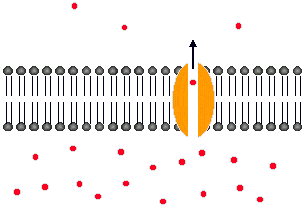
Need help from channel proteins. No energy required.



