
 Worksheets
3RD NINE WEEKS EXAM 1-3
Total questions: 185
Worksheet time: 6hrs 4mins
f(x)=x2+5
f(x)=(x+7)2


Where is the axis of symmetry?
Does the graph of this equation open up or down?
f(x) = -(x + 3)2 - 5
up
down
Identify A, B, and C if y=3x2-8+5x
A=3, B=5, C=-8
A=3, B=-8, C=5
A=3x2, B=5x, C=-8
A=3x2 , B=-8, C=5x


f(x) = -x2+8x-10?
Find the vertex of the quadratic function: y = 4x2 + 24x + 5
(−3, −31)
(3, 113)
(−3, −76)
(3, 5)

y = -8x2 + 3x - 7

The graph of a quadratic function is shaped like a U, but it can be upside down.
True
False
The graph of a quadratic function is called __________ .
a vertex
an ellipse
a parabola
the axis of symmetry
f(x) = ax2 + bx +c is the __________ form of the quadratic function.
Factored
Standard
Vertex
None of the above
In the quadratic expression, f(x) = ax2 + bx + c , the quadratic term of the function is
bx
undefined
c
all of them
In the quadratic expression, f(x) = ax2 + bx + c , the values a, b, and c are
coefficients
variables
quadratic terms
none of the above
In the quadratic expression, f(x) = ax2 + bx + c , "c" represents the:
Axis of symmetry
vertex
y-intercept
x-intercept
In the quadratic expression, f(x) = −3x2 + 12x + 4 , what is the y-intercept?
y = -4
y = -2
y = 2
y = 4
Does the parabola from the quadratic expression, f(x) = −ax2 + bx + c , open upwards or downwards?
upwards because "a" is negative
upwards because "a" is positive
downwards because "a" is negative
downwards because "a" opens positive
Does the parabola from quadratic expression, f(x) = ax2 + bx + c , have a maximum or minimum point?
minimum because it opens upwards
minimum because it opens downwards
maximum because it opens upwards
maximum because it opens downwards
What are the values of a, b, and c in the following quadratic equation:
y = 4x2 – 8x + 3
a = -4, b = -8, c = +3
a = 4, b = -8, c = -3
a = 4, b = 8, c = 3
a = 4, b = -8, c = 3

What is the green dashed line called?
the roots or x-intercepts
a parabola
the axis of symmetry
the x axis
In the quadratic expression, f(x) = ax2 + bx + c , the formula for the axis of symmetry is:
x = ax2
x = −2ab
x = f(x)
x = c
What is the axis of symmetry of the following expression?
f(x) = x2- 4x + 5.
x = 2
x = -2
x = 4
x = -4
Find the axis of symmetry in the following equation:
y = 3x2 + 18x + 6
x = 3
x = -2
x = 6
x = -3
Find the axis of symmetry in the following equation:
y = 2x2 + 2x + 2
x = 0.5
x = -0.5
x = 1
x = -1

Find the coordinates of the vertex (x, y) from the expression: y = 2x2 + 4x - 3
(-1,-5)
(1,-5)
(-1,5)
(1,5)
Find the coordinates of the vertex (x, y) from the expression:
y = 2x2 + 4x + 6
(-1,-4)
(1,-4)
(-1,4)
(1,4)

What is the vertex of this parabola?
(5, 3)
(3, -1)
(-1,4)
(-1,-5)
The vertex of this graph is a maximum.
True
False
y = - x2 + 2x - 3
y = x2 - 2x + 3
y = x2 - 3
y = - 4x2 +9x - 3
Determine what the question is looking for:
Jack is throwing a baseball. What is the highest in the air the ball will get?
y-intercept
vertex
plug in a value for x
x-intercept

If each mark on the x-axis represents one second, when did the object reach the ground?
2.5 seconds
6 seconds
5.5 seconds
5 seconds

A kid launches a rock off of a cliff. The height of the rock after t seconds can be modeled by the graph shown. What is the height of the cliff?
1.094 ft
174.141 ft
155 ft
4.393 ft
None of the above
A kid launches a rock off of a cliff. The height of the rock after t seconds can be modeled by the graph shown. When does the rock hit the ground?
1.094 seconds
174.141 seconds
155 seconds
4.393 seconds
None of the above
A kid launches a rock off of a cliff. The height of the rock after t seconds can be modeled by the graph shown. What is the maximum height the rock reaches ?
1.094 ft
174.141 ft
155 ft
4.393 ft
None of the above
A kid launches a rock off of a cliff. The height of the rock after t seconds can be modeled by the graph shown. How long does it take the rock to reach its maximum height?
1.094 seconds
174.141 seconds
155 seconds
4.393 seconds
None of the above

Mrs. Martone's 7th grade science class built and launched rockets. The graph below shows the height, in feet, over time, in seconds, of a student's rocket. Use the graph to answer the questions below. How long did it take the rocket to reach its maximum height?
1 second
5 seconds
7 seconds
11 seconds
Mrs. Martone's 7th grade science class built and launched rockets. The graph below shows the height, in feet, over time, in seconds, of a student's rocket. Use the graph to answer the questions below. What was the maximum height the rocket reached?
25 feet
45 feet
65 feet
85 feet

A projectile bottle rocket is launched in the air. What is the highest altitude of the projectile?
7 ft
500 ft
200 ft
350 ft
A projectile bottle rocket is launched in the air. How long does it take the projectile to reach the ground?
5.2 seconds
6.8 seconds
7 seconds
3 seconds
A projectile bottle rocket is launched in the air. From what height was the bottle rocket launched?
200 feet
6.8 feet
3 feet
50 feet
A projectile bottle rocket is launched in the air. How long did it take the bottle rocket to reach its maximum altitude?
3 seconds
6.8 seconds
50 seconds
200 seconds
A toy rocket is launched from the top of a 48-foot hill. The rocket's height, h(x), is modeled by the
equation h(x) = -16x2 + 32x +48 after x seconds. How high was the rocket at 2 seconds?
3
32
48
64
100
x2+7x+12
(x + 3)(x + 4)
(x + 6)(x + 2)
(x - 3)(x - 4)
(x + 1)(x + 12)
x2+6x−27
(x - 9)(x + 3)
(x + 9)(x - 3)
(x + 3)(x + 3)
(x + 9)(x + 3)
2x2−15x+7
(2x + 1)(x - 7)
(2x + 7)(x - 1)
(2x + 1)(x + 7)
(2x - 1)(x - 7)
5x2−13x−6
(5x + 2)(x - 3)
(5x - 2)(x + 3)
(5x + 1)(x - 6)
(x + 3)(5x + 2)
3x2+22x−16
(3x + 2)(x + 8)
(3x - 2)(x + 8)
(3x - 4)(x + 4)
(3x - 2)(x - 8)
x2− 7x −18
(x + 9)(x + 2)
(x - 9)(x - 2)
(x - 9)(x + 2)
(x + 9)(x - 2)
6x2+11x+4
(6x + 1)(x + 4)
(3x - 4)(2x - 1)
(6x + 2)(x + 2)
(3x + 4)(2x + 1)
x2−20x+64
(x - 4)(x - 16)
(x + 4)(x + 16)
(x - 8)(x - 8)
(x + 32)(x - 2)
x2+12x−45
(x - 15)(x + 3)
(x - 15)(x - 3)
(x + 9)(x - 5)
(x + 15)(x - 3)
4x2−21x−18
(4x - 3)(x + 6)
(2x + 9)(2x - 2)
(4x + 3)(x - 6)
(2x - 3)(2x + 6)
9x2−6x−8
(3x - 4)(3x - 2)
(3x + 2)(3x + 4)
(3x + 8)(3x - 1)
(3x + 2)(3x - 4)
8x2−22x+5
(8x - 5)(x + 1)
(4x - 1)(2x - 5)
(4x + 5)(2x + 1)
(8x - 1)(x - 1)
x2 − 7x − 18
(x − 9)(x + 2)
(x + 9)(x + 2)
(x − 9)(x - 2)
(x − 9)(x - 2)
p2 − 5p − 14
( p + 2)( p + 7)
( p + 2)( p − 7)
( p - 2)( p − 7)
( p - 2)( p + 7)
m2 − 9m + 8
(m + 1)(m − 8)
(m − 1)(m + 8)
(m − 1)(m − 8)
(m + 1)(m + 8)
x2 − 16x + 63
(x + 9)(x + 7)
(x − 9)(x + 7)
(x + 9)(x − 7)
(x − 9)(x − 7)
7x2 − 31x − 20
(7x + 4)(x − 5)
(7x - 4)(x − 5)
(7x + 4)(x + 5)
(7x - 4)(x − 5)
7k2 + 9k
k(7k - 9)
k(7k + 9)
7k(k + 9)
(k+3)(7k + 3)
7x2 − 45x − 28
7(x + 4)(x − 7)
(x + 4)(7x - 7)
(7x + 4)(x − 7)
(7x - 4)(x + 7)
2b2 + 17b + 21
(2b + 7)(b + 3)
(2b + 3)(b - 7)
2(b + 3)(b + 7)
(2b + 3)(b + 7)
5p2 − p − 18
5(p + 9)( p − 2)
(p + 9)( 5p − 2)
(5p - 9)( p + 2)
(5p + 9)( p − 2)
28n4 + 16n3 − 80n2
4n2 (7n + 10)(n - 2)
(28n2 − 10)(n2 + 2)
4n2 (7n − 10)(n + 2)
(7n − 10)(4n2 + 2)
3b3 − 5b2 + 2b
b(3b − 2)(b − 1)
(3b2 − 2)(b − 1)
(3b − 2)(b2 − 1)
b(3b + 2 )(b + 1)
7x2 − 32x − 60
(7x + 10)(x − 6)
7(x + 10)(x − 6)
(7x - 10)(x − 6)
(7x - 10)(x + 6)
30n2b − 87nb + 30b
(6nb − 5)(5n − 2)
3n(2b − 5)(5n − 2)
3b(2n − 5)(5n + 2)
3b(2n − 5)(5n − 2)
9r2 − 5r − 10
(9r + 2)(r - 5)
(3r + 2)(3r - 5)
9(r + 2)(r - 5)
not factorable
9p2r + 73pr + 70r
r(p + 7)(9p + 10)
(rp + 7)(9p + 10)
r(3p + 7)(3p + 10)
p(r + 7)(9r + 10)
9x2 + 7x − 56
(3x + 7)(3x - 8)
9(x + 7)(x - 8)
(3x - 7)(3x - 8)
not factorable
10m2 + 89m − 9
(m + 9)(10m + 1)
(m + 9)(10m − 1)
(m - 9)(10m − 1)
not factorable
4x3 + 43x2 + 30x
x(x + 10)(4x + 3)
(x2 + 10)(4x + 3)
x(x + 3)(4x + 10)
(x + 10)(4x + 3)
Factor: 7k2+9k
k(7+9)
7k(k+9)
k(7k+9)
k2(7+9)
Factor p2−5p−14
(p+7)(p−2)
(p+2)(p−7)
Factor m2−9m+8
(m−1)(m−8)
(m+8)(m−1)
Factor 2b2+17b+21
(2b+7)(b−3)
(b−7)(2b−3)
(2b+3)(b+7)
(2b−7)(b−3)
Factor 28n4+16n3−80n2
4n2(7n2+4n−20)
(7n−10)(n+2)
(28n3−40n2)(n+2)
4n2(7n−10)(n+2)
Factor 5p2−p−18
(5p−9)(p+2)
(5p+9)(p−2)
(p+9)(9p−5)
(9p+5)(2p−1)
Factor:
x2 + 11x + 24
(x + 6)(x + 4)
(x + 12)(x + 2)
(x - 8)(x - 3)
(x + 8)(x + 3)
Factor:
5x3 - 7x2
x2(5x - 7)
x(5x2 - 7x)
x3(5 - 7x)
Prime
Factor: 25x2 - 9
(5x + 3)(5x - 3)
(x + 5)(x - 3)
(x - 3)(x + 5)
(5x + 3)(3x + 5)
x2 − 7x − 18
(x − 9)(x + 2)
(x + 9)(x + 2)
(x − 9)(x - 2)
(x − 9)(x - 2)
p2 − 5p − 14
( p + 2)( p + 7)
( p + 2)( p − 7)
( p - 2)( p − 7)
( p - 2)( p + 7)
m2 − 9m + 8
(m + 1)(m − 8)
(m − 1)(m + 8)
(m − 1)(m − 8)
(m + 1)(m + 8)
x2 − 16x + 63
(x + 9)(x + 7)
(x − 9)(x + 7)
(x + 9)(x − 7)
(x − 9)(x − 7)
2b2 + 17b + 21
(2b + 7)(b + 3)
(2b + 3)(b - 7)
2(b + 3)(b + 7)
(2b + 3)(b + 7)
5p2 − p − 18
5(p + 9)( p − 2)
(p + 9)( 5p − 2)
(5p - 9)( p + 2)
(5p + 9)( p − 2)
10m2 + 89m − 9
(m + 9)(10m + 1)
(m + 9)(10m − 1)
(m - 9)(10m − 1)
not factorable
Factor completely.
x2−16
(x + 8)(x - 8)
(x + 4)(x - 4)
(x + 6)(x - 10)
(x + 4)(x + 4)
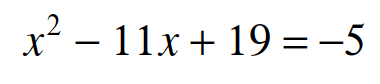
Solve the equation by factoring.
x = {3,8}
x = {-3,8}
x = {3,-8}
x = {-3,-8}
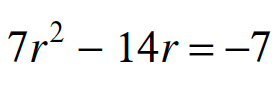
Solve the equation by factoring.
x = {1}
x = {-1}
x = { }
no solution
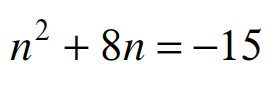
Solve the equation by factoring.
x = {-5,-3}
x = {5,-3}
x = {-5,3}
x = {5,3}
How many solutions can a quadratic have?
1 solution
3 solutions
0 solutions
2 solutions
What can the roots to a quadratic equation be called?
zeros
solutions
x-intercepts
none of the choices
What is the quadratic formula?


What is the axis of symmetry formula?
y = mx+b
y = ax2+bx+c
b2 - 4ac
x = -b/2a
Solve the equation using the quadratic formula.
x2 + 7x = x - 10
-6/2 + √4
-6/2 - √4
no solution
∅
Solve the equation using the quadratic formula.
4x2 +9x = 12x
x = {0, 3/4}
x = {0, -3/4}
x = {0, 4/3}
no solution
Use the discriminant to find the number of solutions for the following equation.
y = x2 +10x + 25
2 solutions
1 solution
0 solutions
Use the discriminant to find the number of solutions for the following equation.
y = -3x2 +5x - 8
2 solutions
1 solution
0 solutions
Use the discriminant to find the number of solutions for the following equation.
y = 4x2 - 9
2 solutions
1 solution
0 solutions
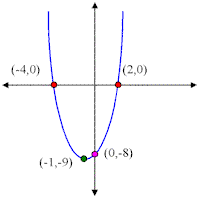
Which value is the vertex?
(-4, 0)
(-1, -9)
(0, -8)
(2, 0)
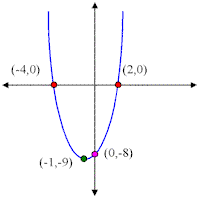
Which value is the y-intercept?
(-4, 0)
(-1, -9)
(0, -8)
(2, 0)

What are the zeros of this graph?
x = {-4, 2}
(-4, 0 ) and (2, 0)
x = {-1, 0}
(-1, 9 ) and (0, -8)

Does this graph have a maximum or a minimum?
maximum
minimum
I am not sure.
neither

Does this graph have a maximum or a minimum?
maximum
minimum
I am not sure.
neither
Does this graph have any roots?
yes
no
I am not sure.
Does this graph have a y-intercept?
yes
no
I am not sure.
What is the equation for standard form?
y = x2 + bx + c
y = ax2 + bx + c
y = mx + b
Ax + By = C
What is the standard form formula?
y=mx+b
y=ax2+bx+c
y=a(x-h)2+k
What is the vertex form formula?
y=ax2+bx+c
y=mx+b
y=a(x-h)2+k

Is the graph shown above a max or min?
Maximum
Minimum

What is the domain of the graph shown above.
x=19
all real numbers
y=3
Maximum

What are the zeros of the graph shown above?
2 and 6
4 and 2
6 and 9
5 and 1
What is a axis of symmetry?
all real numbers
y=5
the line that divides the graph in equal halves
y=mx+b

Is the graph shown above a max or min?
Minimum
Maximum

What is the y-intercept of the graph shown above?
all real numbers
(0,6)
(0,2)
(0,-6)

What is the vertex of the graph shown above?
(7,6)
(-1,2)
(2,-1)
(5,0)
Graph the following equation:
y=x2-2x-3


36
4
6
9

4
16
36
64

4
-4
16
-16


2
4
8
16


29
23
(23)2
(29)2
Complete the square for the equation:
x2+6x−4=0
(x+3)2=4
(x−3)2=4
(x+3)2=13
(x−3)2=13
Complete the square for the equation:
x2−10x+7=0
(x−5)2=18
(x+5)2=18
(x−5)2=−7
(x+5)2=−7
Complete the square for the equation:
x2−24x+23=0
(x+12)2=121
(x−12)2=121
(x+12)2=144
(x−12)2=144
x2 + 6x + ____
x2 + 22x + ____
x2 + 18x + ____
x2 - 30x + ____
x2 - 4x + ____
x2 - 2x + ____
r2 - 4r = 30
m2 - 16m = -59
a2 - 2a - 35 = 0
m2 + 12m + 19 = 0
Solve by completing the square.
x2−8x−20=0
x={−2, 10}
x={−10, 2}
x={−20, −8}
x={8, 20}
Solve by completing the square.
x2−12x+20=0
x={2, 10}
x={−10, −2}
x={−12, 20}
x={12, 20}
Solve by completing the square.
x2−4x−20=0
x={±62−2}
x={±62+2}
x={±26+2}
x={±26−2}
Solve by completing the square.
x2−6x−27=0
x={−9, −3}
x={−3, 9}
x={−9, 3}
x={3, 9}
Solve by completing the square.
x2−14x−15=0
x={1, 15}
x={−15, −1}
x={−15, 1}
x={−1, 15}
a, b, and c for
the quadratic equation:
4x2 – 8x = 3
Use the quadratic formula to find the solutions for
y = -x2 - 5x + 12
-4.9 and -0.1
-8.54 and 8.54
-0.45 and 3.55
-6.77 and 1.77
2x2 - 9x - 35 = 0

y = 2x2 - 9x + 5


y = x2 + 3x - 5
y = x + 3
When x = 2, what is the value of y?
y = x2 - 4x + 6
y = x + 2
The system of a linear function and a quadratic function may have 0, 1, or 2 solutions.
True
False
Cannot be determined
"Nobody cares, Ms. Malcolm"
y2-26=-x2
x-y=6

