
Font size
 Worksheets
Unit 4 Review - Biology
Total questions: 45
Worksheet time: 31mins

Transcribe the following DNA strand: CTG AAT
GAC TTA
CTG AAT
GAC UUA
CUG AAU

Which of the following make up a nucleotide?
Sugar, phosphate, and base
Sugar, nitrate, and base
Lipid, phospate, and sugar
Protein, phosphate, and base
Arrange the following into the correct order that shows the "Central Dogma" of Molecular Biology.
RNA
DNA
Protein
Process of copying a nucleotide sequence of DNA to form a complementary strand of mRNA
Translation
Transcription
Replication
Synthesis
Molecule that makes up proteins (monomer of proteins)
Ribosome
rRNA
Ribose
Amino acid
Carries copies of DNA's genetic material from the nucleus to ribosomes in the cytoplasm.
messenger RNA (mRNA)
transfer RNA (tRNA)
ribosomal RNA (rRNA)
Ribosome
Process by which mRNA is decoded and a protein is produced
Transcription
Translation
Replication
Synthesis
In RNA, the base thymine is replaced with this base that will bond Adenine instead in RNA.
Cytosine
Guanine
Uracil
Ribose
The creation or combination of something
mutation
transcription
translation
synthesis
Composed of a sugar, phosphate group, and nitrogenous base. These are the building blocks of DNA.
codon
nucleotide
protein
amino acid
Examples are: cytosine, adenine, thymine, and guanine.
nitrogenous bases
sugars
phosphate groups
amino acids
Organelle that is the site of protein synthesis
ribosomes
Golgi body
cell membrane
chloroplasts
During ___, the cell uses information from messenger RNA to make polypeptides.
replication
translation
transcription
meiosis
How many amino acids are coded for by the strand of mRNA shown here? Assume the reading frame begins with the first nucleotide.
A U G U A C
1
2
3
4
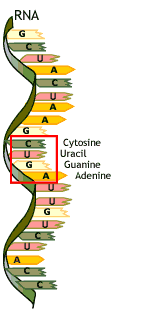

Why must transcription occur where DNA can be found?
because DNA can't leave
because ribosomes are in the nucleus
because DNA polymerase is found there
because helicase unzips the DNA
How many nucleotides equal 1 amino acid?
1
2
3
4
On which molecule can an anticodon be found?
mRNA
DNA
tRNA
rRNA

A polypeptide is a sequence of ____________________ held together by a ______________ bond.
amino acids; peptide
fatty acids; ionic
proteins; hydrogen
fatty acids; covalent

In which stage of MEIOSIS does crossing over occur? (The exchange of genetic material between chromosomes in a tetrad.)
Anaphase I
Metaphase I
Prophase I
Telophase I
In Anaphase I, the _________ are separated by the pulling of the spindle fibers to opposite poles of the cell.
homologous pairs of chromosomes
sister chromatids
centromeres
centrosomes
In Anaphase II, the _________ separate.
Homologues
Sister Chromatids
Tetrads
Centrioles
How many cells are formed at the end of Meiosis II?
2
3
4
8
True or False. In Meiosis II, there are TWO cells that go through each phase at the same time.
true
false


What is it called when a chromosome doesn't separate correctly during division?
crossing over
Meiosis
Non-disjunction
mutation
Which of the following would result in a frameshift mutation?
Insertions only
Substitution only
Deletion only
Insertions and Deletions
A mutation is defined as:
A change in the cell's structure
Anything that changes in an embryo
Any change in the physical features of a human
A change in the DNA sequence
Mutation
a change in the DNA sequence
Point mutation
a type of mutation where one to few bases are substituted with different bases
Frameshift mutation
a type of mutation caused by adding or deleting bases, affecting all the codons after the change
Silent mutation
a type of mutation that doesn't result in a change in the amino acid sequence (same protein)
Chromosomal mutation
a type of mutation where large sections of the chromosome are affected

