
 Worksheets
Natural Selection & Taxonomy
Total questions: 44
Worksheet time: 29mins
the movement of genes into or out of a population
Gene Flow
Random chance; small population
Genetic Drift
A sudden change in one or more characteristics due to a change in a gene
Mutation
The movement of organisms from one place to another
Migration
In a cold environment what are some traits that could increase fitness? Select all that apply.
thick blubber
thick fur
thin fur
wings
Which scientist is considered the father of evolution?
Jean-Baptist Lamarck
Hershey and Chase
Charles Darwin
Carleous Linnaeus

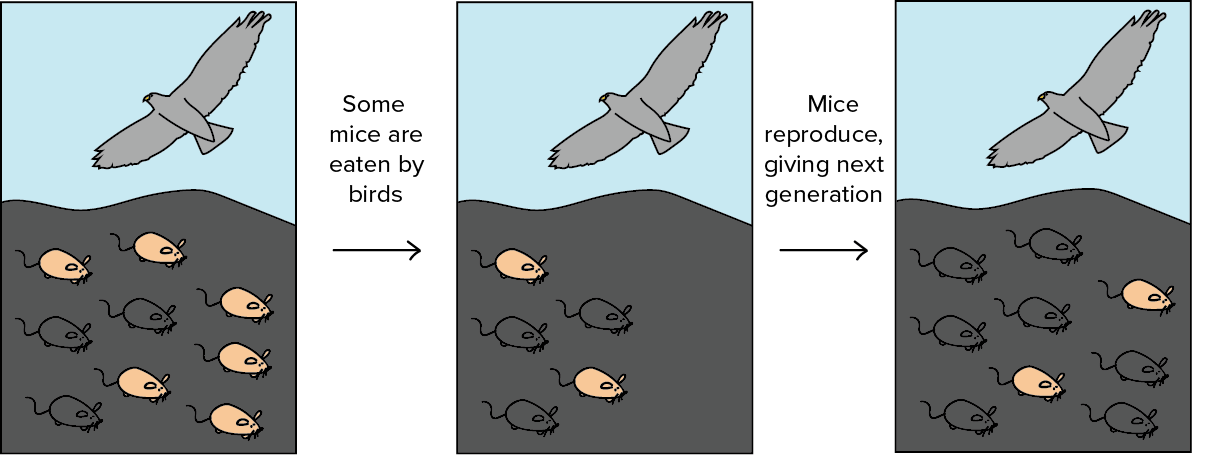
"Organisms that are better adapted to the environment survive to pass traits to their offspring" is the definition of
Natural Selection
Evolution
Selective Breeding
Artificial Selection

Which of the following represents gene flow?


Change in a population over time that descend from a common ancestor.
Natural Selection
Selective Breeding
Homeostasis
Evolution
Mutations are a change in what?
DNA
tRNA
protein
rRNA
What is a trait?
a color
the quality or characteristic of an organism
the DNA of an organism
when mutatuons cause extra limbs.
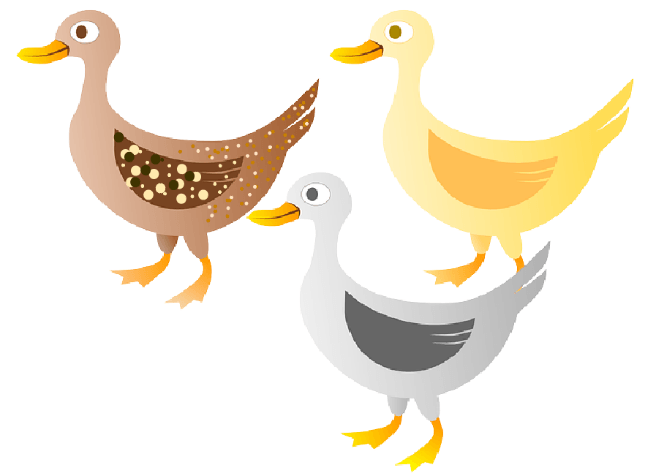
All the possible gene combinations in a population.
allele
gene pool
genome
mitosis
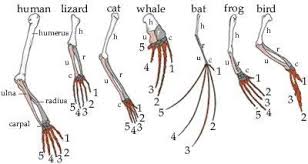
Look at the picture. All of these organisms share an ancient common ancestor. Scientists can prove this because of the similarities in the organisms' body structures. Which term below BEST describes this type of evidence?
vestigial structures
embryology
homologous structures
fossil record

Which rock layer would contain the oldest fossils?
1
2
3
4

Charles Darwin wrote that "organisms with traits that are best suited to their environment will survive and __________ ".
reproduce more often.
become extinct.
never reproduce.
lose all their traits.

Look at this cladogram of mammal evolution. Which species DNA is most similar to the DNA of the toothed whale?
Hippopotamus
Baleen Whale
Grazing Mammals
Camels
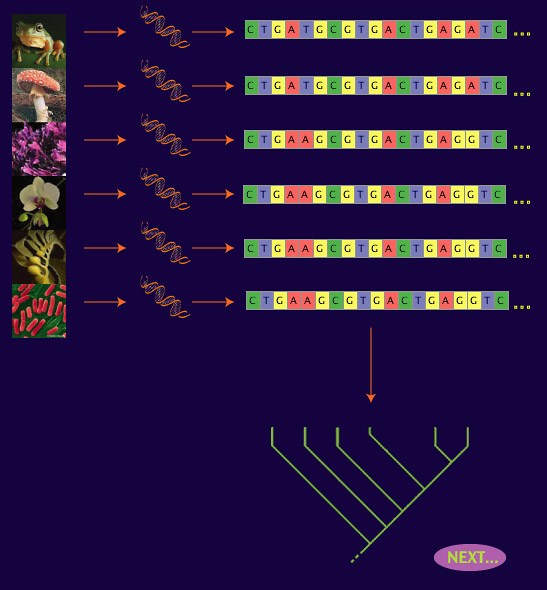
Two organisms that are closely related would have...
very similar DNA molecules.
the same exact DNA molecules.
no protein molecules in common.
completely different DNA molecules.

Based on the diagram, the salamander is most closely related to the:
chimp
perch
pigeon
hagfish

The scientific name of an organism comes from the (a) and (b) categories.

An illustration and a dichotomous key are given. What is the correct classification for the organism in the illustration?
Class Insecta
Order Amblygygi
Order Araneae
Order Scorpiones

Members of this kingdom are eukaryotic, multicellular, heterotrophic, and do NOT have cell walls.
Plantae
Protista
Animalia
Achaebacteria

This organism is multicellular, heterotroph, that has a cell wall made of chitin. What kingdom does it belong to?
fungi
plantae
animalia
eubacteria
Organisms in this taxonomic group would have the most characteristics in common:
Domain
Phylum
Order
Species
The more genetic variation a population has, the more likely it is for some individuals to
evolve
migrate
survive
mutate

Mountains and now breeds on the Santa Rita Mountains with another established population.
Gene Flow
Genetic Drift
Which of the following could not be a possible cause of the bottleneck effect?
Overhunting of northern elephant seals
A forest fire that destroys most of a population of deer
A crop that is destroyed by blight
A small group of fish that are added to a pond
What is genetic drift?
A population for which the gene frequencies do not change
A change in allele frequencies due to selection
The addition or removal of alleles in a population due to individuals entering or leaving one population for another
A change in the gene pool due to chance
A gene pool consists of (a) frequencies that can change randomly through generations due to chance.
Mutation
Change in DNA sequence
Gene Flow
Increases genetic variation
Genetic Drift
Usually decreases genetic variation
Bottle Neck
Population gets smaller (Natural Disaster)
Founders Effect
Starting a new population

This image is an example of:
genetic drift
gene flow

the selection pressure favors the extreme phenotypes, dividing the population into 2 distinct groups
directional selection
stabilizing selection
disruptive selection

Individuals with intermediate traits are more likely to survive and reproduce
stabilizing selection
directional selection
disruptive selection
A change in a gene pool due to chance.
Genetic drift
gene pool
Founder effect
Bottleneck effect

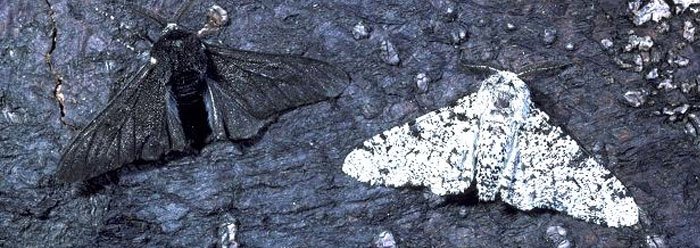
Scientists have discovered the specific mutation that famously turned moths black during the Industrial Revolution. In an iconic evolutionary case study, a black form of the peppered moth rapidly took over in industrial parts of the UK during the 1800s, as soot blackened the tree trunks and walls of its habitat.
Stabilizing Selection
Directional Selection
Disruptive Selection
Bacteria that are too large cannot obtain nutrients efficiently and bacteria that are too small cannot compete for those nutrients successfully
directional selection
stabilizing selection
disruptive selection
Robins typically lay fours eggs. If more then four eggs are produced then the baby chicks are malnourished while smaller egg numbers result in no viable (able to live) baby chicks. This is an example of
stabilizing
disruptive
direction

