wayground logo

Free Printable Worksheets

Font size

S
M
L
XL
Worksheets

Physics| Recap

Total questions: 100

Worksheet time: 1hrs 15mins

Name
Class
Date
1.
a)

A

b)

B

c)

C

d)

D

2.

A tunnel has a length of 50 km. A car takes 20 min to travel between the two ends of the tunnel. What is the average speed of the car?

a)

2.5 km / h

b)

16.6 km / h

c)

150 km / h

d)

1000 km / h

3.
a)

pole 1 and pole 2.

b)

pole 2 and pole 3.

c)

pole 3 and pole 4.

d)

pole 4 and pole 5.

4.
a)

A

b)

B

c)

C

d)

D

5.

A small steel ball is dropped from a low balcony. Ignoring air resistance, which statement describes its motion?

a)

It falls with decreasing acceleration.

b)

It falls with constant acceleration.

c)

It falls with decreasing speed.

d)

It falls with constant speed.

6.

Which speed/ time graph applies to an object at rest?

a)

A

b)

B

c)

C

d)

D

7.
a)

A

b)

B

c)

C

d)

D

8.
a)

150 m

b)

300 m

c)

600 m

d)

1200 m

9.
a)

4.0 s

b)

6.0 s

c)

10 s

d)

16 s

10.
a)

A

b)

B

c)

C

d)

D

11.
a)

A

b)

B

c)

C

d)

D

12.
a)

A

b)

B

c)

C

d)

D

13.
a)

A

b)

B

c)

C

d)

D

14.
a)

A

b)

B

c)

C

d)

D

15.
a)

A

b)

B

c)

C

d)

D

16.
a)

A

b)

B

c)

C

d)

D

17.
Why do ice cubes float in a  glass of water?
a)
the ice cubes are more dense than the water
b)
the water is more dense than the ice cubes
c)
the water is more dense than the glass
d)
the ice is more dense than the glass
18.
A mechanical pencil has the density of 3.000 g/cm3.  The volume of the pencil is 15.8 cubic centimeters.  What is the mass of the pencil?
a)
47.4 g
b)
50 g
c)
0.190  g
d)
5.27 g
19.
What is the density of water?
a)
0 g/ml
b)
1 g/ml
c)
10 g/ml
d)
100 g/ml
20.
Helium balloons rise on earth because
a)
helium is less dense than air
b)
helium is more dense than air
c)
helium is cooler than air
d)
helium is warmer than air
21.
Why do some substances float on water?
a)
they are warmer than water
b)
they are cooler than water
c)
they are more dense than water
d)
they are less dense than water
22.
What is the volume of Object X?
a)
10.0 cm3
b)
15.0 cm3
c)
20.0 cm3
d)
25.0 cm3
23.
The tool used to measure the mass of a substance or object is a ______________.
a)
balance
b)
graduated cylinder
c)
ruler
d)
thermometer
24.

A radioactive source emits radiation that can pass through a sheet of paper but not through thick aluminium. What does this show about the radiation?

a)

It is alpha-particles.

b)

It is beta-particles.

c)

It is gamma-rays.

d)

It is a mixture of alpha-particles and gamma-rays

25.

Which line in the table describes the nature of an alpha-particle and a gamma-ray?

a)

A

b)

B

c)

C

d)

D

26.

A radioactive nucleus R decays with the emission of a β-particle as shown:


Which equation is correct?

a)

x = p

b)

y = q

c)

p = x – 1

d)

q = y – 1

27.

The equation shows the decay of the nuclide X:


What are the values of P and Q ?

a)

A

b)

B

c)

C

d)

D

28.

Which type of radiation has the greatest ionising effect?

a)

α-particles

b)

β-particles

c)

γ-rays

d)

all have the same ionising effect

29.

In nuclear ……1……, hydrogen nuclei ……2…… to form helium nuclei, releasing energy.

Which words correctly complete gaps 1 and 2?

a)

A

b)

B

c)

C

d)

D

30.

When Uranium decays it emits an alpha particle, forming an isotope of Thorium. Which of the above decay equations is correct?

a)

A

b)

B

c)

C

d)

D

31.

The diagram shows a radioactive source, a thick aluminium sheet and a radiation detector.

The radiation detector shows a reading greater than the background reading.

Which type of radiation is being emitted by the source and detected by the detector?

a)

α-radiation

b)

β-radiation

c)

γ-radiation

d)

infra-red radiation

32.

Americium - 241 has a half life of 400 years. If a sample contains 24 grams starts to decay, after how long will 3 grams be left?

a)

400 yrs

b)

800 yrs

c)

1200 yrs

d)

1600 yrs

33.

The half-life of a radioactive substance is 10 minutes. A sample of the radioactive substancecontains 2000 nuclei.

How many radioactive nuclei were in the sample half an hour earlier?

a)

250

b)

4000

c)

6000

d)

16 000

34.
The law of conservation of momentum states that, 
a)
p before is less than p after
b)
p before is the same as p after
c)
p before is more than p after
35.
A 0.250 kg cart moving at 0.400 m/s has how much momentum?
a)
0.1 kg-m/s
b)
1 kg-m/s
c)
10 kg-m/s
d)
100 kg-m/s
36.
If 2 objects collide and stick together, what will happen to their velocities?
a)
velocities will increase
b)
velocities will decrease
c)
velocities will stay the same
d)
none of the above
37.
A 10kg toy truck moves at 5m/s East. It collides head-on with a 5kg toy car moving 10 m/s moving west. What is the total momentum of the system?
a)
0 kgm/s
b)
30 kgm/s
c)
50 kgm/s
d)
10 kgm/s
38.
A large box slides across a frictionless surface with a velocity of 12 m/s and a mass of 4 kg,  collides with a smaller box with a mass of 2 kg that is stationary.  The boxes stick together. What is the velocity of the two combined masses after collision?
a)
0 m/s
b)
4 m/s
c)
8 m/s
d)
12 m/s
39.
A biker with a mass of 75 kg moves along the path with a constant velocity of 5 m/s. What is the biker's momentum?
a)
25 m/s
b)
375 m/s
c)
25 kg m/s
d)
375 kg m/s
40.
When the speed of an object is doubled, its momentum
a)
remains unchanged in accord with the conservation of momentum.
b)
doubles
c)
quadruples
d)
decreases
41.
In this type of collision, objects tend to "stick" together.
a)
elastic
b)
inelastic 
c)
They "stick" together in both types of collisions
42.
A big fish swims upon and swallows a small fish at rest. After lunch, the big fish has less
a)
momentum
b)
velocity
c)
mass
43.
An 1 kg object moving to the right at 2 m/s collides inelastically with a 1 kg object moving to the left at 2 m/s. The final velocity of both objects will be 
a)
0 m/s
b)
1 m/s
c)
2 m/s
d)
4 m/s
44.
A 10kg toy truck moves at 5m/s East. It collides head-on with a 5kg toy car moving 10 m/s moving west. What is the total momentum of the system?
a)
0 kgm/s
b)
30 kgm/s
c)
50 kgm/s
d)
10 kgm/s
45.
The difference between a car hitting a wall vs. a car hitting a hay stack is
a)
the Impulse on the car hitting the wall is greater
b)
the change in momentum of the car hitting the wall is greater
c)
the force on the car hitting the hay stack is greater
d)
the collision time of the car hitting the hay stack is greater
46.
The graph shows the force on an object of mass M as a function of time. For the time interval 0 to 4 s, the total change in the momentum of the object is
a)
40 kg m/s 
b)
20 kg m/s
c)
0 kg m/s 
d)
– 20 kg m/s
47.
In any collision (crash) the ______ is ALWAYS constant.
a)
Total Momentum
b)
total speed
c)
total Velocity
d)
Energy
48.
In a physics experiment, two carts of mass 1.5 kg each are rolled towards each other.  The orange cart has a velocity of 2 m/s and the blue cart has a velocity of -1m/s.  The carts stick together when they collide.  Calculate their final speed.
a)
0.5 m/s
b)
1.0 m/s
c)
0.33 m/s
d)
0.67 m/s
49.
A 5 N force is applied to a 3 kg ball to change its velocity from +9 m/s to +3 m/s.  The time for the collision is _____ seconds.
a)

1.8

b)

2.5

c)

3.6

d)

10

50.
A 40-kilogram mass is moving across a horizontal surface at 5.0 m/s.  What is the magnitude of the net force required to bring the mass to a stop in 8.0 seconds?
a)
1 N
b)
40 N
c)
25 N
d)
5 N
51.

A car moves along a level road.

The diagram shows all of the horizontal forces acting on the car.

Which statement is correct?

a)

The car is slowing down.

b)

The car is speeding up.

c)

The car is moving at a constant speed.

d)

The car is moving backwards.

52.

Which force and distance produce the smallest moment about a pivot?

a)

a 6.0 N force at a perpendicular distance of 4.0m from the pivot

b)

a 7.0 N force at a perpendicular distance of 6.0 m from the pivot.

c)

a 10 N force at a perpendicular distance of 4.0 m from the pivot

d)

a 12 N force at a perpendicular distance of 3.0 m from the pivot.

53.

The diagram shows a tug-of-war between team X and team Y. The arrows show the forces exerted by the teams on the rope.

What is the size of the resultant force on the rope and in which direction does the resultant force act?

a)

size of resultant force = 75 N; direction of resultant force = to the left

b)

size of resultant force = 75 N; direction of resultant force = to the right.

c)

size of resultant force = 725 N; direction of resultant force = to the left

d)

size of resultant force = 725 N; direction of resultant force = to the right.

54.

Which property of an object cannot be changed by a force?

a)

mass

b)

motion

c)

shape

d)

size

55.

A spring is suspended from a stand. Loads are added and the extensions are measured.

Which graph shows the result of plotting extension against load?

a)
b)
c)
d)
56.

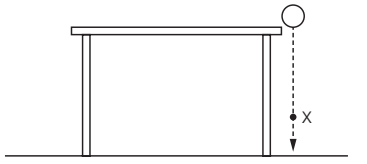
A ball is dropped from a table-top. Air resistance may be ignored.

Which row describes the velocity and the acceleration of the ball at point X

a)

acceleration = constant; velocity = constant

b)

acceleration = constant; velocity = increasing

c)

acceleration = increasing; velocity = constant

d)

acceleration = increasing; velocity = increasing
57.

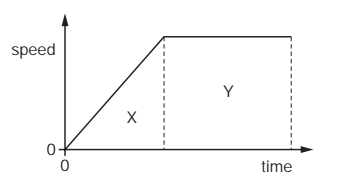
The diagram shows the speed-time graph for a car.

Which area represents the distance travelled while the car is accelerating?

a)

X

b)

X + Y

c)

Y

d)

Y - X

58.
What is the moment acting on the seesaw?
a)
1.6Nm
b)
15Nm
c)
16N
d)
4Nm
59.

A wooden bar is pivoted at its centre so that it can rotate freely. Two equal forces F are applied to the bar.

In which diagram is the turning effect greatest?

a)
b)
c)
d)
60.

A hole is drilled in a square tile. The diagram shows the tile hanging freely on a nail.

Where is the centre of mass of the tile?

a)

A

b)

B

c)

C

d)

D

61.

A balloon and a mass are attached to a rod that is pivoted at P.

The balloon is filled with helium, a gas less dense than air, so that it applies an upward force on the rod.

The rod is horizontal and stationary.

Which action causes the rod to rotate clockwise?

a)

Move both the balloon and mass 10 cm to the left.

b)

Move both the balloon and mass 10 cm to the right.

c)

Move both the balloon and mass to the 25 cm mark

d)

Move the balloon to the 20 cm mark and the mass to the 30 cm mark.

62.
Link between velocity, momentum and mass
a)
momentum = velocity x mass
b)
momentum = mass / velocity
c)
momentum = velocity / mass
d)
momentum = mass x momentum
e)
momentum = velocity / momentum
63.

A gas molecule strikes the wall of a container. The molecule rebounds with the same speed.

What happens to the kinetic energy and what happens to the momentum of the molecule?

a)

Kinetic energy changes; momentum changes

b)

Kinetic energy changes; momentum stays the same.

c)

Kinetic energy stays the same; momentum changes

d)

Kinetic energy stays the same; momentum stays the same.

64.

A tennis ball of mass 0.060 kg travels horizontally at a speed of 25 m/s. The ball hits a tennis racket and rebounds

horizontally at a speed of 40 m/s.

The ball is in contact with the racket for 50 ms.

What force does the racket exert on the ball?

a)

0.018 N

b)

0.078 N

c)

18 N

d)

78 N

65.
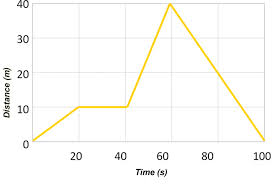
How long did it take this object to travel 10 m?
a)
0 s
b)
10 s
c)
15 s
d)
20 s
66.
What is happening from point D to E?
a)
The object is moving SLOWLY
b)
The object is moving FAST
c)
The object is decelerating
d)
The object is NOT moving
67.
This is a velocity-time graph.  What is the object doing in segment A?
a)
Positive acceleration
b)
Negative acceleration
c)
Constant Velocity
d)
Not moving
68.
A drag racer accelerated from 0 m/s to 200 m/s in 5 s.  What was the acceleration?
a)
0 m/s
b)
40 m/s2
c)
-40 m/s2
d)
40 m/s
69.
The lines represent the how the displacement of 3 cars, A, B and C, vary over 5 seconds.
Which of the 3 cars is/are at rest?
a)
A
b)
B
c)
C
d)
B & C
70.

Do molecules generally move faster at 45 C or 106 C?

a)

45 C because molecules have more energy than in 106C

b)

106 C because molecules have more energy than in 45C

c)

106 C because molecules have less energy than in 45C

d)

45C because molecules have less energy than in 106 C

71.

Specific Heat is..

a)

the temperature initial minus temperature final

b)

the amount of heat/energy required to raise 1 gram of a substance by 1°C (or K) aka "C"

c)

the temperature final minus temperature initial

d)

the item in a system with given weight in grams

72.

Define Endothermic

a)

Energy is absorbed; ΔH is negative; Going from Liquid to Gas, and Gas to Liquid

b)

Energy is released; ΔH is negative; Going from Solid to Liquid, and Liquid to Gas

c)

Energy is released; ΔH is positive; Going from Solid to Liquid, and Liquid to Gas

d)

Energy is absorbed; ΔH is positive; Going from Solid to Liquid, and Liquid to Gas

73.

Define Exothermic

a)

Energy is released; ΔH is negative; Going from Gas to Liquid, Liquid to Solid

b)

Energy is absorbed; ΔH is positive; Going from Gas to Liquid, Liquid to Solid

c)

Energy is released; ΔH is positive; Going from Solid to Liquid, Liquid to Gas

d)

Energy is absorbed; ΔH is negative; Going from Gas to Liquid, Liquid to Solid

74.
The first law of thermodynamics states that the change in the internal energy of a system is equal to the difference in energy transferred to or from the system as heat and
a)
mass
b)
work done
c)
force
d)
pressure
75.
The first law of thermodynamics is a restatement of the
a)
Zeroth law of thermodynamics
b)
law of heat addition
c)
principle of entropy
d)
conservation of energy
76.

Process B on the PV diagram is an ______________ process.

a)

adiabatic

b)

isobaric

c)

isochoric

d)

isothermal

77.

A thermodynamic system where no exchange of heat takes place between system and surrounding is...

a)

Isothermal process

b)

Adiabatic process

c)

Isobaric process

d)

Isochoric process

78.

A thermodynamic system where no exchange of heat takes place between system and surrounding is...

a)

Isothermal process

b)

Adiabatic process

c)

Isobaric process

d)

Isochoric process

79.

What is the name of the process in which pressure remains constant.

a)

Isochoric process

b)

Adiabatic process

c)

Isobaric process

d)

Isolated process

80.
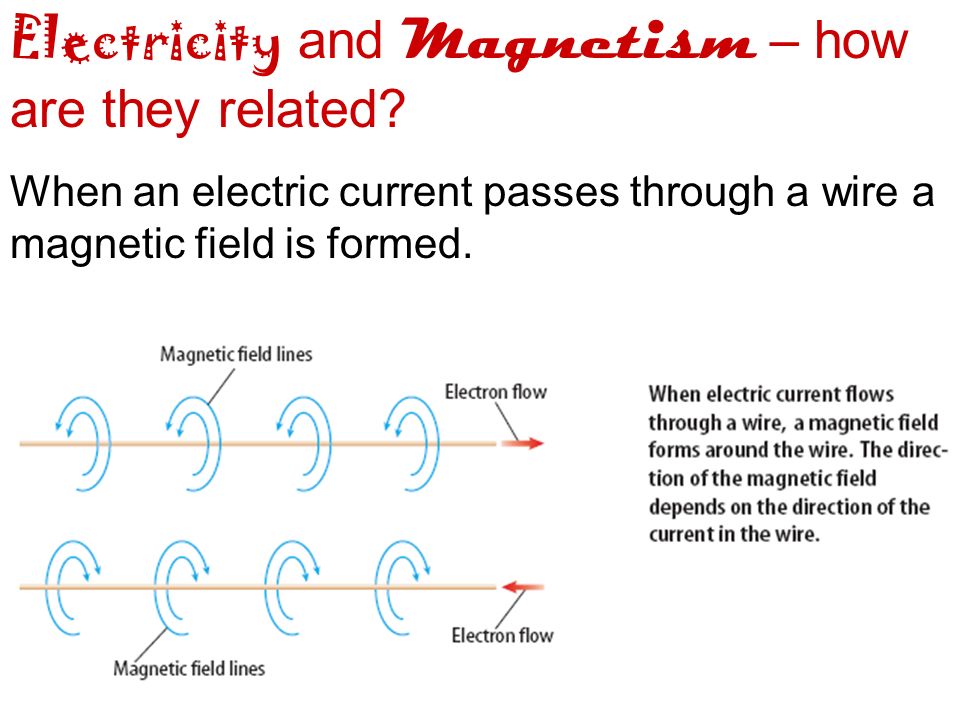
While electric current is flowing through a wire, what surrounds the wire?
a)
a magnetic field
b)
a glowing light
c)
neutrons
d)
protons
81.

What two forces are required for generators and electric motors to work?

a)

magnetism and thermal

b)

electricity and thermal

c)

electricity and magnetism

d)

magnetism and radiant

82.
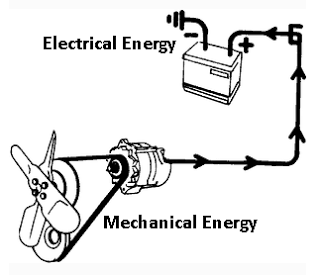
What is the transfer of electricity in a generator?
a)
Mechanical to Electrical 
b)
Physical to Potential 
c)
Electrical to Mechanical
d)
Yogurt to Light
83.
What is the transfer of electricity in a motor?
a)
chemical to mechanical 
b)
electrical to mechanical
c)
mechanical to electrical 
d)
physical to potential 
84.
This picture shows a turbine generator used to produce electricity at a geothermal power plant.
Electricity is produced by using steam to _____________.
a)
heat the turbine generators
b)
spin the turbine generators 
c)
reduce friction in the turbine generators
d)
reduce emissions from the turbine generators
85.

What would happen if you broke a bar magnet into 8 pieces?

a)

You would have 8 half magnets

b)

You would have 4 complete magnets

c)

You would have 8 complete magnets

d)

They wouldn't be magnets anymore

86.

A transformer actually transforms

a)

voltage

b)

magnetic field lines

c)

generators into motors

87.

A device that transforms mechanical energy to electrical energy is a

a)

generator

b)

motor

c)

transformer

d)

magnet

88.

A device that transforms electrical energy to mechanical energy is a

a)

generator

b)

motor

c)

transformer

d)

magnet

89.
The transformer shown is what type?
a)
step-up
b)
step-down
c)
current transformer
d)
isolation transformer
90.

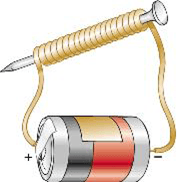
Why did this simple electric motor work?

a)

The current from the battery induces a magnetic field in the copper loop, turning it into an electromagnet that repels from/attracts to the permanent magnet

b)

The electromagnet on top of the battery pulls on the magnetic copper wire

c)

The magnet induces a current in the copper loop which makes it rotate.

d)

The magnetic field from the battery induces an electric current in the copper loop, turning it into an electromagnet that repels from/attracts to the permanent magnet

91.
An electric motor changes electrical energy to _________ energy. 
a)
mechanical 
b)
chemical
c)
potential
d)
free
92.

How are electromagnets different from permanent magnets?

a)

magnets can be turned on/off

b)

you can turn an electromagnet on/off

c)

magnets are more powerful

d)

magnets have a North and South pole

93.
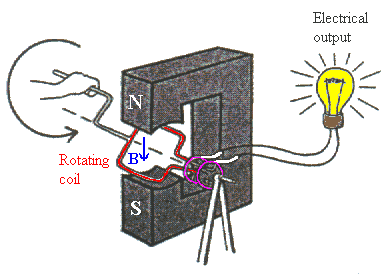
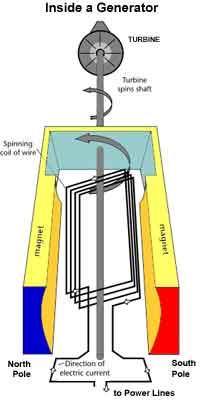
In large generators in power plants, ___________ rotate inside a coil of wire to produce an electric current.
a)
Wind
b)
Water
c)
Magnets
d)
Circuits
94.
Based on this picture, which side will have a higher voltage?
a)
Secondary
b)
Primary
c)
Both sides have the same voltage
d)
Cannot be determined
95.
A magnet is moved in and out of a coil of wire connected to a high-resistance voltmeter. If the number of coils doubles, the induced voltage 
a)
quadruples
b)
doubles
c)
is the same
d)
halves
96.

An ideal transformer has 12 V input voltage with 10 turns on the primary (input) coil, and 100 turns on the secondary coil has. What is the secondary voltage?

a)

0.12 V

b)

1.20 V

c)

12.0 V

d)

120.0 V

97.
What is the device seen here?
a)
generator
b)
electric motor
c)
electromagnet
d)
magnet
98.
When John plugs in a toy and turns it on, a marble is carried up to the top of a slide. At the top, a marble is released and it goes down a slide. What kind of energy transformation occurs to make this toy work?
a)
chemical to heat
b)
electrical to chemical
c)
sound to electrical
d)
electrical to mechanical
99.
A device that converts kinetic energy into electrical energy
a)
A. electric generator
b)
B. electric motor
c)
C. electromagnetic induction
d)
D. electricity
100.
What is the relationship between electrical current and magnetic field strength in an electromagnet?
a)
When current is increased, magnetic field strength increases
b)
When current is increased the strength of magnetic field decreases
c)
When the current is decreased, the strenght of the magnetic field is increased.
d)
There is an "indirect proportion," meaning, if the value of one goes up, the value of the other goes down.