
 Worksheets
Physics / Basic Technology
Total questions: 100
Worksheet time: 1hrs 15mins


If a glass plate is placed over a magnet and iron filings are sprinkled over the glass, a pattern will be visible. What does this pattern indicate?
The magnetic field
The electrostatic field
The piezoelectric effect
The chemical reaction of the magnet and the filings

Magnets on refrigerator cannot be turned off. Which type of magnets they belong?
electromagnets
battery
permanent magnets
copper wire
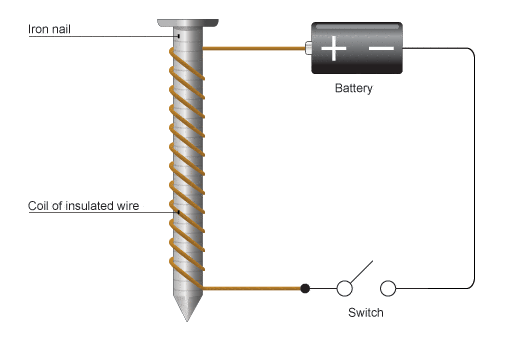
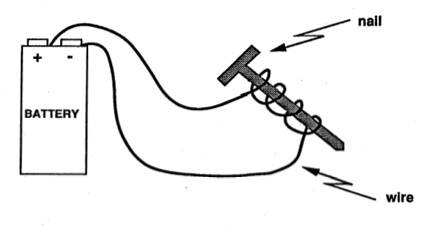
What are the components of the electromagnets?
battery, wire and bulb
battery , copper wire and plastic bottle
battery, copper wire and iron nail
battery, wire and aluminum

What would happen if you took one end of the wire off the battery?
The nail will be a magnet.
The nail would no longer be a magnet
Nothing will happened.
The nail will heats up.
How can the strength of an electromagnet be increased? (mark all that apply)
increase the current flowing through the coil
increase the number of coils
add an amplifier to it
put iron core inside the coil

Which electromagnet is stronger?
A
B
What is the definition of net force?
a push or a pull that acts on an object
Net force equal 0N and there is no change in the object's motion
the overall force acting on an object after all the forces are combined
The force does not equal 0N, the object accelerates
What do we call a force that causes an object to accelerate?
net force
moving force
acceleration force
unbalanced force

What is the magnitude and direction of the force in the free body diagram shown?
70 N right
70 N left
50 N right
50 N left

What is the magnitude and direction of the force in the free body diagram shown?
20 N, no change in motion
20 N right
20 N left
0 N , no change in motion

What is the magnitude and direction of the force in the free body diagram shown?
2000 N forward
800 N backward
1200 N forward
2800 N forward

What is the magnitude and direction of the force in the free body diagram shown?
5 N down
0 N, no change in movement
15 N up
15 N down
The sum of all forces acting on an object and direction is called the
Balanced Force
Net Force
Unbalanced Force
Contact Force
A push/pull exerted on an object is called
Force
Momentum
Speed
Net force
Forces have both ________ and direction.
Magnitude
Speed
Gravity
Height
A Newton is a unit of ______.
Acceleration
Inertia
Force
Velocity

Name the missing force.
Gravitational Force
Normal Force
Friction Force
Applied Force

Name the missing force.
Normal Force
Friction Force
Gravitational Force
Push/Pull Force

Name the missing force.
Gravitational Force
Normal Force
Tension Force
Friction Force
The force that keeps objects on top of surfaces instead of letting them sink into the surface is known as:
Normal Force
Gravitational Force
Friction Force
Air resistance

This diagram can be used to indicate which of the following? (TWO correct answers)
An object at rest
An object accelerating
An object decelerating
an object moving at a constant velocity (speed)
(Trick question -- there is only one correct answer)

Which of the following is true about this free-body diagram?
the forces are balanced
the object is moving upward
the object is free-falling
the forces are unbalanced
Newton's First Law: An object in motion will stay in motion and an object at rest will stay at (a) unless acted on by an outside force.
A leftward force is applied to a crate to push it across the floor at a constant speed. Which is the correct force diagram?


A rightward force is applied to a dresser to accelerate it to the right across the bedroom floor.


The definition of energy is
the cause for change and not produce work
the inability to do something
the ability to do work and cause change
The Law of Conservation of Energy states:
energy can be created and destroyed and changed
energy can be created but not destroyed and simply changes forms
energy cannot be created or destroyed it simply changes forms
Potential energy is best described as...
the same as electrical energy
stored or "waiting" energy
the energy of motion
another name for radiant energy
The type of energy stored in the bonds between atoms
Electrical
Chemical
Mechanical
Thermal
The energy an object has due to its position
Thermal
Kinetic
Potential
Radiant
Which of the following converts chemical energy to thermal energy.
Food is digested to regulate body temperature
A battery heats up after prolonged use.
Coal is burned to heat water.
Car engine feels warm after driving.
All of the above

Select the correct sequence of energy transformations represented in the diagram
mechanical->chemical->radiant
radiant->electrical->mechanical
mechanical->electrical->radiant
radiant->chemical->electrical
The light that comes from the sun is ________ energy.
electrical
thermal
radiant
chemical
The flow of electrons is what type of energy?
chemical
electrical
thermal
potential
burning a candle transforms into which two forms of energy
Thermal and electrical energy
Radiant and thermal energy
Nuclear and chemical energy
Chemical and radiant energy

For the picture of the roller coaster above. Which letter represents the point where the car has the most kinetic energy?
W
X
Y
Z

Identify the energy transformation which takes place during the process of photosynthesis.
Radiant->chemical
mechanical->nuclear
Potential->electrical
chemical->radiant
Two people push on a wall with 100 N. The wall doesn’t move. How much work is done?
100J
100N
0J
0N

Ahmed is out with his friends. Misfortune occurs and Ahmed and his friends find themselves getting a workout. They apply a cumulative force of 1000 N to push the car 200 m out of the sand. Determine the work done on the car.
2 x 10⁵ J
2.70 x 10⁴ J
3.2 x 10⁻⁴ J
3.54 x 10⁵ J
If 40N of force is applied to Rollo Koster's 10 kg cart over a distance of 50 meters, how much work is done?
8000J
8000N
4000J
2000J
if you push a cart with a force of 60 N for 2 m... how much work have you done
120 J
30 J
120 N
30 N
what are the elements of the rescue process?
Assess
Act
React
Rescue
What is the first thing you should do if you find an injured person?
Move the injured person to a safe place
Tell your superior
Check that you are not in danger
Ask the injured person what happened
What is the first step in assessing a rescue environment?
use all your senses when approaching and checking the rescue environment.
make sure there is no danger to you or the victim.
if it is safe conduct a primary assessment.
remove any hazard that can cause danger to you or further danger to the victim.
What is the second step in assessing a rescue environment?
use all your senses when approaching and checking the rescue environment.
make sure there is no danger to you or the victim.
if it is safe conduct a primary assessment.
remove any hazard that can cause danger to you or further danger to the victim.
What is the third step in assessing a rescue environment?
use all your senses when approaching and checking the rescue environment.
make sure there is no danger to you or the victim.
if it is safe conduct a primary assessment.
remove any hazard that can cause danger to you or further danger to the victim.
After making sure the rescue environment won’t endanger you or the victim, it’s time to conduct a (a) assessment of the victim’s condition.
The primary assessment includes the checks of the _____ priorities
RAA
ABC
DEF
WON
You must attend a formal first aid course before giving first aid to a stranger on the street
TRUE
FALSE
Which of these is NOT an aim of first aid?
Preserve Life
Protect wounds
Promote recovery
Prevent worsening
What factors should be considered when assessing the rescue environment
victim's conditions
weather conditions
hazards that may injure the rescuer
victim's conditions then your conditions
What does ABC stands for in first aid?
(a)
what are two things you have to make sure happen while doing ABC?
the tongue hasn't fallen back into the throat
check to make sure there's no liquid inside of the mouth
make sure that the patient's eyes are opened
the tongue is pointing to the top
why do rescuers do the head tilt chin lift?
so that the head is in the right position
to ensure the tongue is pointing to the top
to ensure that the tongue doesn't fall back
if there is no response from the victim the rescuer should......
ask simple questions
pinch the skin or rub a knuckle on the victim’s sternum
pinch the skin on the victim’s spine
pinch the skin or rub a knuckle on the victim’s forhead

