wayground logo

Free Printable Worksheets

Font size

S
M
L
XL
Worksheets

Weather Review

Total questions: 52

Worksheet time: 51mins
Name
Class
Date
1.
What type of storm front is this? 
a)
warm front
b)
cold front
c)
stationary front
d)
occluded front
2.
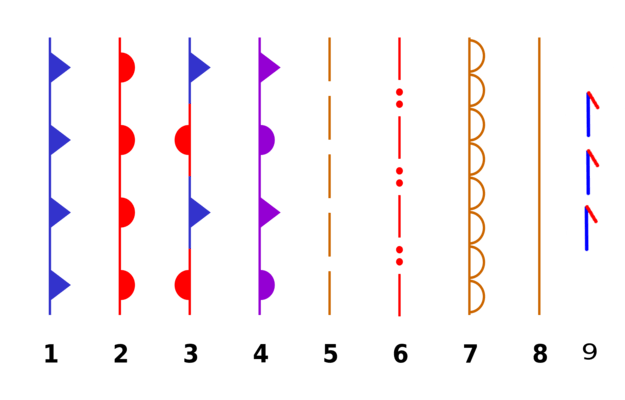
What does symbol # 3 mean?
a)
stationary front
b)
occluded front
c)
warm front
d)
cold front
3.
A front is
a)
where warm air is cooling at earth's surface
b)
a line where hot and cold air are separating
c)
a line where two different air masses meet
d)
where cold air is rising and forming rain clouds
4.
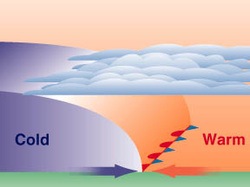
Which type of front is pictured?
a)
Cold front
b)
Warm front
c)
Occluded front
d)
Stationary front
5.
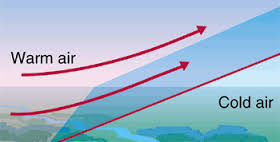
Which type of front is pictured?
a)
Cold front
b)
Warm front
c)
Occluded front
d)
Stationary front
6.
What symbol is this?
a)
warm front
b)
cold front
c)
stationary front
d)
occluded front
7.
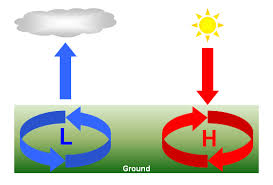
Which system results in rainy or stormy weather?
a)
high pressure
b)
low pressure
c)
hurricane
d)
weather system
8.
Which system results in drier, fairer weather?
a)
high pressure
b)
low pressure
c)
hurricane
d)
weather system
9.
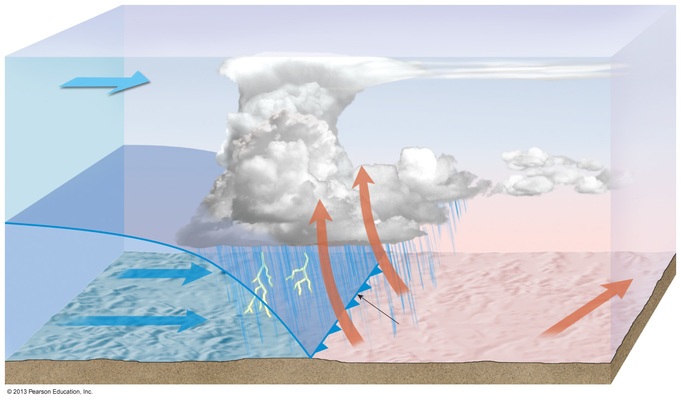
When a cold front is approaching, what happens?
a)
warm air is pushing under cold air causing humid weather and lower temperatures
b)
warm air is pushing under cold air causing humid weather and higher temperatures
c)
warm air rises, cools, and causes rain and thunderstorms
d)
cold air is pushed over warm air causing rain and thunderstorms
10.
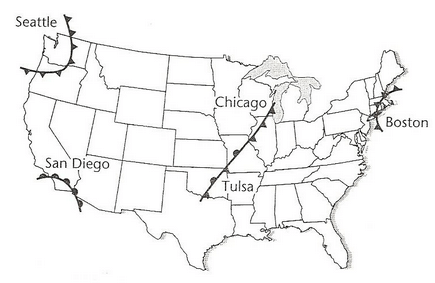
Which type of front is near Seattle?
a)
cold front
b)
warm front
c)
occluded front
d)
stationary front
11.
Which front is located near San Diego?
a)
cold front
b)
warm front
c)
occluded front
d)
stationary front
12.
Which type of front is located near Boston?
a)
warm front
b)
cold front
c)
stationary front
d)
occluded front
13.
What direction is the warm front moving on the map? 
a)
North
b)
South
c)
East
d)
West
14.
What direction is the cold front moving on the map? 
a)
Southwest
b)
Northwest
c)
Southeast
d)
Northeast
15.

Heat we feel from the sun

a)

conduction

b)

convection

c)

radiation

16.

Warm air rises above cooler air. This is an example of:

a)

conduction

b)

radiation

c)

condensation

d)

convection

17.
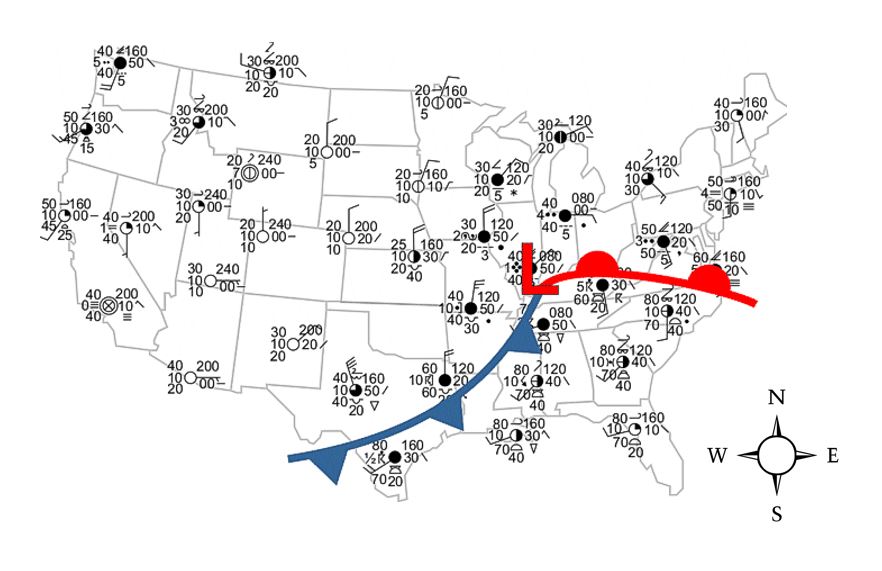
Based on the weather map, which city will most likely experience increasing temperatures during the next 24 hours? 
a)
Denver, because it is raining there
b)
Minneapolis, because a cold front is approaching
c)
Atlanta, because a warm front is approaching
d)
Houston, because it is in a high pressure area
18.
Based on the information provided in the weather map, which city shown most recently saw a drop in temperature? 
a)
Boise
b)
Denver
c)
Louisville
d)
Shreveport
19.

What is a convection current?

a)

Air that moves in an upward direction only resulting from temperature differences.

b)

Air that moves in a downward direction only resulting from temperature differences.

c)

A circulating flow of air or water resulting from temperature differences.

d)

A circulating flow of air or water resulting from temperatures that are exactly the same.

20.
What causes damage in a hurricane?
a)
Winds
b)
Flooding
c)
Storm Surge
d)
All of the above
21.
Hurricanes typically form over...
a)
cold ocean water. 
b)
tropical rain forests. 
c)
warm ocean water. 
d)
very dry land masses. 
22.
The major difference between a tropical storm and a hurricane is __________.
a)
rainfall amounts
b)
wind speed
c)
air temperature
d)
circulation
23.

Air moves from areas of ________ pressure to __________ pressure

a)

low / high

b)

high / low

c)

high / high

d)

low / low

24.
The curving of moving objects including wind, from a straight path due to Earth’s rotation.
a)
Eye
b)
Coriolis Effect 
c)
Tornado
d)
Meteorologist
25.
Where air masses meet and produce different kinds of weather.
a)
Air mass
b)
Front
c)
Relative Humidity
d)
Wind
26.
Air moving from high pressure to low pressure
a)
Wind
b)
Climate
c)
Seasons
d)
Temperate Zones
27.

An air mass is

a)

a large body of air with about the same temperature and humidity throughout

b)

the amount of moisture in the air

c)

a place where two different air masses meet

d)

a cold air mass that bumps against a warm air mass

28.

If an air mass forms above land, it will be

a)

wet

b)

dry

c)

cold

d)

hot

29.

If an air mass forms over an ocean it will be

a)

wet

b)

dry

c)

cold

d)

warm

30.

Match the correct air mass with the name below.


** M= Maritime and C= Continental, so M. tropic= Maritime tropic

17. This air mass is dry and cold.

a)

M. Tropic

b)

C. Polar

c)

M. Polar

d)

C. Arctic

e)

C. Tropic

31.

Match the correct air mass with the name below.

** M= Maritime and C= Continental, so M. tropic= Maritime tropic


18. This air mass is moist and cold.

a)

M. Tropic

b)

C. Polar

c)

M. Polar

d)

C. Arctic

e)

C. Tropic

32.

Match the correct air mass with the name below.

** M= Maritime and C= Continental, so M. tropic= Maritime tropic


19. This air mass is dry and warm.

a)

M. Tropic

b)

C. Polar

c)

M. Polar

d)

C. Arctic

e)

C. Tropic

33.

Name the correct air mass with the name below.

** M= Maritime and C= Continental, so M. tropic= Maritime tropic


20. This air mass is moist and warm.

a)

M. Tropic

b)

C. Polar

c)

M. Polar

d)

C. Arctic

e)

C. Tropic

34.
The pressure inside a hurricane is _______.
a)
High
b)
Low
35.

What is the significance of the Coriolis effect in global wind patterns?

a)

It causes winds to move in a straight line from high to low pressure.

b)

It has no significant effect on wind patterns.

c)

It causes winds to deflect to the right in the Northern Hemisphere and to the left in the Southern Hemisphere.

d)

It increases the speed of winds globally.

36.
What causes warm air to rise?
a)
the fact that it's less dense than cold air 
b)
The fact that it weighs more than cold air 
c)
The fact that it has higher pressure than cold
d)
the fact that its more dense than cold air 
37.

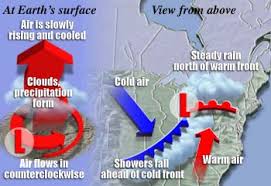
Why do you see precipitation near the L? (select 2 answers)

a)

because that is low pressure and that is where air rises, forming clouds

b)

because that is where air is falling and it brings rain with it

c)

because southern Ohio is always rainy this time of year

d)

because the cold front is meeting the warm front which forces warm air to rise rapidly forming clouds

38.

Where do warm ocean currents come from

a)

the poles

b)

near the land

c)

the equator

d)

middle of the oceans

39.

How to warm waters contribute to hurricane development

a)

evaporating water adds heat to the atmosphere

b)

rising tides cause the ocean level to rise

c)

waves cause the hurricane to develope

d)

currents carry the warm water to the hurricane

40.
Ocean currents bring warm water from the equator towards Earth's
a)
Southern Hemisphere
b)
Continents
c)
Equator
d)
Poles
41.
The warm, strong current off the coast of Florida is the 
a)
Gulf Stream
b)
California Current
c)
North Equatorial Current
d)
Brazil Current
42.

Cold air travels down and creates a/an ______ pressure system

a)

High

b)

Low

c)

Even

43.

Hot air travels up and creates a/an _____ pressure system

a)

High

b)

Low

c)

Even

44.

A strong thunderstorm followed by clear skies and a drop in temperature is the result of a _____________ moving through.

a)

warm front

b)

cold front

c)

air mass

d)

pressure front

45.

What kind of weather is a low-pressure system most likely to bring?

a)

Clear weather

b)

Hot, sunny weather

c)

Clouds and possible storms

d)

Light breezes

46.

What kind of weather is a high-pressure system most likely to bring?

a)

Clear, sunny weather

b)

Hot, sunny weather

c)

Precipitation (rain and snow)

d)

Light breezes

47.

What type of weather may occur with high pressure?

a)

clear skies and light winds

b)

temperature rising

c)

temperature dropping

d)

rainy or stormy weather and strong winds

48.

Which will most likely result from a low-pressure weather system?

a)

cloudy conditions

b)

warm temperatures

c)

cooler days

d)

clear skies

49.

Which factors would make an hurricane die? Select two.

a)

Entering colder waters

b)

Entering warmer waters

c)

lack of pressure

d)

lack of fuel (warm/humid air)

50.
Air travels in patterns around the Earth called
a)
Global Winds
b)
Local Winds
c)
Ocean Winds
d)
Blowing Winds
51.
The deflection of currents due to Earth's rotation is called the
a)
Rotation Effect
b)
Current Effect
c)
Coriolis Effect
d)
Deflection Effect
52.

The Earth's oceans are generally warmer near the equator and cooler near the poles. Currents in the water near the surface circulate the water. Some of these currents are shown in the image below. Warm currents are shown in red. Cool currents are shown in blue.


Which of the following best describes what the pictured currents do?

a)

carry warm water away from the poles

b)

carry cool water toward the poles

c)

carry warm water toward the equator

d)

carry warm water away from the equator