
 Worksheets
Mitosis/Meiosis Review
Total questions: 209
Worksheet time: 2hrs 59mins
Ends with diploid number of chromosomes
Mitosis
Meiosis
Both
Involves crossing over
Mitosis
Meiosis
Both
Chromosomes condense
Mitosis
Meiosis
Both
Produces four cells
Mitosis
Meiosis
Both
involves 1 division of nucleus
Mitosis
Meiosis
Both
produces identical daughter cells
Mitosis
Meiosis
Both
forms gametes
Mitosis
Meiosis
Both
for growth and repair
Mitosis
Meiosis
Both
involves two divisions of the nucleus
Mitosis
Meiosis
Both
produces haploid cells
Mitosis
Meiosis
Both
produces two cells
Mitosis
Meiosis
Both
produces non-identical cells
Mitosis
Meiosis
Both
begins with diploid parent cell
Mitosis
Meiosis
Both
Match the following for mitosis and meiosis.
PMAT happens once or twice
Mitosis & Meiosis
makes 4 genetically different cells
Meiosis
Sister Chromatids (already crossed over) pull apart
Anaphase 2 of Meiosis
Homologous Chromosomes pulled apart & Independent assortment
Anaphase 1 of Meiosis
makes 2 identical cells
Mitosis
2 diploid (2n) daughter cells form in what phase of Meiosis?
Telophase 2
Telophase/Cytokinesis 1
Anaphase 2
Cytokinesis 2
Which of the following are CORRECT observations about MITOSIS and MEIOSIS? (Check all that apply.)
Mitosis produces cells that identical to the parent cell.
Meiosis produces cells that have half the number of chromosomes as the parent cell.
All cells go through INTERPHASE as part of the cell cycle, whether it goes to mitosis or meiosis next.
In both types of cell division, the chromosomes are only duplicated once.
Only in Mitosis, do you see chromosomes pair up to form a tetrad.

Name this phase of Meiosis:
Prophase II
Metaphase I
Metaphase II
Anaphase II
In Anaphase II, the _________ separate.
Homologues
Sister Chromatids
Tetrads
Centrioles
how many chromosomes do human gametes have?
46
23
18
36

Crossing over usually occurs between:
Sister Chromatids
Homologous Chromosomes
Alleles
Non-Homologous Chromosomes


Name this phase of Meiosis:
Telophase I
Prophase II
Telophase II
Anaphase II

Name the phase:
Telophase I
Metaphase I
Anaphase II
Metaphase II
In Metaphase II, _________ line up on equatorial plane.
homologous pairs of chromosomes
single chromosomes (made up of 2 sister chromatids)
tetrads
centrosomes
Which part of MEIOSIS is more similar to MITOSIS?
Meiosis I
Meiosis II

Name this phase of Meiosis
Anaphase II
Anaphase I
Metaphase I
Metaphase II

In which stage of MEIOSIS does crossing over occur? (The exchange of genetic material between chromosomes in a tetrad.)
Anaphase I
Metaphase I
Prophase I
Telophase I
In which cell(s) will meiosis occur? (Check all that apply)
muscle cell
gamete
sperm cell
skin cell
Which of the following is not a stage of interphase?
Gap 1
Synthesis
Gap 2
Anaphase
Which stage facilitates cell growth and preparation for mitosis?
Interphase
Metaphase
Prophase
Anaphase
DNA is replicated in which stage?
Interphase
Prophase
Anaphase
Metaphase
During which stage(s) do cells just function as they should producing extra proteins adn forming extra organelles?
g-1 and g-2
synthesis
metaphase
telophase
What happens during synthesis?
DNA is replicated in the nucleus resulting in two identical copies of DNA.
Cells just function as they should.
DNA is replicated in the cytoplasm resulting in two different copies of DNA.
Cells are duplicated.
What are loosely packed combination of DNA and proteins (histones)?
chromatin
chromatids
chromosomes
dna
What are 1/2 of duplicated chromosome, made of condensed (packaged) chromatin?
chromatid
chromatin
chromosome
dna
What are two identical sister chromatids connected at the centromere?
chromosome
chromatid
chromatin
dna
What cell cycle process' prupose is to divide the nucleus to make 2 nuclei with identiacal DNA; split the DNA so the correct half can go in the new cell?
mitosis
meiosis
interphase
cytokinesis

What stage of the cell cycle is this?
Prophase
Anaphase
Metaphase
Telophase
Chromosomes become visible in the cell during which phase?
prophase
anaphase
telophase
cytokinesis
The nuclear membrane dissolves, spindle fibers form towards the center of the cell. and centrioles move to opposite poles of the cell during which phase?
prophase
anaphase
telophase
metaphase

Which phase of mitosis is this?
Metaphase
Anaphase
Prophase
Telophase
T or F: Metaphase is the longest phase of mitosis?
True
False
During which phase do chromosomes line up across the middle(equator) of the cell and spindle fibers connect the centromere of each chromosome?
metaphase
anaphase
telephase
cytokinesis

What phase of the cell cycle is this?
anaphase
metaphase
telephase
cytokinesis
During which phase of the cell cycle do sister chromatids separate and then pulled to opposite poles of the cell?
anaphase
metaphase
telophase
prophase


What is the NEXT phase of mitosis after the phase shown?
Prophase
Metaphase
Anaphase
Telophase


if a body cell normally has 24 chromosomes how many will it have at the end of mitosis.
6
12
24
48

In which stage of a cell's life is the nucleolus always visible?
ananphase
telophase
cytokinesis
interphase

Which phase of meiosis is this showing?
metaphase I
metaphase II
anaphase II
prophase I


What are the "X" shaped things in the drawing.
PMATs
Chromosomes
Ribosomes
Telophase
PMAT helps us remember the correct order of the phases of Mitosis. Which of the following has the phases of Mitosis in the correct Order
Interphase, Mitosis, Cytokinesis
Prophase, Metaphase, Anaphase, Prophase
Anaphase, Telophase, Prophase, Telophase
Prophase, Metaphase, Anaphase, Telophase
When the cells completely split it is call what?
Telophase
Cytokinesis
Anaphase
At the end of Meiosis 1 the cytokinesis creates what?
2 diploid cells
2 haploid cells
4 diploid cells
4 haploid cells
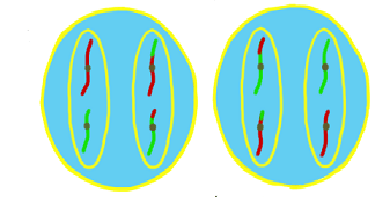
what phase am I?
Prophase II
Metaphase II
Anaphase II
Telophase II
Cytokinesis
Produces 2 daughter cells
Mitosis
Meiosis
Both
Has 2 divisions
Mitosis
Meiosis
Both
Produces body cells
Mitosis
Meiosis
Both
helps with growth
Mitosis
Meiosis
Both
Produces gametes
Mitosis
Meiosis
Both
Helps create genetic variation
Mitosis
Meiosis
Both
Crossing over occurs during Prophase I
Mitosis
Meiosis
Both
Has 1 division
Mitosis
Meiosis
Both
Produces haploid cells
Mitosis
Meiosis
Both
Makes unique cells
Mitosis
Meiosis
Both
Produces 4 daughter cells
Mitosis
Meiosis
Both
helps you heal cuts
Mitosis
Meiosis
Both
Goes through interphase one time
Mitosis
Meiosis
Both
Produces diploid cells
Mitosis
Meiosis
Both
cytokinesis occurs at the end
Mitosis
Meiosis
Both
Makes identical cells
Mitosis
Meiosis
Both
start with one parent cell
Mitosis
Meiosis
Both
Which of the statement is false about INTERPHASE?
Cell grows during interphase
DNA is replicated during S-phase
Interphase only happens in Mitosis and not Meiosis
Interphase happens once during Meiosis
1. Which process makes variation / genetic diversity possible?
a. Mitosis
b. Meiosis
c. Both
d. None
1. What is crossing over?
a. When two homologous chromosomes transfer and exchange genetic information between themselves in Prophase I
b. When two homologous chromosomes lie side by side and form tetrad.
c. When two sister chromatids transfer and exchange genetic Information in Prophase I
d. It is a process that occurs in Prophase II of Mitosis
Which one of the following is a way that Mitosis is different from Meiosis:
a. Meiosis results in 2 daughter cells, while Mitosis produces 4 daughter cells
b. Meiosis results in 4 daughter cells, while Mitosis produces 2 daughter cells
c. Cells produced by meiosis are all genetically different
d. Both b and c are correct
Through meiosis, _________are produced with one half the number chromosomes found in a body cell.
gametes
offspring
species
diploid
(a) is unique to meiosis and results in both original and new.
Chromosomes are arranged as pairs of homologous chromosomes by the end of
anaphase
prophase 1
telophase
cytokinesis
Which of the following distingiushes anaphase 1 of meiosis from anaphase of mitosis?
Chromatids separate from one another in meiosis
Nuclear membrane is not present.
Spindle fibers are attached to chromosomes.
Homologues separate from one another in meiosis.
The number of chromosomes before and after meiosis are best represented by
haploid
haploid
haploid
diploid
diploid
haploid
diploid
diploid
______refers to having one set of chromosomes.
homologous
haploid
diploid
heterozygous
The structure of a cell is related to the function of the cell.
True
False
Cell differentiation in developing embryos occurs due to
genes that are present
number of copies of each gene
genes that are active
types ofproteins produced
In a developing embryo, what process allows cells of the mesoderm to give rise to muscles, bone, and heart tissue?
cell differentiation
cell desperation
cell respiration
cell replication
If you take cell samples from the heart and the stomach of one grasshopper, they would be expected to have the same
cell shape
cell Size
metabolic rates
DNA
In multicellular organisms, different type of cells can perform different functions. This is best described as
development
growth
specialization
generalization
Smaller cells are more efficient than larger cells because they have a larger surface area to volume ratio.
True
False
After replication has taken place, DNA is two molecules each with one original strand and one new strand.
True
False
Theoretically, all cells within an organism contain the same DNA.
True
False
DNA is said to be semiconservative because
both RNA and DNA synthesis are involved
part of the telomere is lost during each round of replication
a new double helix contains one old and one new strand
What structures are in animal cell division but not plant?
membrane
spindle fibers
chromosomes
centrioles
Nervous system cells are least likely to be found dividing.
true
false
Mitosis is the division of the
cell
nucleus
cytoplasm
your mom
Which is the correct order of the Cell Cycle?
Prophase
Anaphase
Telophase
Metaphase
Interphase
Metaphase
Prophase
Anaphase
Telophase
Interphase
Prophase
Metaphase
Anaphase
Telophase
Telophase
Anaphase
Prophase
Metaphase

The diagram shows cells in the tip of an onion root that are in various stages of the cell cycle. Which stage of the cell cycle is labeled Stage Y?
Anaphase
Interphase
Metaphase
Prophase

The image shows a cell in one of the stages of mitosis. Which of the following statements correctly describes the stage of mitosis shown in the image?
The phase shown is anaphase because the copies of each chromosome are separating.
The phase shown is metaphase because the chromosomes are moving toward the center of the cell.
The phase shown is interphase because the chromosomes are duplicating their genetic information.
The phase shown is prophase because the copies of each chromosome are preparing to divide into two daughter cells.
Which of the following statements correctly describes cytokinesis?
Cytokinesis is the stage of the cell cycle when the cytoplasm of the cell divides, resulting in two daughter cells and takes place at the end of mitosis.
Cytokinesis is the stage of the cycle when the genetic information is replicated, resulting in two daughter cells and takes place after mitosis.
Cytokinesis is the stage of the cell cycle when the cytoplasm of the cell divides, resulting in two daughter cells and takes place in the beginning of mitosis.
Cytokinesis is the stage of the cycle when the genetic information is replicated, resulting in two daughter cells and takes place during mitosis.
Which of the following best describes the difference between meiosis I and meiosis II?
Meiosis I is responsible for creating four genetically unique cells and meiosis II is responsible for creating four cells that are genetically different from the parent cell.
Meiosis I is responsible for creating four genetically unique cells and meiosis II is responsible for creating two cells that are genetically different from the parent cell.
Meiosis I is responsible for creating two cells that are genetically different from the parent cell and meiosis II is responsible for creating four cells that are genetically identical to the parent cell.
Meiosis I is responsible for creating two cells that are genetically different from the parent cell and meiosis II is responsible for creating four genetically unique cells.

The image shows a cell in one of the stages of cell division. Which of the following statements correctly describes the stage in cell division shown in the image?
The cell is in prophase of mitosis because the number of chromosomes has doubled.
The cell is in prophase I of meiosis because the number of chromosomes has doubled.
The cell is in telophase I of meiosis because the cell is separating and contains replicated chromosomes.
The cell is in telophase II of meiosis because the cell is separating and contains unreplicated chromosomes.
During which phase of meiosis are sister chromatids separated and pulled to opposite sides of the cell?
telophase of meiosis I
prophase of meiosis II
anaphase of meiosis II
metaphase of meiosis I
Which stage in the cell cycle occurs only once in both mitosis and meiosis?
Cytokinesis
Interphase
Prophase
Telophase
During which phase of meiosis are homologous chromosomes separated and pulled to opposite sides of the cell?
anaphase of meiosis I
prophase of meiosis II
anaphase of meiosis II
metaphase of meiosis I
It is otherwise known as "Resting stage" because the cell is not dividing.
Interphase
prophase
metaphase
anaphase
in the cell cycle, what is the next stage after TELOPHASE (most of the time)?
Metaphase
anaphase
cytokinesis
interphase
In what stage do the chromosomes line up along the equator of the cell?
interphase
prophase
metaphase
anaphae


Structure (c) is a ____. Hint: It is one half of the X shape.
chromosome
chromatid
centromere

Name the phase:
Hint: Chromosomes are moving apart.
Anaphase
Telophase
Metaphase
Prophase


This picture shows which process? (IPMAT)
mitosis
meiosis
the cell cycle

Which phase of Mitosis is shown in the picture?
Anaphase
Metaphase
Prophase
Telophase

Select the correct description for the picture
Prophase: The cell PREPARES for cell division as chromosomes coil up.
Metaphase: Chromosomes line up in the MIDDLE
Anaphase: Chromosomes pull APART to ends of the cell.
Teleophase: Chromosomes unwind and start to form TWO new cells.

Pick the correct description for the picture
Teleophase: Chromosomes unwind and start to form TWO new cells.
Anaphase: Chromosomes pull APART to ends of the cell.
Metaphase: Chromosomes line up in the MIDDLE
Prophase: The cell PREPARES for cell division as chromosomes coil up.

Select the correct description for the picture
Prophase: The cell PREPARES for cell division as chromosomes coil up.
Metaphase: Chromosomes line up in the MIDDLE
Anaphase: Chromosomes pull APART to ends of the cell.
Teleophase: Chromosomes unwind and start to form TWO new cells.

What phase of Mitosis is shown in the picture?
Prophase
Interphase
Metaphase
Telophase

What stage of Mitosis does this picture represent?
Prophase
Metaphase
Anaphase
Telophase

Select the correct description of the picture
Prophase: The cell PREPARES for cell division as chromosomes coil up.
Anaphase: Chromosomes pull APART to ends of the cell.
Teleophase: Chromosomes unwind and start to form TWO new cells.
Metaphase: Chromosomes line up in the MIDDLE

What stage does the picture represent?
Prophase
Metaphase
Anaphase
Telophase

What phase of Mitosis represents the picture?
Prophase
Metaphase
Telophase
Cytokinesis

What phase of Mitosis does the picture represent?
Metaphase
Anaphase
Cytokinesis
Telophase

Interphase
Prophase
Metaphase
Anaphase
Telophase

Prophase
Metaphase
Anaphase
Telophase
Interphase

Interphase
Prophase
Metaphase
Anaphase
Telophase

Interphase
Prophase
Metaphase
Anaphase
Telophase

Interphase
Prophase
Metaphase
Anaphase
Telophase
what is G1 in the stages of the cell cycle?
DNA synthesis
growth and preparation for mitosis
growth
cell division
what is the part of the cell cycle that synthesizes a copy of DNA within the nucleus
M phase
Cytokinesis
G2
S phase
what is common in the G1 and G2 phases in the cell cycle?
both have growth
both parts of interphase
prepares for mitosis
copies organelles
which best describes the G2 phase
the spindles form, the chromatin condenses into chromosomes, centrioles assist with spindles as well as the nuclear envelope breaks down.
double checks the duplicated chromosomes for any errors as well as more cell growth, production of protein and organelles and prepares for mitosis.
the cytoplasm of each cell is divided into two new cells.
where does mitosis take place with prophase, metaphase, anaphase, and telophase?
M phase
S phase
G1
G2
which phase in the cell cycle where there is two new cells?
M phase
Cytokinesis
S phase
G1 phase
which are the ones that mitosis includes?
eukaryotic cell
a single cell divides into 2 daughter cells (identical)
growth
replace worn-out cells
what is one part of the prophase in mitosis?
chromatin condenses into chromosomes
shortest phase
sister chromatids pull apart
chromosomes unfold back into chromatin
select all that apply that check off for metaphase in mitosis
sister chromatid pairs line up in the middle of the cell
the shortest phase
spindle fibers attach to the centrosomes of each sister chromatid pair
sister chromatids pull apart
anaphase concludes of what?
the sister chromatids pull apart and the individual chromosomes are pulled to the opposite side of the cell
the new nuclear envelope forms as well the chromosomes unfold back into chromatin and the nucleoli reappear
telophase is when the nucleoli reappear, the new nuclear envelope forms, and the chromosomes unfold back into chromatin?
yes
no
select all that apply for cytokinesis
happens at the same time as telophase
division of the cytoplasm and organelles
the plant cell membrane is pulled inward
animal cell, cell plant forms and develops cell membranes then cell wall forms between 2 membranes
what is the difference between prophase in meiosis and in mitosis?
condense and duplicated chromosomes
chromosomes begin to uncoil
homologous pairs become zipped together and crossing over occurs
resulting in four daughter cells
what is the difference between metaphase 1 and metaphase in meiosis and mitosis?
tetrads align at the center
sister chromatids separate during anaphase
sister chromatids separate and move to the opposite sides
the end result of two diploid daughter cells
what are the differences between anaphase and anaphase 1?
homologus chromsomes move to the opposite sides of the cell
chromatids move to the opposite of the cell
centromeres divide
occurs in diploid cells
what are the differences between telophase 1 and telophase?
sister chromatid seperate
homologus chromsomes seperate during anaphase
sister chromatin stay together during separating
which are the correct anwsers for the differences for for mitosis and meosis 2?
there is no interphase
prophase 2
no dna replication
what is the difference between prophase 2 and prohpase 1
chromatin is already condensed into chromsomes
no crossovers
occurs in diploid cells
occurs in haploid cell
which are the correct possilbe characteristics of cancer?
uncontrolled growth
divison of cells
start anywhere in the body
growing and multiplying when not told to do so
why can't a cell grow indefintely?
because of the protein signals telling the cell to grow
caused by mutations
the cells are not programmed to
What stage of interphase does DNA replication occur?
G1
S
G2

What do the blue and yellow arrows represent
The blue arrow is prophase and the yellow is interphase
The blue arrow is mitosis and the yellow arrow is meiosis
The blue arrow is interphase and the yellow is mitosis
The blue arrow is meiosis and the yellow is prophase

Crossing over occurs during prophase I of meiosis. Which statement about crossing over is true?
RNA translation occurs in the smooth endoplasmic reticulum
Crossing over takes place in backterial cells
Crossing over produces genetically identical daughter cells
Crossing over provides genetic diversity in eukaryotic cells
Embryonic cells each have an identical copy of DNA. If the DNA in all cells is identical, how do the embryonic cells become specialized (ex: Muscle cell, brain cell, liver cell, etc)
Each cell contains only the active parts of the DNA needed for the cell type
Each cell type has only one chromosome containing the DNA needed for that cell type
Each cell has an identical copy of DNA with enzymes controlling the expression of specific genes, leading to cell variety
If a person has leukemia, they are given a medicine that inhibits (stops) DNA synthesis. Which phase of the cell cycle will be most affected by this medicine?
G1
S
G2
M phase
Which of the following are in order from smallest to largest
Cells -> tissue -> organ -> organ system
Cells -> Organ system -> tissue -> organ
Organ system -> Organ -> Tissue -> Cell
Tissue -> organ system -> Cell -> Organ

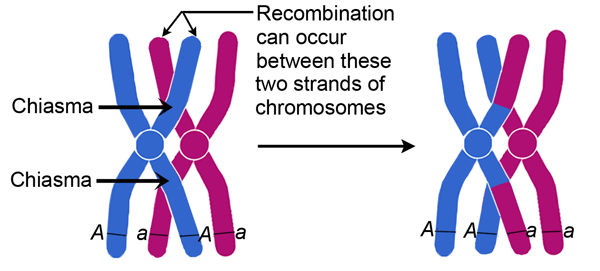
What does the image demonstrate
Punnet squares
Crossing over
Metaphase
Dna replication
During prophase I crossing over occurs and genetic material is exchanged between homologous chromosomes. How is this important
Increases genetic variation
Reduces the diploid number to the haploid number
Increases the haploid number to the diploid number
Reduces the probability of mutations
In mitosis, one parent cell -
Forms two identical daughter cells
Forms four identical daughter cells
Forms two genetically diverse daughter cells
Forms four genetically diverse daughter cells
G1, S, and G2 are all phases of
Mitosis
Meiosis
Interphase
Prophase
What stage of interphase does DNA replication occur?
G1
S
G2
What do the blue and yellow arrows represent
The blue arrow is prophase and the yellow is interphase
The blue arrow is mitosis and the yellow arrow is meiosis
The blue arrow is interphase and the yellow is mitosis
The blue arrow is meiosis and the yellow is prophase
Crossing over occurs during prophase I of meiosis. Which statement about crossing over is true?
RNA translation occurs in the smooth endoplasmic reticulum
Crossing over takes place in backterial cells
Crossing over produces genetically identical daughter cells
Crossing over provides genetic diversity in eukaryotic cells
Embryonic cells each have an identical copy of DNA. If the DNA in all cells is identical, how do the embryonic cells become specialized (ex: Muscle cell, brain cell, liver cell, etc)
Each cell contains only the active parts of the DNA needed for the cell type
Each cell type has only one chromosome containing the DNA needed for that cell type
Each cell has an identical copy of DNA with enzymes controlling the expression of specific genes, leading to cell variety
If a person has leukemia, they are given a medicine that inhibits (stops) DNA synthesis. Which phase of the cell cycle will be most affected by this medicine?
G1
S
G2
M phase
Which of the following are in order from smallest to largest
Cells -> tissue -> organ -> organ system
Cells -> Organ system -> tissue -> organ
Organ system -> Organ -> Tissue -> Cell
Tissue -> organ system -> Cell -> Organ
What does the image demonstrate
Punnet squares
Crossing over
Metaphase
Dna replication
During prophase I crossing over occurs and genetic material is exchanged between homologous chromosomes. How is this important
Increases genetic variation
Reduces the diploid number to the haploid number
Increases the haploid number to the diploid number
Reduces the probability of mutations
In mitosis, one parent cell -
Forms two identical daughter cells
Forms four identical daughter cells
Forms two genetically diverse daughter cells
Forms four genetically diverse daughter cells
G1, S, and G2 are all phases of
Mitosis
Meiosis
Interphase
Prophase

