wayground logo

Free Printable Worksheets

Font size

S
M
L
XL
Worksheets

Ap bio CA exam Review part 2

Total questions: 181

Worksheet time: 10hrs 28mins

Name
Class
Date
1.
The three stages of cell signalling are
a)
paracrine, local, and synaptic
b)
reception, transduction, and response
c)
transcription, translation, and folding
d)
alpha, beta, and gamma
2.
A signal molecule that binds to a plasma-membrane protein is a
a)
ligand
b)
second messenger
c)
protein kinase
d)
receptor protein
3.
Which of the following is a chemical message that usually travels through the bloodstream to target cells?
a)
hormone
b)
local regulator
c)
endocrine cell
4.

In response to a signal begin received a cell may ________.

a)

Grow and divide

b)

Survive

c)

Die

d)

All of the above

5.

In the signal transduction pathway the signal is passed though the cytoplasm via....

a)

Extracellular signalling molecules

b)

Effector proteins

c)

Receptor proteins

d)

Intracellular signalling molecules

6.

Cyclic AMP is synthesised by adenyl cyclase and degraded by ......

a)

Phospholipase C

b)

PKA

c)

cyclic AMP phosphodiesterase

d)

cyclic AMP phospholipase C

7.

Signalling molecules fall into 2 classes based on what?

a)

Size and charge

b)

Size only

c)

Charge only

d)

Chain length

8.

Which of the following are differences in the structure between RNA and DNA

a)

DNA uses deoxyribose sugar, RNA uses sugar ribose

b)

DNA pairs Adenine with Uracil, RNA pairs Adenine with Thymine

c)

DNA is a double helix, RNA is a single helix

d)

DNA pairs Adenine with Thymine, RNA pairs Adenine with Uracil

9.

During transcription, this type of ribonucleic acid is responsible for copying the DNA and brining it out of the nucleus.

a)

tRNA

b)

mRNA

c)

rRNA

d)

dRNA

10.

During translation, this type of ribonucleic acid is responsible for delivering amino acids to help make a protein.

a)

mRNA

b)

rRNA

c)

tRNA

d)

dRNA

11.

mRNA occurs during this process

a)

Translation

b)

Transcription

c)

Replication

d)

Delivery

12.
This is the triplet of bases on the end of a tRNA molecule
a)
Anticodon
b)
Codon
c)
Protein
13.
The function of ______ is to combine with proteins to form ribosomes.
a)
rRNA
b)
tRNA
c)
mRNA
d)
DNA
14.
The process where mRNA is read and made into an amino acid chain.
a)
Transcription
b)
Translation
c)
Transportation
d)
Transient
15.
What is the three base sequence of mRNA that codes for a single amino acid?
a)
Anticodon
b)
Codon
c)
Protein
16.
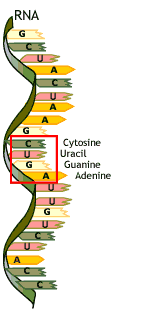
The principle shown in the image is called what?
a)
Transcription
b)
The Central Dogma
c)
Translation
d)
The Principle of Proteins
17.
In RNA, Uracil pairs with ______. 
a)
cytosine
b)
adenine
c)
guanine
d)
thymine
18.
DNA holds the code for
a)
lipids
b)
carbohydrates
c)
protein
d)
sugar
19.

This enzyme is capable of breaking Hydrogen bonds found between the bases of DNA

a)

Topoisomerase

b)

DNA Helicase

c)

DNA Polymerase

d)

Exonuclease

20.
What is the purpose of DNA replication?
a)
Cut the DNA 
b)
Make more cells
c)
Apoptosis
d)
Duplicate the DNA
21.
Which enzyme seals okazaki fragments together on the lagging strand?
a)
Topoisomerase
b)
Helicase
c)
Polymerase
d)
Ligase
22.
What do we call DNA replication since new DNA has 1 parent strand and 1 new strand?
a)
Conservative 
b)
Semiconservative 
c)
Dispersive
23.

This enzyme is capable of breaking Hydrogen bonds found between the bases of DNA

a)

Topoisomerase

b)

DNA Helicase

c)

DNA Polymerase

d)

Exonuclease

24.

This enzyme is used to remove short RNA bases

a)

Topoisomerase

b)

DNA Helicase

c)

Exonuclease

d)

Telomerase

25.
What is the purpose of DNA replication?
a)
Cut the DNA 
b)
Make more cells
c)
Apoptosis
d)
Duplicate the DNA
26.
Which enzyme seals okazaki fragments together on the lagging strand?
a)
Topoisomerase
b)
Helicase
c)
Polymerase
d)
Ligase
27.
What do we call DNA replication since new DNA has 1 parent strand and 1 new strand?
a)
Conservative 
b)
Semiconservative 
c)
Dispersive
28.
What is the backbone of DNA made of?
a)
Nitrogen bases
b)
Amino acids
c)
Double H
d)
Sugar & Phosphate
29.
Why is it crucial that living things are able to replicate their DNA?
a)
Each cell must have its own DNA
b)
Less copies of DNA are needed when a new cell is created
c)
A cell needs multiple copies of DNA
d)
Only muscle cells need DNA 
30.
Which enzyme is responsible for adding nucleotides?
a)
Topoisomerase
b)
DNA Polymerase
c)
Ligase
d)
Primase
31.

The separation of the two single strands of DNA creates a ‘Y’ shape?

a)

enzyme

b)

unzip

c)

A replication fork

32.

This enzyme helps helicase unzip DNA by relieving supercoiling

a)

Topoisomerase

b)

Exonuclease

c)

DNA Primase

d)

DNA Polymerase

33.

This enzyme is responsible for creating telomeres added to the ends of DNA

a)

Topoisomerase

b)

Telomerase

c)

DNA Helicase

d)

DNA Primase

34.

This enzyme synthesizes short RNA sequences to guide DNA Polymerase

a)

Primers

b)

DNA Primase

c)

DNA Polymerase

d)

Topoisomerase

35.

What is the LAST step of the completion of DNA replication?

a)

Telomeres are added to ends of DNA

b)

Ligase glues Okazaki fragments

c)

DNA polymerase proofreads

d)

Topoisomerase relieves supercoiling

36.

Which enzyme is responsible for checking DNA for errors, and fixing it?

a)

DNA Polymerase

b)

DNA Primase

c)

DNA Helicase

d)

RNA Polymerase

37.

In what direction does the Leading strand run?

a)

3' ----> 5'

b)

5' -----> 3'

c)

It doesn't matter

d)

Both directions

38.

Each DNA molecule created contain one NEW strand and one OLD strand

a)

True

b)

False

39.

Okazaki fragments are found on the _______________ strand

a)

Leading

b)

Lagging

40.

This enzyme ONLY works in one direction which is 5'------> 3'

a)

DNA Polymerase

b)

DNA Helicase

c)

Topoisomerase

d)

Telomerase

41.

What is the LAST enzyme used in DNA replication

a)

Topoisomerase

b)

Telomerase

c)

DNA Polymerase

d)

DNA Ligase

42.

Okazaki fragments are unified into a single continuous strand by the use of this enzyme

a)

DNA Helicase

b)

DNA Ligase

c)

Topoisomerase

d)

Telomerase

43.
Why is it crucial that living things are able to replicate their DNA?
a)
Each cell must have its own DNA
b)
Less copies of DNA are needed when a new cell is created
c)
A cell needs multiple copies of DNA
d)
Only muscle cells need DNA 
44.
Which enzyme is responsible for adding nucleotides?
a)
Topoisomerase
b)
DNA Polymerase
c)
Ligase
d)
Primase
45.

The separation of the two single strands of DNA creates a ‘Y’ shape?

a)

enzyme

b)

unzip

c)

A replication fork

46.

This enzyme helps helicase unzip DNA by relieving supercoiling

a)

Topoisomerase

b)

Exonuclease

c)

DNA Primase

d)

DNA Polymerase

47.

This enzyme synthesizes short RNA sequences to guide DNA Polymerase

a)

Primers

b)

DNA Primase

c)

DNA Polymerase

d)

Topoisomerase

48.

In what direction does the Leading strand run?

a)

3' ----> 5'

b)

5' -----> 3'

c)

It doesn't matter

d)

Both directions

49.

Okazaki fragments are found on the _______________ strand

a)

Leading

b)

Lagging

50.

Okazaki fragments are unified into a single continuous strand by the use of this enzyme

a)

DNA Helicase

b)

DNA Ligase

c)

Topoisomerase

d)

Telomerase

51.

What stage in the cell cycle is this?

a)

Telophase

b)

Prophase

c)

Anaphase

d)

Metaphase

52.

What stage of the cell cycle is this?

a)

Interphase G1

b)

Cytokinesis

c)

Telophase

d)

Prophase

53.

What happens during the S phase of Interphase?

a)

The nucleus disappears

b)

The DNA replicates

c)

The organelles double

d)

The cell grows and does its normal functions

54.

What happens during the G1 phase of Interphase?

a)

The nucleus disappears

b)

The DNA replicates

c)

The organelles double

d)

The cell grows and does its normal functions

55.

What stage in the cell cycle is this?

a)

S

b)

G1

c)

G2

d)

Prophase

56.

What happens during cytokinesis?

a)

The nucleus disappears

b)

The cell membrane divides

c)

The DNA divides

d)

Two new nuclei form

57.

During prophase

a)

DNA lines up in the middle of the cell and DNA attaches to spindle fibers

b)

DNA condenses into chromosomes, centrioles and spindle fibers appear

c)

2 new identical cells are created

d)

DNA gets copied

58.

During anaphase

a)

DNA lines up in the middle of the cell and DNA attaches to spindle fibers

b)

centrioles and spindle fibers appear

c)

Each DNA gets pull to the opposite sides of the cell

d)

DNA gets copied

59.

What part of the cell cycle is considered interphase? Select all that apply.

a)

G1

b)

G2

c)

S

d)

M

60.

Which statement is NOT true about interphase?

a)

It's the longest phase of the cell cycle

b)

During interphase organelles duplicate

c)

During interphase, DNA replicates

d)

During interphase, the chromatin condenses into chromosomes.

61.
Why would it be important to replicate DNA before a cell divides in mitosis or meiosis?
a)
In order for genetic information to be transferred into daughter cells.
b)
In order for the cell to be able to increase in size.
c)
In order for the DNA to be contained in the nucleus.
d)
In order for the cell to re-order the DNA sequencing in the new cells.
62.

Centrioles form _______ during Prophase

a)

Spindle Fibers

b)

Chromosomes

c)

Sister Chromatids

d)

Chromatin

63.
What phase is this?
a)
Interphase II
b)
Prophase I
c)
Metaphase I
d)
Anaphase II
64.
What phase is shown here?
a)
Prophase II
b)
Metaphase I
c)
Metaphase II
d)
Anaphase I
65.
What phase is shown here?
a)
Anaphase II
b)
Metaphase I
c)
Anaphase I
d)
Telophase II
66.
What phase is shown here?
a)
Metaphase II
b)
Telophase I
c)
Telophase II
d)
Metaphase I
67.
What phase is shown here?
a)
Anaphase I
b)
Prophase I
c)
Metaphase II
d)
 Metaphase I
68.
What phase is shown here?
a)
Telophase I
b)
Metaphase II
c)
Telophase II
d)
Anaphase I
69.

Which phase of meiosis is shown in the picture?

a)

Prophase II

b)

Metaphase II

c)

Telophase I

d)

Telophase II

70.

Which phase of meiosis does the picture on the left happen?

a)

prophase I

b)

prophase II

c)

metaphase I

d)

telophase II

71.
The brain or "control center" of the cell. 
a)
Mitochondria
b)
Cell Membrane
c)
Cytoplasm
d)
Nucleus
72.

Protective outermost layer of animal cells:

a)

Cell Membrane

b)

Nucleus

c)

Chromatin

d)

Microtubules

73.

What is the function of a chloroplast?

a)

makes proteins for animal cells

b)

allows materials in and out of the cell

c)

provides structure and support

d)

absorbs sunlight for photosynthesis

74.

Identify the structure that is indicated by the arrow in the image.

a)

cell wall

b)

central vacuole

c)

chloroplast

d)

cell membrane

75.

The arrow is showing the fluid inside the cell that surrounds the cell organelles and gives the cell its shape. What is the arrow pointing to in the cell?

a)

cytoplasm

b)

mitochondria

c)

ribosomes

d)

nucleus

76.

What organelle is this??

a)

cell wall

b)

chloroplast

c)

mitochondria

d)

nucleus

e)

cell membrane

77.
All living things are made of...
a)
atoms 
b)
cells 
c)
bacteria 
d)
plants 
78.

If many of the ribosomes of a cell were destroyed, what effect would this most likely have on the cell?

a)

The cell would not be able to create energy.

b)

The cell would not be able to make proteins.

c)

The cell would not e able to photosynthesize.

d)

The cell would not be able to break down waste in the cell.

79.

The arrow is showing the fluid inside the cell that surrounds the cell organelles and gives the cell its shape. What is the arrow pointing to in the cell?

a)

cytoplasm

b)

mitochondria

c)

ribosomes

d)

nucleus

80.
What is a substance called if it speeds up a chemical reaction?
a)
reusable
b)
catalyst
c)
specific
d)
fragile
81.
With what 3 letters do enzymes typically end?
a)
-ose
b)
-ase
c)
-ese
d)
-tic
82.

Enzymes are an example of

a)

Lipids

b)

Carbohydrate

c)

Protein

d)

Nucleic Acid

83.
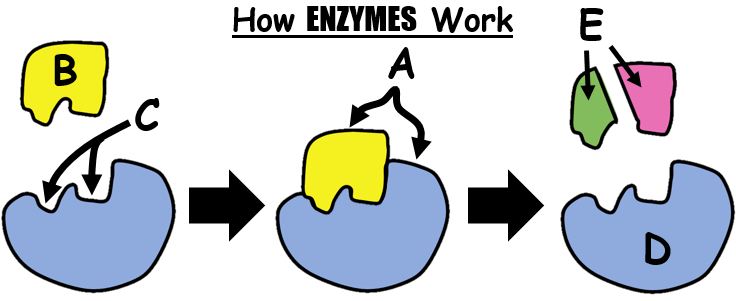
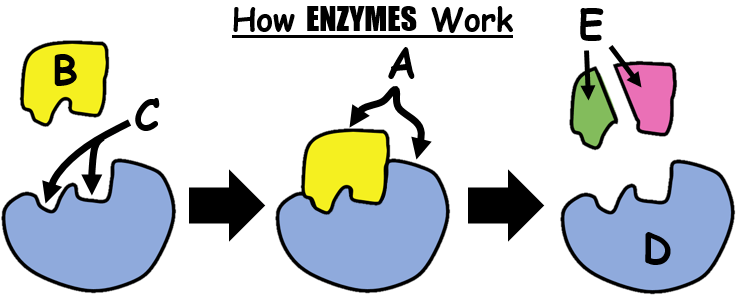
In the diagram, what is letter A? 
a)
product
b)
substrate
c)
enzyme-substrate complex
d)
active site
84.
Letter D...
a)
active site
b)
enzyme
c)
substrate
d)
products
85.
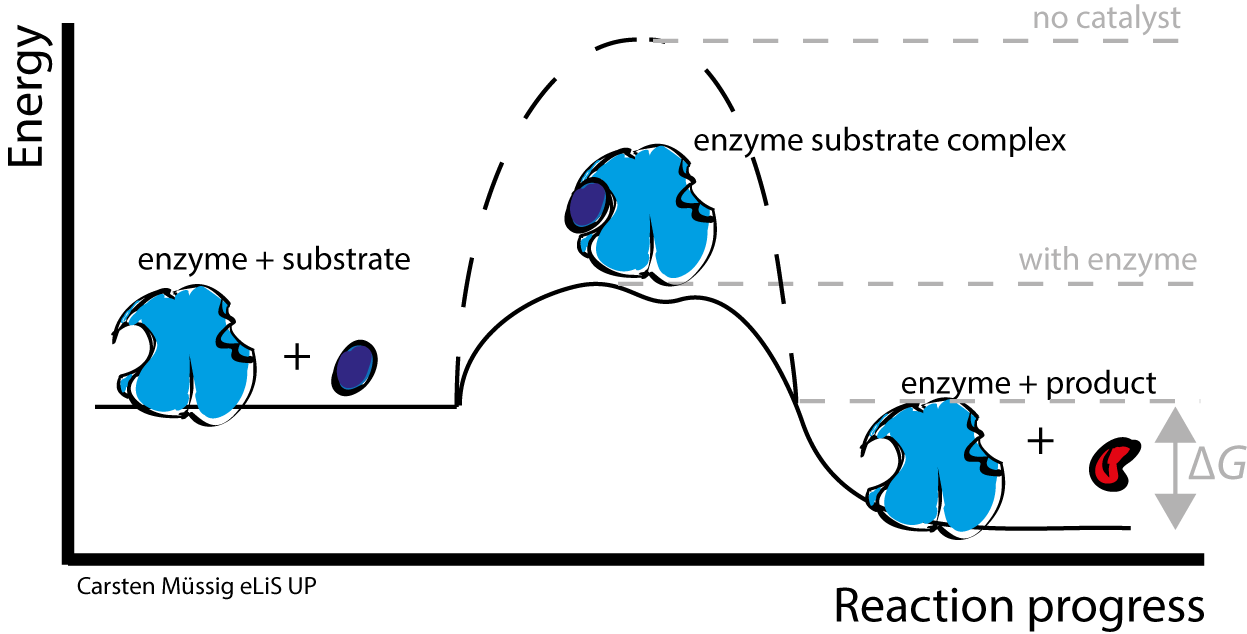
An enzyme speeds up a reaction by
a)
lowering the activation energy.
b)
raising the activation energy.
c)
releasing energy.
d)
absorbing energy.
86.

Each enzyme only has 1 substrate that will fit its active site.  What is this called?

a)

reusable

b)

catalyst

c)

fragile

d)

specific

87.

What happens when enzymes are heated to a high temperature?

a)

The shape of the enzyme are changed and it denatures

b)

The enzymes die

c)

The enzymes' amino acid sequence changes

d)

The enzymes remain the same

88.

Absorbs energy

a)

endothermic reaction

b)

exothermic reaction

89.

Releases energy

a)

endothermic reaction

b)

exothermic reaction

90.

Slows down reaction

a)

temperature

b)

pH

c)

cataysts

d)

competitive inhibitor

91.
In pea plants, the trait for tall stems is dominant over the trait for short stems. If two heterozygous tall plants are crossed, what percentage of the offspring would be expected to have the same phenotype as the parents?
a)
100%
b)
75%
c)
50%
d)
25%
92.
The observable traits of an organism are known as its
a)
allele
b)
dominance
c)
phenotype
d)
genotype
93.
In snapdragons, Tallness (T) is dominant to dwarfness (t). In a cross between two plants that are homozygous for the recessive allele, the percent of offspring expected to exhibit tallness is
a)
 25%
b)
 75%
c)
100%
d)
0%
94.
The gene makeup of an organism for a particular trait is known as its
a)
dominance
b)
phenotype
c)
allele
d)
genotype
95.

A tool used to predict the probability of offspring inheriting certain traits is called a ...

a)

karyotype

b)

Punnett Square

96.

Cross 2 heterozygous tall pea plants. Tall (T) is dominant to short (t). What fraction of the offspring do you predict will be tall?

a)

1/4

b)

2/4

c)

3/4

d)

4/4

97.

In pea plants, tall (T) is dominant over short (t). If two heterozygous tall pea plants are mated, what is the the expected genotypic ratio of their offspring?

a)

3 tall : 1 short

b)

1 TT : 2 Tt : 1 tt

98.
What are the possible genotypes for this cross?
a)
TT = 25% Tt= 50% tt=25%
b)
all tall
c)
TT= 75% tt = 25%
d)
Tt = 100%
99.
Cross Two Homozygous plants
(
RRYY x rryy)
R = round seeds, r  = wrinkled seeds Y = yellow seeds, y = green seeds
What percent will have Round and Yellow seeds? 
a)
0%
b)
25%
c)
50%
d)
100%
100.
What is the genotype for a pea plant heterozygous for round seeds (R), and homozygous recessive for green seeds (y)?
a)
Ry
b)
RRyy
c)
RrYy
d)
Rryy
101.

In mice black fur color (B) is dominant over brown fur color(b).In a cross between two heterozygous mice

(Next 2 questions will be about this information)

a. what is the probability of a black male mouse?

a)

1/2

b)

1/4

c)

3/4

d)

3/8

102.

In pea plants tall stems(T) are dominant over short stems(t) and round seeds(R) are dominant over wrinkled seeds(r). Consider the following cross: TtRr X Ttrr

Next 4 questions will be about this information. Please take notes.


a. Find the number of possible phenotypes

a)

2

b)

4

c)

6

d)

8

103.

What type of inheritance do two alleles have if their traits blend together?

a)

Incomplete Dominance

b)

Co-Dominance

c)

Mendelian Inheritance (Complete Dominance)

d)

Homozygous Inheritance

104.

In Andalusian fowls, black individuals (BB) and white individuals (WW) are homozygous. Heterozygous individuals are grey (BW).

What is the genotype ratio for a cross between a grey fowl and a white fowl?

a)

2 BB: 2 BW: 0 WW

b)

0 BB: 4 BW: 0 WW

c)

0 BB: 2 BW: 2 WW

d)

1 BB: 2 BW: 1 WW

105.

In human genetics, brown eyes (B) are dominant over blue eyes (b). A brown-eyed man is heterogeneous (Bb). He marries a blue-eyed woman. What is the probability of their child having blue eyes?

a)

100%

b)

75%

c)

25%

d)

50%

106.

In a pedigree, which shape represents a male?

a)

circle

b)

square

107.

On a pedigree, this symbol represents a ----

a)

not affected male.

b)

not affected female.

c)

affected male.

d)

affected female.

108.

How many alleles does a person carry for a trait?

a)

1

b)

2

c)

3

d)

4

109.

How many alleles does a child get from each parent for a trait?

a)

1

b)

2

c)

3

d)

4

110.
What do we use pedigrees for?
a)
To look at families
b)
To make determinations about the offspring
c)
To track traits in families
d)
Nothing
111.

In a pedigree, which shape represents a male?

a)

circle

b)

square

112.

On a pedigree, this symbol represents a ---

a)

not affected female.

b)

not affected male.

c)

affected male.

d)

affected female.

113.

On a pedigree, this symbol represents a ----

a)

not affected male.

b)

not affected female.

c)

affected male.

d)

affected female.

114.

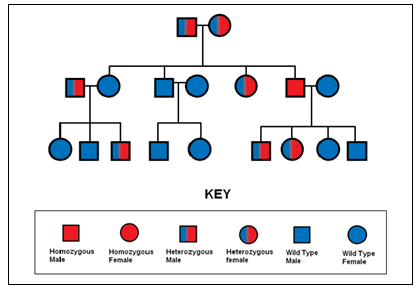
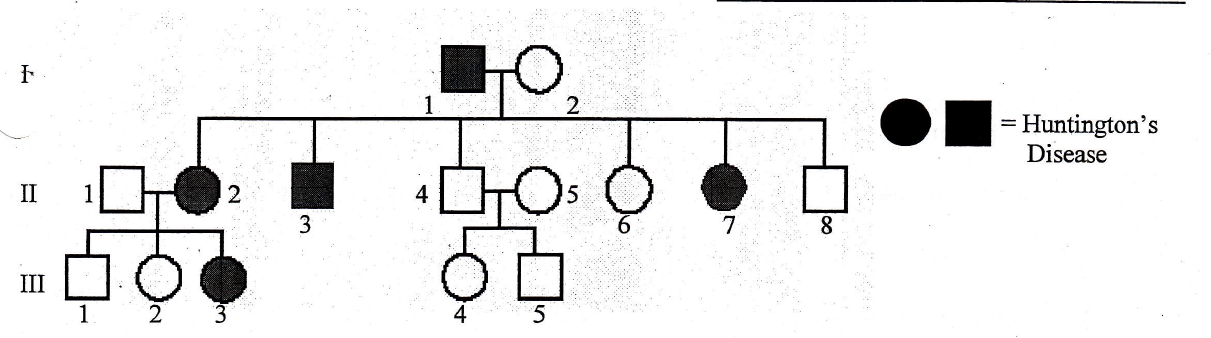
How many individuals are there in the 3rd generation?

a)

1

b)

2

c)

4

d)

6

115.

How are individuals III-2 and II-4 related?

a)

Brother and sister

b)

Dad and daughter

c)

Uncle and niece

d)

Grandfather and granddaughter

116.

The trait this pedigree traces is recessive because it skips a generation and individuals can be carriers. What is the most likely genotype for person III-3?

a)

GG

b)

Gg

c)

gg

117.
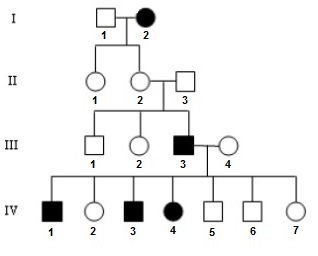
If this pedigree shows an autosomal recessive disorder, what MUST the genotype of individual II-3 be?
a)
HH
b)
Hh
c)
hh
d)
None of the above
118.

If this pedigree shows a recessive disorder, what MUST the genotype of individual 4 be?

a)

HH

b)

Hh

c)

hh

119.
How many kids did the mother and father from the first generation have?
a)
2
b)
4
c)
5
d)
6
120.
There are no carriers for Huntington's Disease- you either have it or you don't. Is Huntington's disease caused by a dominant or recessive trait?
a)
Dominant
b)
Recessive
121.
How are individuals I-2 and III-5 related?
a)
Grandpa and grandson
b)
Mom and son
c)
Uncle and nephew
d)
Grandma and grandson
122.
This pedigree represents the inheritance of hemophilia in this family. How many of the females have the hemophilia trait?
a)
8
b)
5
c)
2
d)
3
123.
Huntington's Disease is a dominant trait.
What is the correct genotype for individual I-2?
a)
HH
b)
Hh
c)
hh
d)
H_
124.
Does this pedigree show a dominant or recessive trait?
a)
Dominant
b)
Recessive
125.
What is the genotype of the mother?
a)
BB
b)
bb
c)
Bb
d)
BB or Bb
126.
What is the genotype of the father?
a)
AA
b)
aa
c)
Aa
d)
AA or aa
127.

Generation 2 individuals 5 and 6 are

a)

brother and sister.

b)

cousins.

c)

married.

d)

not related.

128.

Pass through cell cycle checkpoints no matter what.

a)

cancerous cells

b)

normal cells

c)

apoptosis

d)

tumors

129.

Can redirect blood to feed a tumor

a)

apoptosis

b)

cytokinesis

c)

cancer cells

d)

epidermal cells

130.

What does this depict?

a)

meiosis

b)

mitosis

c)

apoptosis

d)

cell function

131.

The rungs on the DNA ladder are made of

a)

sugar

b)

phosphate

c)

nitrogen bases

d)

deoxyribose

132.

What is the name of the signaling molecule in cell communication?

a)

ligand

b)

receptor

c)

operon

d)

inhibitor

133.

Choose the correct order of communication.

a)

reception, response, transduction

b)

transduction, reception, response

c)

response, transduction, reception

d)

reception, transduction, response

134.

All cells have the same response to the same signal.

a)

True

b)

False

135.

Adrenaline is released from your adrenal glands to affect various systems in the body. This is an example of ____ signaling.

a)

synaptic

b)

endocrine

c)

paracrine

d)

autocrine

136.

Which are two widely used second messengers?

a)

cAMP

b)

RTK's

c)

Ca2+

d)

sodium

137.

Which kind of receptors are seen here?

a)

G-coupled protein receptor

b)

RTK's

c)

Gated ion channels

138.

Phosphorylation cascades are often used for

a)

reception

b)

responses

c)

amplification

d)

termination

139.

Programmed cell death is known as

a)

mutation

b)

termination

c)

cytokinesis

d)

apoptosis

140.

Which of the following can activate a protein by transferring a phosphate group to it?

a)

cAMP

b)

G-protein

c)

protein kinases

d)

phosphatases

141.

What is the first step of apoptosis?

a)

the organelles fragment

b)

the cell is engulfed by a scavenger

c)

the DNA is destroyed

d)

The cell blebs

142.

After a cellular response, how is it terminated?

a)

separate the ligand and receptor

b)

block the transduction pathway

c)

it will keep responding

d)

send out a different signal

143.

Communication between neighboring/touching cells is common in plants.

a)

True

b)

False

144.

Ions diffusing through the ligand-gated ion channel is a form of...

a)

ATP

b)

Endocytosis

c)

Active transport

d)

Facilitated diffusion

145.
Which of the following sequences of processes correctly reflects the central dogma?
a)
protein synthesis, transcription, translation
b)
protein synthesis, translation, transcription
c)
transcription, translation, protein synthesis
d)
translation, transcription, protein synthesis
146.
Which do DNA and RNA have in common?
a)
Both are double stranded.
b)
Both contain ribose molecules.
c)
Both contain phosphate groups.
d)
Both contain uracil.
147.
What process is shown in the illustration below?
a)
commensalism
b)
deletion
c)
passive transport
d)
replication
148.
Are all mutations bad?
a)
Yes
b)
No
149.
Any change in the sequence of DNA is...
a)
transgenic shift
b)
Single Genotype
c)
Monohybrid Trait
d)
Mutation
150.
DNA has a ______ strand; RNA has a ______ strand.
a)
double/double
b)
double/triple
c)
double/single
d)
single/single
151.
Assembles RNA during transcription
a)
RNA Polymerase 
b)
Mutations
c)
Gene Expression
d)
Point Mutation
152.
In analyzing the number of different bases in a DNA sample, which result would be consistent with the base-pairing rules?
a)
A = G
b)
A + G = C + T
c)
A + T = G + G
d)
A = C
153.
In his work with pneumonia-causing bacteria & mice, Griffith found that 
a)
the protein coat from pathogenic cells was able to transform nonpathogenic cells.
b)
heat-killed pathogenic cells caused pneumonia.
c)
some substance from pathogenic cells was transferred to nonpathogenic cells, making them pathogenic.
d)
the polysaccharide coat of bacteria caused pneumonia.
154.
What is the basis for the difference in how the leading and lagging strands of DNA molecules are synthesized?
a)
DNA polymerase can join new nucleotides to the 3' end of the preexisting strand.
b)
Helicases and single-strand binding proteins work at the 5' end.
c)
The origins of replication occur only at the 5' end.
d)
DNA ligase works only in the 3' to 5' direction
155.
In analyzing the number of different bases in a DNA sample, which result would be consistent with the base-pairing rules?
a)
A = G
b)
A + G = C + T
c)
A + T = G + G
d)
A = C
156.
The elongation of the leading strand during DNA synthesis 
a)
progresses away from the replication fork.
b)
occurs in the 3' to 5' direction.
c)
produces Okazaki fragments
d)
depends on the action of DNA polymerase
157.
In a nucleosome, the DNA is wrapped around
a)
polymerase molecules.
b)
ribosomes.
c)
histones.
d)
a thymine dimer.
158.
E. coli cells grown on N-15 medium are transferred to N-14 medium and allowed to grow for 2 more generations.  DNA extracted from these cells is centrifuged.  What density distribution of DNA would you expect in this experiment?
a)
one high-density and one low-density band
b)
One intermediate-density band
c)
one high-density and one intermediate-density band
d)
one low-density and one intermediate-density band
159.
A student isolates, purifies, and combines in a test tube a variety of molecules needed for DNA replication.  After adding some DNA to the mixture, replication occurs, but each DNA molecule consists of a normal strand paired with numerous segments of DNA a few hundred nucleotides long.  What has the student probably left out of the mixture?
a)
DNA polymerase
b)
DNA ligase
c)
Okazaki fragments
d)
primase
160.
In eukaryotic cells, transcription cannot begin until 
a)
the two DNA strands have completely separated and exposed the promoter.
b)
several transcription factors have bound to the promoter.
c)
the 5' caps are removed from the mRNA.
d)
the DNA introns are removed from the template.
161.
Which of the following is NOT true of a codon?
a)
It may code for the same amino acid as another codon.
b)
It never codes for more than one amino acid.
c)
It extends from one end of a tRNA molecule.
d)
It is the basic unit of the genetic code.
162.
The anticodon of a particular tRNA molecule is 
a)
complementary to the corresponding mRNA codon.
b)
complementary to the corresponding triplet in rRNA.
c)
the part of tRNA that bonds with a specific amino acid.
d)
catalytic, making the tRNA a ribozyme.
163.
Which component is NOT directly involved in translation?
a)
GTP
b)
DNA
c)
tRNA
d)
ribosomes
164.
Which of the following mutations would be MOST likely to have a harmful effect on an organism?
a)
a deletion of three nucleotides near the middle of a gene.
b)
a single nucleotide deletion in the middle of an intron.
c)
a single nucleotide deletion near the end of a coding sequence.
d)
a single nucleotide insertion downstream of, and close to, the start of the coding sequence.
165.
In a nucleosome, the DNA is wrapped around
a)
polymerase molecules.
b)
ribosomes.
c)
histones.
d)
a thymine dimer.
166.
The anticodon of a particular tRNA molecule is 
a)
complementary to the corresponding mRNA codon.
b)
complementary to the corresponding triplet in rRNA.
c)
the part of tRNA that bonds with a specific amino acid.
d)
catalytic, making the tRNA a ribozyme.
167.
Which of the following mutations would be MOST likely to have a harmful effect on an organism?
a)
a deletion of three nucleotides near the middle of a gene.
b)
a single nucleotide deletion in the middle of an intron.
c)
a single nucleotide deletion near the end of a coding sequence.
d)
a single nucleotide insertion downstream of, and close to, the start of the coding sequence.
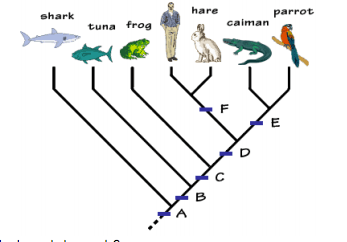
168.
On the cladogram, which organism is the closest relative of the human?
a)
Frog
b)
Hare
c)
Caiman
d)
Parrot
169.
If green is dominant over purple, then what is the genotype for this individual?
a)
Purple
b)
Green
c)
GG
d)
gg
170.
Which of the following terms refers to the different possibilities of a gene?
a)
chromosome
b)
DNA
c)
Punnett Squares
d)
allele
171.
A phenotype is the...
a)
letter combination
b)
dominant gene
c)
recessive gene
d)
physical appearance
172.
Which factor can affect the epigenome?
a)
nutrition
b)
exercise
c)
stress 
d)
all of these factors can affect the epigenome
173.
Protein molecules around which DNA is tightly coiled in chromatin
a)
Histones
b)
Whey
c)
Casein
d)
Hemoglobin
174.

The study of changes in organisms caused by modification of gene expression rather than alteration of the genetic code itself

a)

hypogenomics

b)

epigenetics

c)

microgenomics

d)

none of these

175.

Which of these can cause a gene to be expressed more - that is, can cause more protein to be made from it?

a)

removal of methyl groups from the DNA

b)

loosening of how tight the DNA is coiled around histones

c)

both of these are correct

176.

True or False: Epigenetic changes are permanent.

a)

True

b)

False

177.
At what stage in the life of identical twins is the epigenome expected to be most similar?
a)
Age 6 months
b)
Age 21
c)
Age 55
d)
Trick quesiton; the epigenome never changes
178.

A chemical modification of DNA that does not affect the nucleotide sequence of a gene but makes that gene less likely to be expressed.

a)

activators

b)

methylation

c)

acetylation

d)

proteins

179.

Every cell has a copy of every gene

a)

True

b)

False

180.

All genes are expressed in every cell

a)

True

b)

False

181.

Which factor can affect the epigenome?

a)

Diet

b)

Exercise

c)

Stress

d)

Aging