
 Worksheets
US - SIM Review 2 - 23
Total questions: 50
Worksheet time: 25mins

**EXPLORATION**
-
Spain - claimed Florida, Texas, California; searched for gold and built missions to spread their culture
France - claimed Louisiana territory and made money by trading beaver fur
-
European countries sent explorers across the Atlantic Ocean to -
gain wealth in the "new world"
spread their religion and culture to the "new world"
expand their empire by claiming land in the "new world"
ALL of these are correct

**COLONIZATION**
-
New England - fishing, lumbering, shipbuilding
Middle Colonies - farming wheat and other grains
Southern Colonies - cash crops and the slave trade
-
Which PEGS category would this information fit into?
P - Political
E - Economic
G - Geographic
S - Social

**COLONIZATION**
-
Puritans - wanted to escape persecution in England
Catholics - settled in Maryland to practice their beliefs peacefully
Quakers - settled in Pennsylvania, started the first anti-slavery group
-
All three of these groups came to the "new world" to find ___ freedom.
religious
economic
political
ALL of these are correct

**COLONIZATION**
-
Several of the New England colonies [like Rhode Island, founded by Roger Williams] were established to provide a place -
where people could practice their religion freely
that could be filled with England's debtors and non-violent criminals
where settlers could grow tobacco and cotton
that could peacefully trade with local Native Americans

**REVOLUTION**
-
Which of these protest cries showed the American colonists' anger over British taxes and laws that they didn't agree with? [hint: the British did NOT have the "consent of the governed"]
"No taxation without representation!"
"Don't tread on me!"
"No way! We won't pay! Come again some other day!"
"Just say no!"

**REVOLUTION**
-
In 1776, Thomas Jefferson wrote the Declaration of Independence. In it, he listed the "unalienable rights" as Life, ____ , and the Pursuit of Happiness.
Liberty
Health
Education
Responsibility

**REVOLUTION**
-
The First Continental Congress gathered in Philadelphia to discuss a unified resistance and send grievances to England after Boston Harbor was shut down in the -
Intolerable Acts
Stamp Act
Sugar Act
NONE of these are correct

**CONSTITUTION**
-
Which principle of government establishes the idea that each branch has power over the other branches [to make sure that no one branch becomes too powerful]?
checks and balances
federalism
popular sovereignty
republicanism

**CONSTITUTION**
-
1st = freedom of religion, speech, press, etc.
4th = no unreasonable search and seizure
6th = right to a trial by jury
8th = no cruel or unusual punishments
10th = powers belonging to the states
-
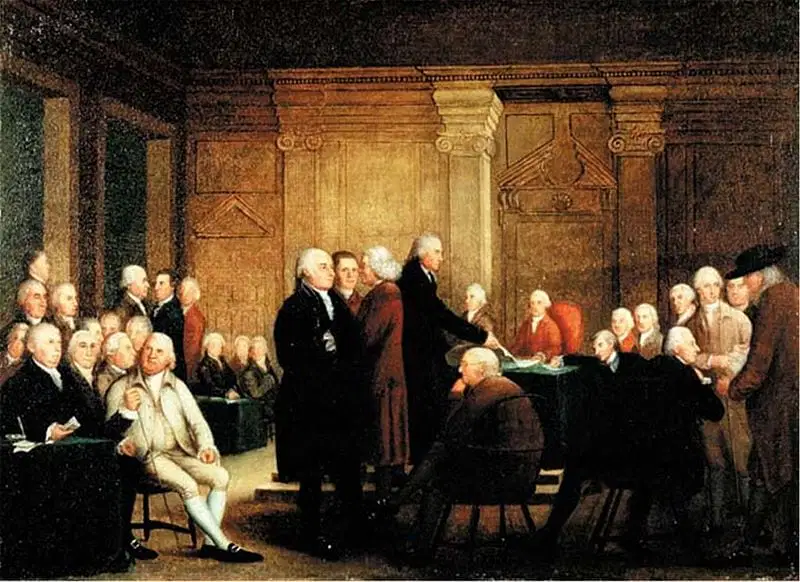
If the federal government performs illegal surveillance on you by tracking your cell phone, they have violated the -
6th amendment
1st amendment
4th amendment
8th amendment
**CONSTITUTION**
-
What the the first government created in the U.S.? [hint: it didn't last long; it could negotiate treaties and declare war, but had no executive branch and could not raise taxes]
the Declaration of Independence
the Articles of Confederation
the Fundamental Orders of Connecticut
the Virginia House of Burgesses

**CONSTITUTION**
-
Which of these items established a way for territories to govern themselves until they reached a population of 60,000 and could become states in the U.S.?
the Northwest Ordinance
the Northeast Law
the Southeast Act
the Southwest Provision

**EARLY REPUBLIC**
-
Which of the following was part of Alexander Hamilton's financial plan for fixing the U.S. economy?
establish a National Bank
pass a tax on whiskey
pay off the debts from the Revolutionary War
ALL of these are correct

**EARLY REPUBLIC**
-
During the presidency of John Adams, many of the American people were angered when Adams signed the ____ [which they felt violated the 1st Amendment protection of 'freedom of speech'].
Alien and Sedition Acts
No Free Speech Laws
New Rules on Government
Adams Policy

**EARLY REPUBLIC**
-
What name is given to the U.S. policy warning European countries not to colonize or interfere in the affairs of countries in the Western Hemisphere? [hint: it basically told Europe to stay on its own side of the world]
the Monroe Doctrine
the Madison Policy
the Jefferson Law
the Adams Rule

**EARLY REPUBLIC**
-
Which of these choices is a CAUSE of the War of 1812 that was fought between the U.S. and Great Britain?
British impressment of U.S. sailors
the discovery of gold in the U.S.
the U.S. wanted to expand into British territory located in Canada
the British wanted to reclaim control over their original 13 colonies

**AGE OF JACKSON**
-
The Hudson River School focused on -
painting the natural beauty of the American landscape
science, technology, engineering and math
history, literature, philosophy, and psychology
courses of higher learning, such as law or medicine

**AGE OF JACKSON**
-
Nullification Crisis
-
Which state nullified [ignored] the Tariff of Abominations and threatened to secede from the U.S. if it was enforced by the federal government? [hint: this state backed down when President Jackson threatened to use force against them]
Texas
Georgia
South Carolina
Tennessee

**AGE OF JACKSON**
-
*Worcester v. Georgia - Supreme Court case that ruled the Cherokees couldn't be forced off their homelands.
-
What did President Jackson tell Georgia to do about the ruling?
President Jackson didn't tell Georgia to do anything
President Jackson told Georgia to obey the ruling and leave the Cherokees alone
President Jackson told Georgia to ignore the ruling and remove the Cherokees anyway

**AGE OF JACKSON**
-
"Jacksonian Democracy" saw voting rights expanded during this time period when -
women were given the right to vote
it was no longer required to own property in order to vote
the government lowered the voting age from 30 to 25
NONE of these are correct

**INDUSTRIALIZATION**
-
Many immigrants from ___ came to the U.S. to escape a potato famine. They were a source of cheap labor, and often found jobs in factories or working on the Transcontinental Railroad.
Ireland
Germany
Sweden
Norway

**INDUSTRIALIZATION**
-
What did the telegraph allow people to do?
communicate rapidly over long distances
move more goods at a faster rate
vote in elections every four years
clean clothes faster then ever before

**INDUSTRIALIZATION**
-
What did many women do during this time period that contributed to an increase in "urbanization"?
they got jobs working in textile mills [in the city]
they moved to farms and ranches [in the west]
they went to college [mostly in the east]
they voted in elections [even though it was illegal]

**INDUSTRIALIZATION**
-
Which of these best summarizes the economic system known as "free enterprise"?
privately-owned businesses compete for profits
the government owns all businesses and keeps all profits
all business profits are shared equally among the citizens of the country
NONE of these are correct

**REFORM ERA**
-
The "Transcendentalism" movement was founded by Ralph Waldo Emerson and led by Henry David Thoreau. It focused on man's relationship to nature and the idea that -
ideal societies can exist if people are self-reliant and rise above corrupt society
slavery should be allowed to exist anywhere in the world
all women should be allowed to vote, own property, attend college, and serve on juries
prisons and mental health facilities could do a better job taking care of the mentally ill

**REFORM ERA**
-
Led by Elizabeth Cady Stanton, Susan B. Anthony, and Lucretia Mott, the biggest "women's rights" issue during this time period was fighting for the right to -
vote
own property
serve on a jury
attend college

**WESTWARD**
-
Look at the map provided. Which letter represents the area known as "Oregon Territory"? [hint: the U.S. acquired this land after negotiations with Great Britain]
B
C
A
E

**WESTWARD**
-
Where was gold discovered in 1848 that caused a HUGE population boom as people rushed to the area to get rich? [hint: in addition to gold prospectors, this area also saw an increase in immigrants from China, many of whom worked on the Transcontinental Railroad]
California
Oregon
New York
Florida

**WESTWARD**
-
What conflict was caused by a boundary dispute [stemming from the annexation of Texas in 1845] and caused by President Polk's desire to achieve "manifest destiny"?
the U.S.-Mexican War
the War of 1812
the American Revolution
the Civil War
**INDUSTRIALIZATION**
-
Which of these innovations [created by Eli Whitney] resulted in a more efficient way to make goods? [hint: it led to mass production and decreased prices of goods]
Bessemer steel process
barbed wire
interchangeable parts
mechanical reapers
**CONSTITUTION**
-
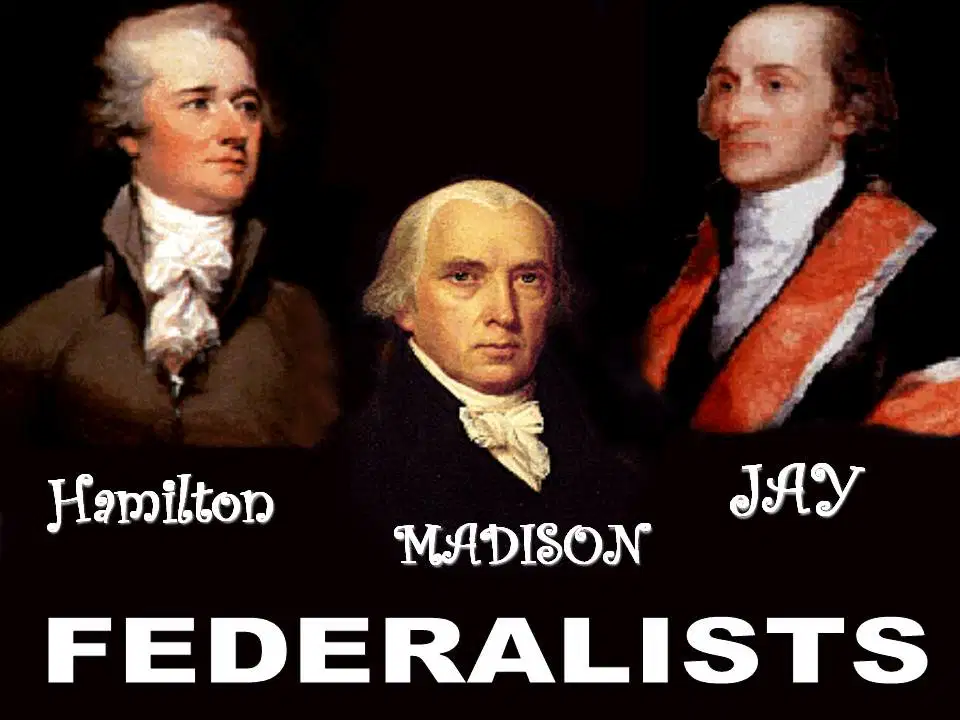
Led by Alexander Hamilton, James Madison, and John Jay, the FEDERALISTS wanted to approve the Constitution because they believed it created a more stable union. Their opponents were the ___ who believed the Constitution needed a "bill of rights" to protect the freedoms of American citizens.
REPUBLICANS [John Adams and Thomas Jefferson]
ANTI-FEDERALISTS
[Patrick Henry and George Mason]
DEMOCRATS [George Washington and James Monroe]
INDEPENDENTS [Benjamin Franklin and Thomas Paine]

**SECTIONALISM**
-
In the 1840s and 1850s, the different regions of the country were separated by _____ .
geography - the different climates and landforms of each region
economy - different activities that created jobs and money for citizens of each region
culture - the different ways of living that fit the needs of the citizens in each region
ALL of these are correct

**SECTIONALISM**
-
*Northern Economy = factories, textile mills, cheap labor
* Southern Economy = ? ? ? ? ? ? ? ? ? ?
*Western Economy = mining for gold, farming wheat and grains
cash crops on plantations, slave labor
fishing, lumbering, and ship-building
ranching cattle, horses, goats, and pigs
NONE of these are correct

**SECTIONALISM**
-
The Fugitive Slave Law involved -
capturing escaped slaves and returning them to the South
helping escaped slaves find jobs in the North
forcing escaped slaves to live in Canada
NONE of these are correct

**SECTIONALISM**
-
What is the name of the agreement that saw California enter the U.S. as a "free state" and the passage of a strict "Fugitive Slave Law"?
the Compromise of 1850
the Kansas-Nebraska Act
the Northwest Ordinance
The Cooperative Agreement

**SECTIONALISM**
-
What happened as a result of the Kansas-Nebraska Act?
the population of Kansas increased rapidly, and violence broke out between those FOR and AGAINST slavery [known as "Bleeding Kansas"]
the legislative branch of government was separated into two parts: a Senate and a House of Representatives
all trade between the U.S. and foreign nations was stopped [to protect our ships and our sailors] and the U.S. economy was nearly destroyed
the U.S. doubled in size, and a huge amount of land became available for people to move into

**SECTIONALISM**
-
In the Supreme Court case _____ v. Sanford, the court ruled that slaves were property [not citizens of the U.S.], and therefore had no rights to petition the government for anything.
Dred Scott
Worcester
Marbury
Douglass

**CIVIL WAR**
-
Look at the graph provided. According to the graph, which side had the resource advantage during the Civil War?
the Union had more resources
the Confederacy had more resources
the two sides had the same amount of resources
that information is NOT on this graph

**CIVIL WAR**
-
Midway through the war, President Abraham Lincoln issued a message of freedom for slaves in the south. This message weakened the Southern economy and gave the Union soldiers a moral reason to keep fighting. It was known as -
the Emancipation Proclamation
the Northwest Ordinance
the Nullification Crisis
the Compromise of 1850

**CIVIL WAR**
-
Which of these Civil War battles was a turning point victory for the Union? [hint: General Grant was able to take control of the Mississippi River and divide the Confederacy in half]
the Battle of Antietam
the Battle of Vicksburg
the Battle of Gettysburg
the Battle of Bull Run

**CIVIL WAR**
-
Where did the Civil War end? [hint: this is where Confederate General Robert E. Lee surrendered to Union General Ulysses S. Grant]
Washington D.C.
San Antonio, Texas
Appomattox Court House, Virginia
Gettysburg, Pennsylvania

**RECONSTRUCTION**
-
The time period after the Civil War when the Southern states were rebuilt and gradually brought back into the Union was known as -
Reconstruction
Revolution
Regeneration
Renaissance

**RECONSTRUCTION**
-
Which of these groups took control of Reconstruction after President Lincoln's death and worked to punish the former Confederacy for causing the Civil War?
Radical Republicans
Dynamic Democrats
Intellectual Independents
Fancy Federalists

**RECONSTRUCTION**
-
During Reconstruction, many of the Southern states enacted laws that restricted the rights of former slaves. These laws were known as -
Black Codes
Slave Laws
Rules of the South
Reconstruction Rules

**RECONSTRUCTION**
-
What was the name of the government agency that was created during Reconstruction to provide former slaves with food, clothing, education, and jobs?
the Freedmen's Bureau
the Salvation Army
the Helping Hands
the First Aid Stations

**RECONSTRUCTION**
-
Which "Reconstruction Amendment" is the one that officially abolished slavery in the U.S.?
13th Amendment
14th Amendment
15th Amendment
16th Amendment

**RECONSTRUCTION**
-
Which "Reconstruction Amendment" is the one that gave citizenship rights to former slaves?
13th Amendment
14th Amendment
15th Amendment
16th Amendment

**RECONSTRUCTION**
-
Which "Reconstruction Amendment" is the one that gave former slaves the right to vote?
13th Amendment
14th Amendment
15th Amendment
16th Amendment

**RECONSTRUCTION**
-
Hiram Rhodes Revels was the first African American -
from the South to be elected to U.S. Congress
to attend a four-year university
to serve on the U.S. Supreme Court
to be awarded the Medal of Honor

**RECONSTRUCTION**
-
Which U.S. President was impeached for his actions during Reconstruction?
Andrew Johnson
Hannibal Hamlin
James K. Polk
Ulysses S. Grant

**RECONSTRUCTION**
-
Which of these terms is used to describe people who work land owned by someone else in exchange for a portion of the crop that is grown?
carpetbaggers
freedmen
sharecroppers
scalawags

