wayground logo

Free Printable Worksheets

NEW

Font size

S
M
L
XL
Worksheets

Bio Final Review

Total questions: 70

Worksheet time: 1hrs 13mins

Name
Class
Date
1.

Name the phase pictured here:

a)

Anaphase of mitosis

b)

Anaphase I of meiosis

c)

Anaphase II of meiosis

2.

The end result of mitosis is

a)

4 Identical Cells are produced

b)

4 genetically different cells are produced

c)

2 identical cells are produced

d)

2 genetically different cells are produced

3.

The end result of meiosis is...

a)

4 identical cells

b)

4 genetically different cells

c)

2 identical cells

d)

2 genetically different cells

4.

How many chromosomes do the daughter cells have in mitosis?

a)

23

b)

46

c)

2

d)

4

5.

How many chromosomes do the daughter cells have in meiosis?

a)

23

b)

46

c)

2

d)

4

6.

If an organism reproduces asexually, its offspring will most likely be...

a)

genetically identical to the parent

b)

genetically different from each other

c)

produced from specialized cells known as gametes

d)

A mutant

7.

What is the correct order for the phases of mitosis?

a)

Prophase, Anaphase, Telophase, Metaphase

b)

Anaphase, Telophase, Prophase, Metaphase

c)

Telophase, Anaphase, Prophase, Metaphase

d)

Prophase,

Metaphase, Anaphase, Telophase

8.

Timmy fell off his skateboard and scraped his knee. Which cell process is going to be used to heal the wound?

a)

Mitosis

b)

Meiosis

c)

The wound would not heal

d)

Cell diffusion

9.

How many divisions are in meiosis?

a)

46

b)

23

c)

2

d)

4

10.

Which phase of mitosis do the chromosomes line up in the middle of the cell?

a)

Anaphase

b)

Metaphase

c)

Telophase

d)

Prophase

11.

Which of the following characteristics (traits) can be inherited?

a)

curly hair

b)

beautiful handwriting

c)

multiplying numbers

d)

playing a piano

12.

Genotype or phenotype: freckles

a)

genotype

b)

phenotype

13.

Genotype or phenotype: Rr

a)

genotype

b)

phenotype

14.

Which is heterozygous?

a)

WW

b)

Yy

c)

qq

d)

TT

15.

Which is homozygous recessive?

a)

ee

b)

Hh

c)

PP

d)

Vv

16.

How much does each box in the punnet square account for?

a)

25%

b)

50%

c)

75%

d)

100%

17.

What percent of the offspring are hybrids?

a)

25%

b)

50%

c)

75%

d)

100%

18.

Green (G) is dominant over yellow (g). What percent of the offspring will be Green?

a)

0%

b)

25%

c)

50%

d)

100%

19.

When two hybrids are crossed, what percent of the offspring will show the weaker recessive trait?

a)

25%

b)

50%

c)

75%

d)

100%

20.
What is the sugar in DNA called?
a)
Deoxyribose
b)

Ribose

c)
Diglyceride
d)

Cellulose

21.
Adenine pairs with...
a)
Thymine
b)
Cytosine
c)
Guanine
d)
It does not pair with any of them
22.

What are the components of a nucleotide?

a)

nitrogen base, phosphate group, and 5-carbon sugar

b)

5 carbon sugar, purine, and pyrimidine

c)

nitrogen base and a phosphate group

d)

DNA, phosphate group, monosaccharide

23.
Guanine bonds with ______________.
a)
Adenine
b)
Guanine
c)
Cytosine
d)
Thymine
24.

What are the four nitrogen bases?

a)

adenine, thymine, guanine, cytosine

b)

adenine, lysine, prolene, guanine

c)

arganine, cytosine, lysine, purine

d)

lysine, cytosine, lucine, guanine

25.
Which shows the correct complementary base pairing for DNA?
a)
C-A, T-G
b)
A-G, C-T
c)
C-G, U-A
d)
T-A, G-C
26.
The two strands of nitrogenous bases in DNA are joined by which type of bond?
a)
polar bonds
b)
ionic bonds
c)
covalent bonds
d)
hydrogen bonds
27.
Which sequence of DNA bases would pair with this partial strand
ATG TGA CAG
a)
ATG TGA CAG
b)
TAC ACT GTC
c)
GTA AGT GAC
d)
CAT TCA CTG
28.

Which of the following is true for both bacteria and viruses?

a)

both contain genetic material

b)

can be killed using antibiotics

c)

have a cell membrane

d)

have a protein coat

29.

Which statement is true about viruses?

a)

Viruses can eat and metabolize food.

b)

Viruses can reproduce only using a host cell.

c)

Viruses can reproduce on their own at any time.

d)

Viruses contain DNA, so they are alive.

30.

One important way to control the spread of viruses in through

a)

the use of vaccines

b)

drinking a lot of tea

c)

the use of other types of bacteria

d)

the use of antibiotics

31.

A bacterium reproduces asexually by dividing to form two new bacterial cells. What is the name of the process by which bacteria reproduce?

a)

meiosis

b)

mitosis

c)

budding

d)

binary fission

32.

Bacteria come in which of the following shapes?

a)

rod, cone, spiral

b)

rod, sphere, spiral

c)

rod, sphere, cone

d)

sphere, cone, spiral

33.

Which viral life cycle kills its host cell by lysing (bursting)?

a)

Lysogenic Cycle

b)

Lytic Cycle

c)

Binary Fission

d)

Conjugation

34.

Can a virus be cured with antibiotics?

a)

yes

b)

no

35.
Vaccines are made from
a)
dead or weakened viruses
b)
fungi
c)
allergens
d)
strong, active viruses
36.
What happens in the lysogenic cycle? 
a)
Virus goes in and leaves the host cell
b)
Virus quickly kills the host cell
c)
Virus inject the nucleic acid into the host cell, and the nucleic acid integrates into the host cell DNA, and stay dormant for a long time
d)
Bacteria injects DNA into a host cell
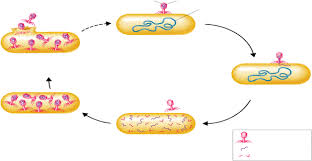
37.

What part of the virus is the DNA?

a)
A
b)
B
c)
C
d)
D
38.
Yogurt contains harmful bacteria.
a)
True
b)
False
39.
Some bacteria move by using a long, whip-like structure called a(n) ____________________
a)
tail
b)
cillia
c)
organs
d)
flagellum
40.

A viruses are considered

a)

Living

b)

Non-living

41.
Where the better adapted organisms survive to pass traits along to offspring.
a)
Evolution
b)
Natural Selection
c)
Extinction
d)
Artifical Selection
42.
Why are advantageous traits more likely to be passed onto offspring?
a)
Because they are more likely to survive and reproduce.
b)
Because they come from dominant alleles.
c)
Because they come from recessive alleles.
d)
Because the trait is an acquired phenotype.
43.
Natural selection is when ____________ decides who survives and who doesn't
a)
nature
b)
humans
c)
animals
d)
years
44.
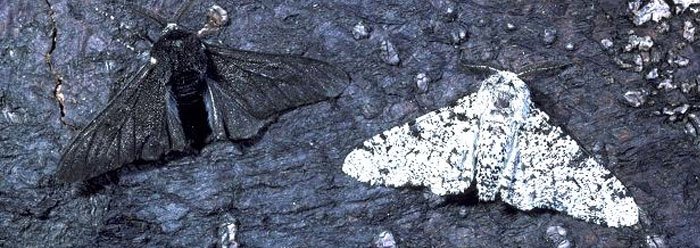
The trees these moths used to live on were white, but have been covered in soot from coal factories. Which moth will be more successful in this environment?
a)
Dark moth
b)
Light moth
c)
Both will be equally successful
d)
Neither will be successful
45.
Structures with the same parts have different functions; suggests that organisms share a common ancestry
a)
vestigial structures
b)
homologous structures
c)
adaptive radiation
d)
fossil
46.
Study of embryos of various organisms to show a common ancestor because of similarities in development
a)
natural selection
b)
embryology
c)
speciation
d)
evolution
47.
The diagram shows fossils in different rock layers. Which of these statements about the age of these fossils is most likely correct?
a)
Fossil A and C are the same age
b)
Fossil B is older than fossil C
c)
Fossils A is older than fossil B
d)
Fossil D is older than fossil C
48.
What does Darwin's theory of evolution suggest?
a)
species change over time
b)
extinct species are not related to living species
c)
different species can interbreed
d)
animals that look alike are most closely related
49.
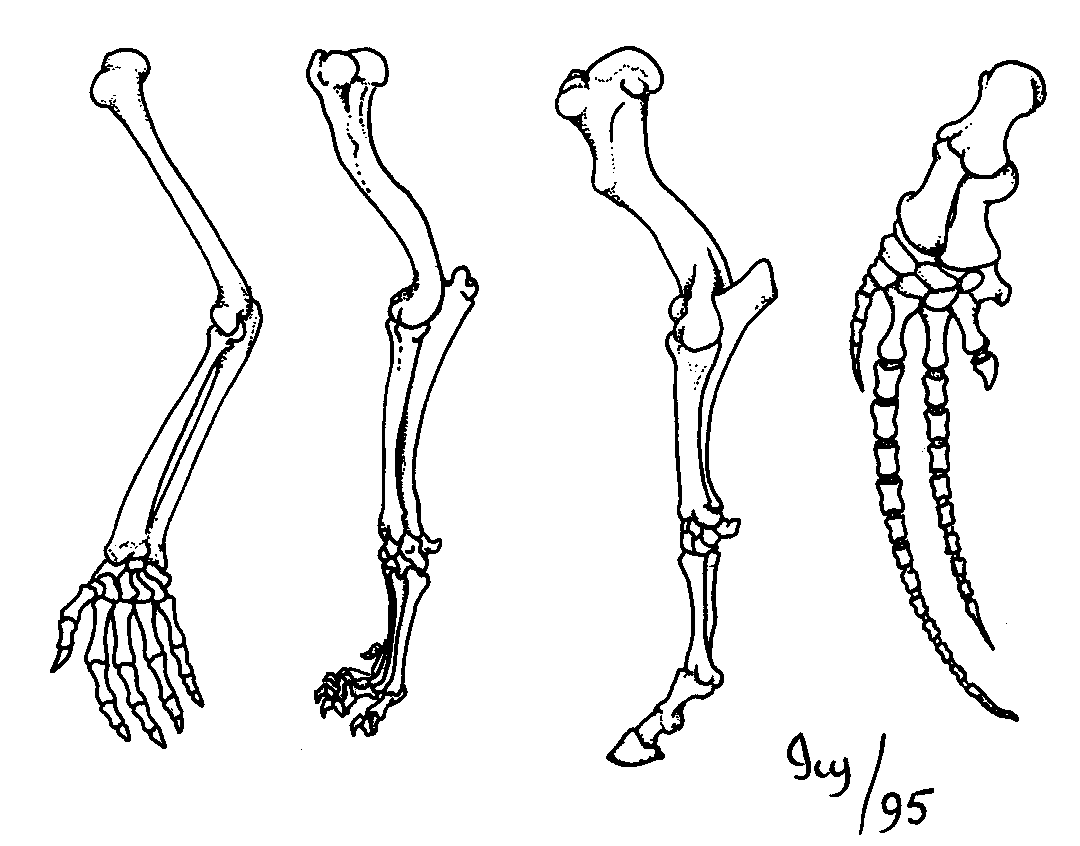
What type of structures are these?
a)
homologous
b)
vestigial 
c)
analogous
d)
fossil
50.
Which of these best represents a time period in which an organism could evolve?
a)
5 days
b)
100 years
c)
10,000 years
d)
2 decades
51.

Whales are aquatic mammals that contain a pelvis (hip) bone. Even though it does not aid in its movement, the function must have been used by a common ancestor of the whale. Thus, the pelvis is referred to as a(n)

a)

vestigial structure

b)

analogous structure

c)

homologous structure

52.
The ability of an organism to survive and reproduce in its specific environment 
a)
diversity.
b)
evolution
c)
adaptation
d)
 fitness
53.
Where humans have bred organisms together based on traits we like.
a)
Evolution
b)
Natural Selection
c)
Extinction 
d)
Artificial Selection
54.
Genetic differences between organisms of the same species
a)
Variation
b)
Adaptation
c)
Behavior
d)
Environment
55.
The difference in the physical traits of an individual from those of other individuals in a group is called a(n)
a)
change
b)
adaption
c)
species
d)
variation
56.
The long and sharp beak of a woodpecker is an example of:
a)
Natural Selection
b)
Selective Breeding
57.
An error in DNA copying that results in a new trait
a)
Homeostasis
b)
Mutation
c)
Natural Selection
d)
Selective Breeding
58.
This scientist came up with the idea of natural selection.
a)
Jean Baptiste Lamarck
b)
Gregor Mendel
c)
Charles Darwin
d)
Thomas Malthus
59.
Inherited trait that helps an organism survive is a(n) __________.
a)
Fossil
b)
Adaptation
c)
Ancestor
d)
Natural selection
60.
Survival of the fittest or when favorable adaptations reproduce faster is called what?
a)
Evolution
b)
Adaptation
c)
Natural selection
d)
Fossilization
61.
If "T" is the allele for tall and "t" is the allele for short, then Tt would produce?
a)
tall
b)
short
c)
medium
d)
not enough info
62.
T - tall and t = short
In the punnett square below, what belongs in the missing square
a)
tt
b)
Tt
c)
Bb
d)
TT
63.
What is the yellow seed genotype?
a)
aa
b)
Aa
c)
AA
d)
AA or Aa
64.
Two brown eyed parents (Bb) have a baby. What is the chance the baby is blue eyed?
a)
0 %
b)
25%
c)
50%
d)
75%
65.

Cats that have wite fur with orange stripes and patches are an example of what?

a)

CoDominance

b)

Incomplete Dominance

c)

Incoherent Dominance

d)

DomDominance

66.

Wavy hair is a mix of curly and straight hair. Which of the following expalains this blending of traits?

a)

CoDominance

b)

Incomplete Dominance

c)

Incoherent Dominance

d)

DomDominance

67.

What sugar does DNA have in its backbone?

a)

Ribose

b)

Deoxyribose

c)

Glucose

d)

Fructose

68.

What sugar does RNA have in its backbone?

a)

Ribose

b)

Deoxyribose

c)

Glucose

d)

Fructose

69.

Which nucleic acid is single-stranded?

a)

DNA

b)

RNA

70.

Which combination of nucleotides does RNA have?

a)

A, C, U, and T

b)

G, U, A, T

c)

A, C, G, T

d)

A, C, G, U