
 Worksheets
Waves Review
Total questions: 53
Worksheet time: 13hrs 15mins

Which part of a wave is shown by the letter A?
Amplitude
Trough
Wavelength
Crest
Which part of a wave is shown by the letter B?
Amplitude
Trough
Wavelength
Crest
Which part of a wave is shown by the letter C?
Amplitude
Trough
Wavelength
Crest
Which part of a wave is shown by the letter D?
Amplitude
Trough
Wavelength
Crest
What is the amplitude of this wave?
2 m
2.5 m
4 m
18 m
What is the wavelength of this wave?
2 m
2.5 m
4 m
18 m
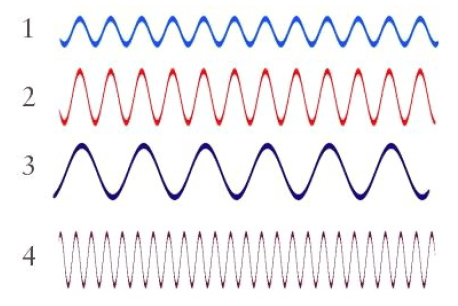
the number of waves that pass a certain point.
wave speed
frequency
The amplitude of a wave is...
The total distance a wave will travel through a medium
The height of a wave from the origin to a crest or trough
The height of a wave from crest to trough
The horizontal distance between two crests or troughs of a wave


Frequency is measured using the unit
Hertz (Hz)
second /cycle
seconds
meters
If the frequency of a wave is changed to 4 times more, then its wavelength will be
4 times more
1/4 of the original
the same as the original
1/2 of the original
What is the correct formula for the period of a wave?
T = 1/f
f = 1/T
v=f⋅λ
f=λv
Sound is an example of a (a) or (b) wave. Light is an example of a (c) or (d) wave.
Waves in which the particles of the medium move only in the same direction as the motion of the wave are ________ waves.
transverse
longitudinal
water
seismic
If a wave starts moving more slowly, the wavelength of the wave will ______
increase
decrease
remain the same
it depends on the amplitude
When light is reflected from a surface, as the angle of incidence increases, the angle of reflection ______.
increases
decreases
remains the same
cannot be determined
If the wavelength is kept constant, which increases as the speed of a wave increases?
phase
amplitude
period
frequency
The less-dense region of a longitudinal wave is called a
compression
rarefaction
rest position
none of these
Match the units to the quantities they measure
meter
wavelength
meters/second
wave speed
hertz
frequency
The loudness of a sound is directly related to the wave's _____.
wavelength
frequecy
rest position
amplitude

Match the following properties of waves with their example.

Refraction

Reflection

Doppler Effect
The same type of light can be brighter if it has a different (a) . If the (b) is different, it is a different color of light.
Reflection is to bouncing as refraction is to:
bending.
breaking.
dissipating.
halting.

In this diagram, which is the angle of incidence?
Angle A
Angle B
Angle C
Angle D
Which of the following best describes the image produced by a plane mirror?
Virtual and erect (upright)
Virtual and Inverted
Real and erect (upright)
Real and inverted

The diagram below depicts a converging lens of focal length F and an object placed between 1 and 2 focal lengths from the lens. Which of the following best describes the image of the object produced by the lens?
Real and erect (upright)
Real and inverted
Virtual and erect (upright)
Virtual and inverted
Virtual images (a) be projected onto a screen and (b) be seen through the lens. They (c) exist without the lens or mirror. Real images can be (d) and (e) be seen without the lens.
What is a characteristic common to BOTH sound waves and light waves?
They transfer energy
They are longitudinal
They are transverse
They can travel in a vacuum
If the period of the wave is 2 seconds, what is its frequency?
2 seconds
0.5 Hz
2 Hz
0.5 seconds
If the frequency of the wave is 0.25 cycle per second, what is the period of the wave?
4 seconds
0.25 seconds
1 second
2 seconds

The diagram below illustrates a parked police car with a siren on top. The siren is producing a sound wave with a frequency of 680 hertz, which travels first through point A and then through point B. The speed of the sound is 340 meters per second. What is the wavelength of the sound produced by the car's siren?
0.50 m
2.0 m
2.3*10^5 m
2.3*10^6 m
What is the velocity of a wave having a frequency of 25 cycles per second and a wavelength of 10 meters?
2.5 m/s
15 m/s
35 m/s
250 m/s

A tree 20 m high is located 40 m from the converging lens of focal length 0.08 m.Calculate the distance from the lens to the image.
0.08 m
0.01 m
0.10 m
0.20 m

An object is located 35.0 cm from a converging lens. The lens forms a real image at a distance of 15.0 cm. What is the focal length?
0.0953 cm
10.5 cm
26.2 cm
0.0678 cm

What color is the longest wavelength?
Green
Yellow
Blue
Red

When objects move towards you, the wavelength....
Increases (gets longer)
Decreases (gets shorter)

When objects move away from you, the wavelength....
Increases (gets longer)
Decreases (gets shorter)
Which of the following best describes the image produced by a plane mirror?
Virtual and Upright
Real and Upright
Virtual and Inverted
Real and Inverted

The diagram below represents a ray of light entering a glass block from air. Also represented are four choices, A, B, C, and D, for the subsequent path of the light ray. Which path best indicates the direction taken by the light ray?
A
B
C
D

