wayground logo

Free Printable Worksheets

NEW

Font size

S
M
L
XL
Worksheets

Timberlake Chapter 10 Study Guide

Total questions: 35

Worksheet time: 45mins

Name
Class
Date
1.

What is the goal of the Lewis Dot Structure?

a)

To determine the electron position.

b)

To show the element's valence electrons & bonding capabilities.

c)

To find the atomic mass of an element.

d)

To search for the number of electrons in an individual atom.

2.

How many valence electrons should Magnesium have in its Lewis dot model?

a)

1

b)

2

c)

3

d)

4

3.
Which of the following is the correct Lewis dot structure for the molecule fluorine (F2)?
a)
A
b)
B
c)
C
d)
D
4.
According to the octet rule most elements need _______ valence electrons.
a)
2
b)
8
c)
6
d)
18
5.
 A lone pair is defined as
a)
A pair of bonding electrons
b)
One non-bonding electron
c)
A pair of non-bonding electrons
d)
A pair of electrons on the central atom
6.
What is the VSEPR theory used to predict?
a)
Bond Strength
b)
Polarity
c)
Molecular Shape
d)
Electronegativity
7.
Which of the following shapes has an unshared pairs of electrons on the central atom? 
a)
Bipyramidal
b)
Bent
c)
Trigonal Planar
d)
Tetrahedral
8.
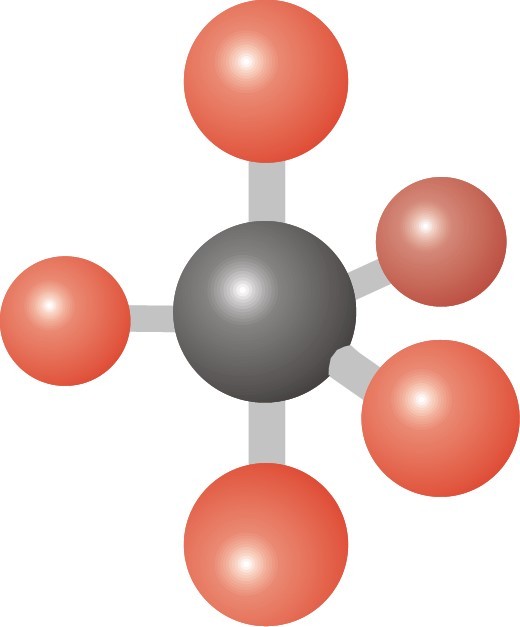
What molecule could this be? 
a)
H2O
b)
CCl4
c)
PCl5
d)
NaCl
9.
Choose the correct shape for this molecule:
a)
linear
b)
Trigonal pyramidal
c)
Bent
d)
Tetrahedral
10.
Choose the set that goes from lowest to highest electronegativity?
a)
Cu, Mg, Sr, Ca
b)
F, Cl, Br, Si
c)
Cs, Rb, Ca, Mg
d)
Zn, Cd, Ag, Cu
11.
Electronegativity is...
a)
how good an atom is at attracting electrons
b)
the ability of an atom to lose electrons
c)
the energy required to remove an electron from a specific atom
d)
how easy it is to make friends. 
12.

The electrons in a POLAR covalent molecule are shared...

a)

Evenly

b)

Unevenly

c)

Electrons are not shared

13.

The electrons in an ionic molecule are shared...

a)

Evenly

b)

Unevenly

c)

Electrons are not shared

14.

In a polar covalent bond, the electrons spend more time and localize around the atom...

a)

with the Greatest Electronegativity

b)

with the Lowest Electronegativity

c)

Each atom Equally

15.

Partial charges like the ones shown here are called:

a)

dipoles

b)

deltas

c)

ions

d)

magnetic poles

16.

In this Lewis structure, the symbol above F means...

a)

electrons are being transferred to Fluorine

b)

electrons are less attracted to F than H

c)

electrons are more attracted to F than H

d)

Fluorine has formed an anion

17.

When you have Br-Br, what is the polarity?

a)

Polar

b)

nonpolar

c)

Ionic

18.

When you have Li-O, what is the polarity?

a)

nonpolar

b)

polar

c)

ionic

19.

When you have H-Cl, what is the polarity?

a)

nonpolar

b)

polar

c)

ionic

20.
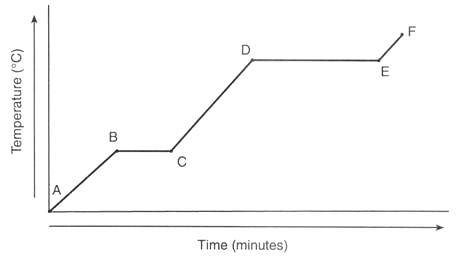
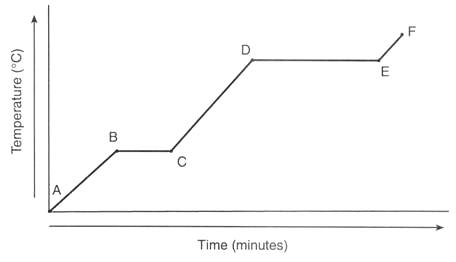
Describe the substance between letters C and D. 
a)
Gas
b)
Liquid
c)
Melting
d)
Evaporating
21.
Between which points is the substance changing its state of matter?
a)
A-B only. 
b)
A-B, C-D, E-F
c)
B-C only. 
d)
B-C, D-E
22.

Thermal energy always moves:

a)

From a high temperature object to a lower temperature object.

b)

From a lower temperature object to a higher temperature object.

c)

From an object with lower kinetic energy to an object with higher kinetic energy.

d)

From an object of higher mass to an object of lower mass.

23.

Given the heating curve of a solid being heated at a constant rate, what is the boiling point of this substance?

a)

20°C

b)

50°C

c)

110°C

d)

170°C

24.

NaCl(s) was heated up starting at an initial temperature of 0°C. The heating curve is shown in the picture. What is the melting point of this substance?

a)

0°C

b)

801°C

c)

1000°C

d)

1465°C

25.
The measure of average kinetic energy of all the particles within an object is called ____________. 
a)
temperature
b)
conduction
c)
radiation
d)
heat 
26.
A high specific heat means...
a)
It heats up quickly with energy added
b)
It requires more energy to change temperature
27.
What  is the formula to calculate heat energy required to raise the temperature of any substance?
a)
Q=mc∆t
b)
Q=mc
c)
Q= ½mv
d)
m=QC
28.
For a skillet, used for cooking, do you want a high or low specific heat
a)
High, so that it will need more energy to heat up
b)
Low, so that it will change temperature quickly
29.
Which of the following is NOT true about heat? 
a)
Heat moves from hot to cold
b)
Heat is a form of energy
c)
Heat cannot be transferred
d)
Heat makes molecules speed up 
30.

A covalent bond usually forms between:

a)

a metal and a nonmetal

b)

either metals or nonmetals

c)

two metals

d)

two nonmetals

31.
The element with the largest electronegativity in the halogens is - 
a)
At
b)
F
c)
Cl
d)
Br
32.
Which has the greater EN: 
Cl or Al?
a)
Cl
b)
Al
33.
Put these in increasing order:
F, N, B
a)
B < N < F
b)
B < F < N
c)
N < F < B
d)
F < N < B
34.

This diagram illustrates which type of molecule configuration?

a)
trigonal pyramid
b)
linear
c)
bent
d)
angular
35.

What shape would this have?

a)

Trigonal planar

b)

Pyramidal

c)

Tetrahedral

d)

Bent