wayground logo

Free Printable Worksheets

NEW

Font size

S
M
L
XL
Worksheets

3rd 9 weeks Review Quiz

Total questions: 43

Worksheet time: 48mins

Name
Class
Date
1.

Which of the following units are repeatedly joined together to form a strand of DNA?

a)

Amino Acids

b)

Nucleotides

c)

Fatty Acids

d)

Polysaccharides

2.

Nitrogen bases are joined by which type of bond?

a)

polar bonds

b)

hydrogen bonds

c)

phosphate bonds

d)

deoxyribose bonds

3.

Adenine bonds with _____

a)

Cytosine

b)

Thymine

c)

Guanine

d)

Uracil

4.

Why is DNA important?

a)

it is very small and very complicated

b)

it's in everything

c)

it serves as the blueprint for traits of all living things

d)

because we eat it every day for energy

5.

Cytosine bonds with ____

a)

Adenine

b)

Thymine

c)

Guanine

d)

Uracil

6.
Which sequence of DNA bases would pair with this partial strand
ATG TGA CAG
a)
ATG TGA CAG
b)
TAC ACT GTC
c)
GTA AGT GAC
d)
CAT TCA CTG
7.
DNA replication results in two DNA molecules,
a)
each one with two original strands
b)
each one with two new strands
c)
each one with one new strand and one original strand
d)
one with two new strands and the other with two original strands
8.

Enzyme that breaks hydrogen bonds (unzips)

a)

Ligase

b)

Polymerase

c)

Primase

d)

Helicase

9.

At what point in the cell cycle does DNA replication occur and why?

a)

before a cell divides, to provide each of the two resulting cells with a complete set of DNA instructions

b)

before a cell divides, to ensure that the DNA will fit into the resulting cells

c)

during cell division, to ensure that the DNA will fit into the resulting cells

d)

after a cell divides, to provide each of the two resulting cells with a complete set of DNA instructions

10.

A diagram of a cellular process is shown above.


Which of the following identifies the process shown at point Z?

a)

translation

b)

translocation

c)

replication

d)

transcription

11.
Which of the following accurately describes the difference between transcription and translation?
a)
In transcription, the genetic code of a DNA molecule is first encoded. Translation is the process of converting the DNA code into code that RNA can use.
b)
In transcription, an amino acid chain is encoded in a DNA molecule. Translation is the process of turning the amino acids into nucleic acids in an RNA molecule.
c)
In transcription, the genetic code of a DNA molecule is transferred to a messenger RNA molecule. Translation is the process of creating an amino acid chain using the encoded messenger RNA.
d)
In transcription, a double helix DNA molecule is split into two separate single strands. Translation is the process of joining each single DNA strand with a single strand of matching RNA
12.
Where does translation take place?
a)
Nucleus
b)
Ribosome
c)
Mitochondria
13.
 Which sequence depicts the correct order of protein synthesis within a cell? 
a)
DNA → mRNA → amino acids → proteins
b)
DNA → amino acids → mRNA → proteins
c)
 DNA → mRNA → proteins → amino acids
d)
DNA → proteins → amino acids → mRNA
14.
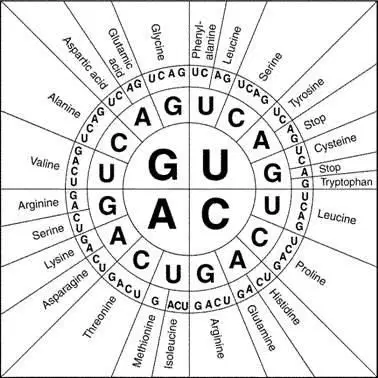
A type of substitution in which no  amino acids change is called 
a)
Missense
b)
Nonsense
c)
Silent
d)
Deletion
15.
What mutation has occurred here? 
T-G-A-C-C-A
T-G-A-G-C-A
a)
Substitution
b)
Deletion
c)
Insertion
d)
Frameshift 
16.

If AAA codes for lysine in a tree, what does AAA code for in a rabbit?

a)

Lyisne, because trees and rabbits are closely related.

b)

Uracil because in rabbits there is no thymine.

c)

Lysine because the genetic code is universal and the same codon chart that can be used for trees, can be used for ALL living things.

d)

Serine because trees have cell walls.

17.

Some organisms are able to reproduce asexually through mitosis, while cells of organisms that reproduce sexually will undergo meiosis to produce gametes. Which process do you predict would be most beneficial to a species during a drastic change in environmental conditions?

a)

Meiosis; it results in more daughter cells, which increases the population of the species.

b)

Meiosis; it results in more genetic variation, which would help ensure the species will survive.

c)

Mitosis; it results in more genetic mutations, which may be advantageous to the species.

d)

Mitosis; it results in more offspring in a short time, which increases the odds that some will survive.

18.

While genetic engineering has positive benefits, there are also concerns associated with widespread use of genetic engineering in agriculture. If many farmers begin to plant more genetically modified crops that have an increased tolerance to insects, which of the following may result? 

a)

an increase in the use of pesticides

b)

a decrease in genetic diversity of the crops

c)

an increase in the contamination of the water supply

d)

a decrease in crop productivity

19.

A single gene has 3 or more alleles. These are called

a)

multiple genes

b)

multiple alleles

c)

codominance

d)

polygenic traits

20.
What is genetic engineering?
a)
Manipulation/addition of genes
b)
Naturally breeding two animals with desired traits
c)
Cross-pollinating two crops
d)
Harvesting stem cells
21.
Traits controlled by genes on the X-chromosome are called___________.
a)
autosomes
b)
sex-linked
c)
codominant
d)
incomplete dominance
22.
This type of inheritance pattern shows BOTH traits in possible offspring
a)
complete dominance
b)
incomplete dominance
c)
co-dominance
d)
dominant pattern
23.

What type of inheritance is determined by multiple genes and there can be a range of traits?

a)

Codominance

b)

Incomplete dominance

c)

Polygenic traits

24.
This type of inheritance pattern is a MIXTURE of both traits.
a)
incomplete dominance
b)
co-dominance
c)
complete dominance
d)
recessive pattern
25.
Crossing over is important because....
a)
It prevents mutations from entering the gametes. 
b)
It allows for even distribution of chromosomes in the gametes.
c)
It allows for more genetic diversity of gametes.
d)
It allows for genetic uniformity of gametes. 
26.
The process of crossing over occurs in what phase of meiosis?
a)
anaphase 1
b)
prophase 1
c)
prophase 2
d)
telophase 1
27.
Why do we need meiosis?
a)
To double the number of chromosomes going into sex cells
b)
To halve the number of chromosomes going into sex cells
c)
To triple the number of chromosomes going into sex cells
d)
To not change the number of chromosomes going into sex cells
28.
What causes genetic variation in meiosis?
a)
chromosomes lining up
b)
crossing over of chromosomes
c)
separation of chromosomes
d)
chromosomes pulling apart
29.

Which law states that alleles for different traits separate independently during meiosis?

a)

Law of Independent Assortment

b)

Law of Segregation

c)

Law of Dominance

d)

Law of Crossing Over

30.
Law of Segregation is when...
a)
alleles separate individually from each other
b)
genes for each trait separate individually from each other
c)
one allele masks the presence of another allele
d)
homologous chromosomes pair with other genes
31.
Which question were the scientists trying to answer with this experiment?
a)
Where do cells come from?
b)
How did prokaryotes form cell membranes?
c)
How are biomolecules formed?
d)
What gave rise to the Eukaryotic cell?
32.
The apparatus in the experiment was used to mimic what?
a)
Proteins
b)
Present Earth conditions
c)
Early Earth conditions
d)
Nucleic acids (DNA/RNA)
33.
Based upon the conditions of the early Earth, which forms of live most likely appeared first?
a)
Prokaryotic and aerobic
b)
Prokaryotic and anaerobic 
c)
Eukaryotic and aerobic
d)
Eukaryotic and anaerobic
34.
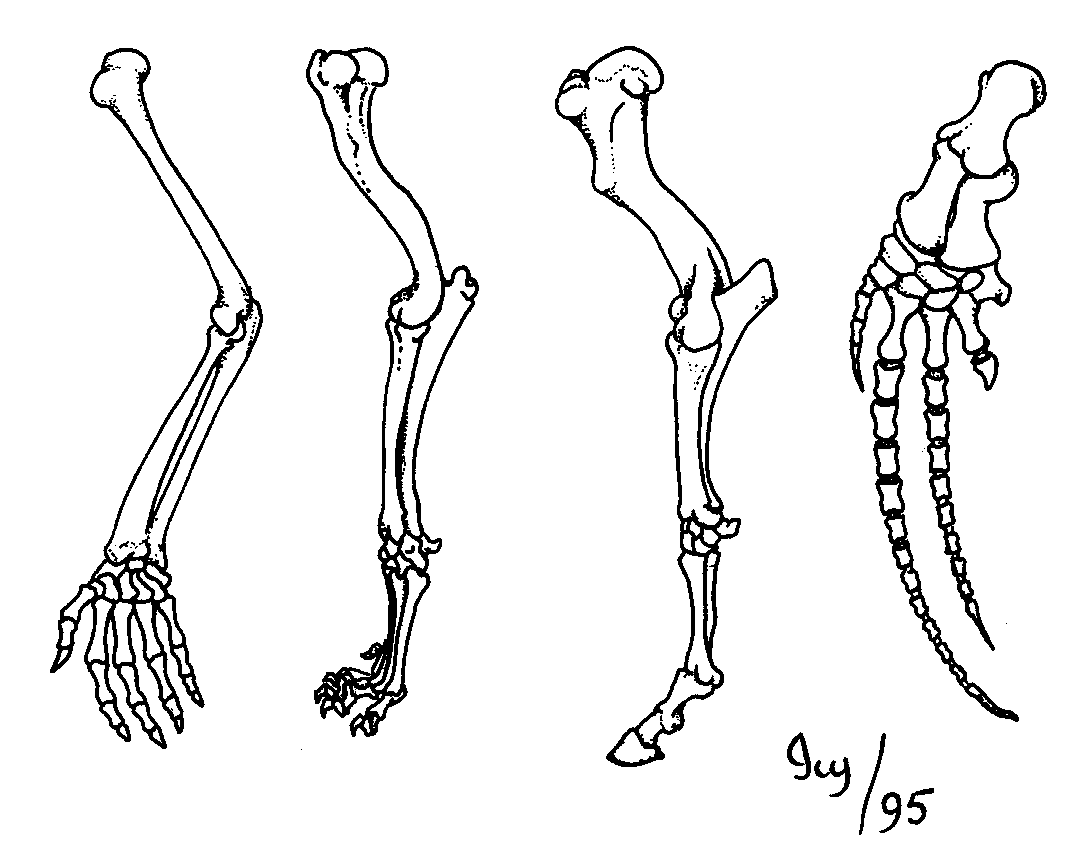
Structures with the same parts have different functions; suggests that organisms share a common ancestry
a)
vestigial structures
b)
homologous structures
c)
adaptive radiation
d)
fossil
35.

Over time, the climate of an island became drier, which resulted in changes to the populations of various island finch species. Finch populations with a certain beak shape thrived, while those not having that beak shape decreased. Which of the following describes a necessary condition for these changes in the finch populations to occur?

a)

fewer mutations

b)

limited food resources

c)

limited beak variations

d)

overproduction of offspring

36.
Which term refers to the process by which individuals that are better adapted to their environment are more likely to survive and reproduce?
a)
natural selection
b)
overproduction
c)
competition
d)
variation
37.
How does natural selection lead to evolution?
a)
Stronger offspring kill weaker members of the species.
b)
Helpful variations accumulate among surviving members of the species.
c)
Overproduction provides food for stronger members of the species.
d)
Environmental changes favor weaker members of the species.
38.
Which mechanism shows genes leaving (immigration) or coming into (emigration) a gene pool?
a)
mutations
b)
natural selection
c)
gene flow
d)
non-random mating
39.

A random change in allele frequencies over generations brought about by chance.

a)

genetic drift

b)

gene flow

40.
If an organism has a vestigial structure, that structure likely once had a function in a(n)
a)
close relative
b)
early ancestor
c)
unrelated organism
d)
embryological stage
41.
Two organisms that are closely related would have
a)
very similar DNA sequence
b)
exactly the same DNA sequences
c)
no proteins in common
d)
completely different DNA sequence
42.

Two populations cannot mate with each other even if they interact with each other. What is this is called?

a)

temporal isolcation

b)

reproductive isolation

c)

behavioral isolation

d)

geographic isolation

43.

The lava released by a volcanic eruption separates two populations of a species of monkey. What does this represent?

a)

biological isolation

b)

geographical isolation

c)

temporal isolation

d)

reproductive isolation