

wayground logo

Free Printable Worksheets

NEW

Font size

S
M
L
XL
Worksheets

Chemical Reactions Test Review

Total questions: 60

Worksheet time: 45mins

Name
Class
Date
1.
What precipitate forms when you mix lead (II) nitrate with sodium chloride?
a)
sodium nitrate 
b)
lead (II) chloride 
c)
sodium lead
d)
chloride nitrate 
2.
Which is the correct net ionic equation for the reaction of AgNO3 and CaCl2?
a)
Ca2+(aq) +  2Cl- (aq) → CaCl(s)
b)
Ag+(aq)  +  Cl- (aq) → AgCl(s)
c)
Ag +  Cl  →  AgCl
d)
Ag+  +  Ca2+   →Ag2Ca (s)
3.
Which of the following does NOT form a precipitate?
a)
Pb(NO3)2(aq) + 2KI(aq) 
b)
Sr(NO3)2 (aq) + K2SO4(aq) →
c)
AgNO3(aq) + Na2S(aq) →
d)
 Pb(NO3)2(aq) + AgNO3(aq) →
4.
What are the spectator ions in the reaction of sodium chloride with silver nitrate?
a)
silver and nitrate
b)
sodium and chloride
c)
sodium and nitrate
d)
silver and chloride
5.
In this equation,
CuCl2 + NaOH  → Cu(OH)2 + NaCl
Which product is insoluble?
a)
copper(II) hydroxide
b)
sodium chloride
c)
sodium hydroxide
d)
copper(II) chloride
6.
Which of these results in the formation of a precipitate?
a)
AgNO3(aq)  +  NaOH(aq)→
b)
BaNO3(aq)  +  CaCl2(aq)→
c)
NaNO3(aq)  +  KOH(aq)→
d)
More than one of these form precipitates
7.
Which of these results in formation of a precipitate?
a)
BaNO3(aq)  +  NaCl(aq)→
b)
KNO3(aq)  +  LiOH(aq)→
c)
Zn(NO3)2(aq)  +  NaOH(aq)→
d)
NaNO3(aq)  +  Ba(OH)2(aq)→
8.
What are the spectator ions in this reaction?
CuCl2(aq) + NaOH(aq) → Cu(OH)2(s) + NaCl(aq)
 
a)
Cu2+ and OH1-
b)
Na2+ and Cl2-
c)
Na1+ and Cl1-
d)
Na1+ and OH1-
9.
What is the result of the reaction between potassium bromide and ammonium sulfide?
a)
potassium sulfide precipitates
b)
ammonium bromide precipitates
c)
potassium ammonium precipitates
d)
no precipitate is formed
10.
In a chemical equation, is it true that -
a)
the reactant side and product side can have different numbers of atoms for each element
b)
there can be different elements on the reactant side and the product side
c)
an element or compound must be accompanied by a phase change
d)
the coefficients indicate the number of molecules of each reactant used and the number of molecules of each product made
11.
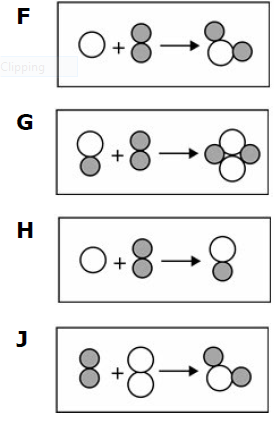
Which of the following models best demonstrates a balanced chemical equation?
a)
F
b)
G
c)
H
d)
J
12.
The reactants are on the left side of the chemical equation.
a)
True
b)
False
13.
Coal contains carbon and other elements. Carbon dioxide forms when coal burns in the presence of oxygen. Which of these is the best evidence that a chemical reaction occurs when coal burns?
a)
The shape of the coal changes
b)
Oxygen is present
c)
A new substance is produced
d)
Coal is made up of more than one element
14.
Is this balanced?
2HgO → 2Hg + O2
a)
Yes
b)
No
15.
Is this balanced?
Al + O2 → 2Al2O3
a)
Yes
b)
No
16.

What is the left part of a chemical equation called?

2H2 + O2 → 2H2O

a)

Reactants

b)

Products 

c)

Yields 

d)

Chemical Equation 

17.
Which is the name of the kind of solid substance formed in this figure?  
a)
aqueous 
b)
precipitate
c)
acid
d)
synthesis 
18.
An element plus additional element reacts to form one product is an example of which type of chemical reaction? 
a)
combustion
b)
decomposition 
c)
synthesis 
d)
single replacement
19.
Which of the following compounds will not disassociate in water? 
a)
NaCl
b)
PbCl2
c)
MgNO3
d)
Na2SO4
20.
Which type of reaction takes place in the presence of oxygen and produces carbon dioxide and water?
a)
double replacement 
b)
decomposition 
c)
combustion 
d)
single replacement
21.
Provides evidence that a chemical reaction has occurred. 
a)
dissolving 
b)
melting
c)
formation of a gas
d)
bending
22.
What is the probable product of a double-replacement reaction?
a)
A new compound and a replaced metal
b)
A new compound and a replaced nonmetal
c)
2 different compounds 1 aqueous and 1 that is a solid, liquid or gas
d)
A single compound
23.
What type of chemical reaction takes place when fluorine reacts with sodium bromide?
a)
single replacement 
b)
double replacement 
c)
combustion
d)
synthesis 
24.
Which reaction between halogens and halide salts will occur?
a)
F2(g)  +  FeI2(aq) → FeF2(aq)  +  I2 (g)
b)
Cl2(g) + SrF2(aq)  → SrCl2(aq)  +  F2(g)  
c)
I2(g)  + MgBr2(aq)  → MnI2(aq)  + Br2(g)
d)
Br2(l)  +  CoCl2(aq) → CoBr2(aq)  +  Cl2(g)
25.
A chemical reaction that shows the formation of a solid and identifies the spectator ions
a)
net ionic equation 
b)
double replacement 
c)
ionic equation 
d)
dissociation 
26.
Predict the following reaction 
NaCl   +   Ca(NO3)2 --> 
a)
no reaction both products are aqueous 
b)
Calcium chloride and sodium nitrate are produced  
c)
sodium nitrate is a solid formed 
d)
calcium chloride is the solid formed
27.
A compound is reacted and forms two new substances. What type of reaction is this? 
a)
combustion 
b)
synthesis 
c)
decomposition 
d)
single replacement 
28.
What are the correct coefficients when this equation is balanced?
KClO3  --> KCl  +  O2
a)
2,2,2
b)
2,2,3
c)
1,2,3
d)
3,3,3
29.
A metal is reacted with an acid to produce a salt and a hydrogen gas. What type of reaction has occurred? 
a)
neutralization 
b)
double replacement 
c)
single replacement 
d)
synthesis 
30.
the starting materials in a chemical reaction
a)
Products
b)
Reactants
c)
Starters
d)
Enders
31.
a substance that is formed as the result of a chemical reaction
a)
Product 
b)
Reactant
c)
Starters
d)
Enders
32.
type of chemical reaction where two compounds react, and the positive ions (cation) and the negative ions (anion) of the two reactants switch places, forming two new compounds or products
a)
Double Displacement
b)
Single Displacement
c)
Synthesis
d)
Decomposition
33.
Translate the following word equation: 
Liquid nitrogen and oxygen gas combine to form nitrogen monoxide gas. 
a)
N + O → NO
b)
N2 + O2 → N2O2
c)
N2(l) + O2(g) → NO(g)
d)
N(l)O2(g) → NO(g)
34.
Aqueous means...
a)
dissolved in water/solution
b)
water
c)
liquid
d)
plasma
35.

Matter cannot be ____ or _____.

a)

made, changed

b)

created, destroyed

c)

rearranged, unmade

d)

stagnant, unchanging

36.
What type of reaction is the equation C + O→ CO2?
a)
Synthesis Reaction
b)
Decomposition Reaction
c)
Single Displacement Reaction
d)
Double Displacement Reaction
37.
What type of reaction is the equation 2NaCl →2Na +Cl2?
a)
Synthesis Reaction
b)
Decomposition Reaction
c)
Single Displacement Reaction
d)
Double Displacement Reaction
38.
Cu + 2Ag(NO3) → 2Ag + Cu(NO3)
a)
Synthesis Reaction
b)
Decomposition Reaction
c)
Single Displacement Reaction
d)
Double Displacement Reaction
39.
Ca3(PO4)2 + 3 H2SO4 + 3 CaSO4 + 2 H3(PO4)
a)
Synthesis Reaction
b)
Decomposition Reaction
c)
Single Displacement Reaction
d)
Double Displacement Reaction
40.
Consider the chemical equation CH4 + 2 O2 → CO2 + 2 H2O. In this equation, CH4 is a
a)
product
b)
reactant
c)
displacement
41.
Consider the equation 4 Fe+3 O2 → 2 Fe2O3 . In this equation, 3 O2 is a
a)
product
b)
reactant
c)
compound
42.
Which generalized equation represents a decomposition reaction?
a)
A + BC → AC+ B
b)
A + B → AB
c)
AB → A + B
43.
Which generalized equation represents a single displacement reaction?
a)
A + BC → AC+ B
b)
A + B → AB
c)
AB → A + B
44.

Identify the type of chemical reaction

a)

Synthesis

b)

Decomposition

c)

Single replacement

d)

Double replacement

e)

Combustion

45.

Identify the type of chemical reaction

a)

Synthesis

b)

Decomposition

c)

Single replacement

d)

Double replacement

e)

Combustion

46.

Magnesium can be burned in oxygen to produce solid magnesium oxide.

a)

Mg + O2→ MgO

b)

Mg+ O→ MgO

c)

Mg + CO2 → MgO + C

d)

Mg + O2→ Mg2O2

47.

Sodium reacts with chlorine gas to produce sodium chloride.

a)

NaCl→ Cl + Na

b)

Na+ CO2 → NaCO2

c)

Na + Cl2→ NaCl

d)

Na + Cl → NaCl

48.

Iron reacts with solid sulfur to produce iron(II) sulfide powder.

a)

Fe + S → Fe2S

b)

Fe + S → FeS

c)

Fe2 + S→ Fe2S2

d)

Fe + S2 → Fe2S

49.

When hydrogen reacts with sulfur, a smelly gas, dihydrogen monosulfide, is produced.

a)

H2 + S → HS

b)

H2 + S → H2S

c)

H + S→ HS

d)

H + S→ H2S

50.

Calcium oxide and water produces calcium hydroxide

a)

CaO + H2O --> Ca(OH)2

b)

Ca2O2 + H2O --> Ca(OH)2

c)

CaO + H2O --> CaOH

d)

Ca2O2 + H2O --> Ca(OH)2

51.

Based on the activity series, what are the predicted products of this reaction?

Br2 (l) + KI (aq) →

a)

KBr + I2

b)

KBr + I

c)

No Reaction

52.

Based on the activity series, will this reaction occur?

Au (s) + HCl (l) →

a)

AuCl + H

b)

No Reaction

c)

AuCl + H2

53.

Predict the product(s) of this reaction (don't worry about balancing):

Mg + HCl →

a)

No Reaction

b)

MgCl2 + H2

c)

MgCl2 + H

54.

What will be the result of : Zn + AuCl2->

a)

ZnCl2 +Au

b)

ZnAu + Cl2

c)

no reaction

55.
Zinc Hydroxide
a)
Soluble 
b)
Insoluble
56.
NiCl2
a)
Soluble 
b)
Insoluble
57.
BaSO4
a)
soluble
b)
insoluble
58.
AgCl
a)
soluble
b)
insoluble
59.
K2SO4
a)
soluble
b)
insoluble
60.

Group 1

a)

Soluble

b)

Insoluble
