
 Worksheets
S2 Pre AP Final Exam Review
Total questions: 64
Worksheet time: 34mins

What is #9 called
Nosepiece
Eyepiece
Arm
Stage
What is #10 called
Nosepiece
Eyepiece
Arm
Stage
What is #11 called
Nosepiece
Eyepiece
Arm
Stage
What is #12 called
Nosepiece
Fine adjustment knob
Arm
Coarse adjustment knob
What is #13 called
Nosepiece
Fine adjustment knob
Arm
Coarse adjustment knob
What is #14 called
Base
Eyepiece
Arm
Stage
What are 3-5 called
Bases
Eyepieces
Arms
Objectives
What is 7 called?
Base
Diaphragm
Arms
light source
Which of the following is TRUE about enzymes?
Enzymes are proteins
Enzymes are very specific for just one type of reaction
An enzyme may be used many times
All are true
Which one of the following is NOT part of the cell theory?
Cells must be capable of making their own food
All cells come from preexisting cells
Which process happens in the mitochondria?
photosynthesis
protein synthesis
DNA replication
cellular respiration

The organelle that is the control center of the cell and contains nearly all of the cell’s DNA:
Ribosome
Centriole
Nucleus
Rough Endoplasmic Reticulum

The organelle that assembles proteins in the cytoplasm:
Ribosome
Nucleus
Mitochondrion
Rough Endoplasmic Reticulum
Found in the nucleus and carries genetic information.
Chromosome
Genes
Traits
Nucleus
What type of transport requires energy?
passive transport
active transport
facilitated diffusion


when some molecules can cross the membrane while others cannot.
Where in a plant cell does photosynthesis take place
Palisade cells
Chlorophyll
Chloroplasts
Vacuole
Which of the following equations represents the overall chemical reaction for photosynthesis?
6O2+ 6H2O → C6H12O6+ 6O2
C6H12O6 + 6H2O→ 6O2+ 6O2
6CO2+ 6H2O→ C6H12O6+ 6O2
6O2 + 6H2O→ C6H12O6 + 6CO2
Which of the following are products of photosynthesis?
glucose and oxygen
glucose and water
carbon dioxide and water
ATP and sunlight
Photosynthesis is the process by which
Which of the following is needed for cellular respiration to begin? Choose all that apply!
Oxygen
Carbon Dioxide
Glucose
Mitochondria
Where does cellular respiration occur?
Nucleus
Chloroplast
Mitochondria
Ribosome
Which of the following statements best describes the relationship between photosynthesis and respiration?
Energy is stored during photosynthesis and released during respiration.
Photosynthesis and respiration are reverse chemical processes.
Photosynthesis takes place during the day and respiration takes place at night.
Photosynthesis is performed by plants and respiration is performed by animals.

Which phase is this in?
Interphase
Metaphase
Anaphase
Telephase

Which phase is this in?
Prophase
Metaphase
Anaphase
Telephase

Which phase is this in?
Prophase
Metaphase
Anaphase
Telephase

Which phase is this in?
Interphase
Metaphase
Anaphase
Telephase
Spindle fibers attach, centrioles line chromosomes in the center of the cell describes:
Prophase
Telophase
Metaphase
Anaphase
Centrioles pull the chromosomes apart towards the opposite sides of the cell describes:
Prophase
Metaphase
Telophase
Anaphase
Centrioles pull the chromosomes apart towards the opposite sides of the cell describes:
Prophase
Metaphase
Telophase
Anaphase
Which phase is DNA replicated?
Interphase
Prophase
Anaphase
Telophase
In what stage are two new cells formed?
Telophase
In this stage, the nuclear membrane disappears and the spindle fiber is formed.
The importance of mitosis is
growth of cells
repair of cells
renewal of cells
all of the above
Meiosis is the process by which
the chromosome number is reduced by one-half
the chromosome number is doubled in sperm and egg cells
the chromosome number of the daughter cells remains the same as the parent cell
there is an unequal division of the chromosomes.
If an organism has 20 chromosomes in each of his body cells, how many chromosomes would you expect to find in his sperm cells?
20
40
10
5
Cells formed by meiosis are:
used in growth and repair of tissues
reproductive cells
are diploid
contain only small amounts of cytoplasm.
In what cells of the body would Meiosis take place?
egg and sperm cells
DNA is composed of monomers called
What is the name of the 5 carbon sugar found in DNA?
If one half of a DNA strand had the sequence ATG GCA TAG, the complementary DNA strand to that would be
GTA GCC TAU
UGC CGA TAC
You have the following DNA sequence: CCT GAC Identify the correct complementary mRNA sequence that would correspond to the given DNA sequence.
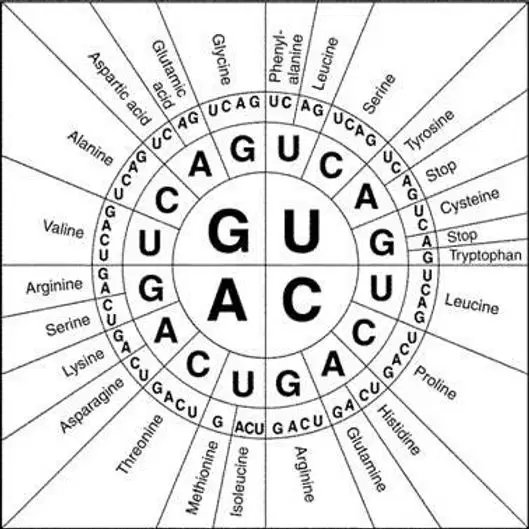
Using the amino acid wheel, what amino acids are produced from the following mRNA sequence? GGA CUG
Which of the following is found in RNA but not DNA?
The building blocks of proteins are
Match the following with the location where they occur
DNA replication
Nucleus
Protein Synthesis
Ribosome
Photosynthesis
Chloroplasts
Cellular Respiration
Mimtochondria
Match the following
small segment of DNA
gene
Dominant
Allele that overshadows another allele
Recessive
allele expressed only when there are 2
Homozygous
Having 2 of the same alleles
Heterozygous
Having 2 different alleles
The genetic makeup of an organism is called _______ while the physical trait it shows is called _______
phenotype, genotype
gene pool, karyotype
homozygous, heterozygous
genotype, phenotype

Look at the punnett square. What is the probability that the offspring's alleles will be homozygous dominant?
100%
75%
50%
25%
0%

Look at the punnett square. What is the probability of the offspring showing the recessive trait?
100%
75%
50%
25%
0%

Look at the punnett square shown. What is the probability that the offspring will show the dominant trait?
100%
75%
50%
25%
0%

