
 Worksheets
The Blood Unit
Total questions: 92
Worksheet time: 53mins
True or False: Blood is the only fluid tissue in the body.
True
False
Red Blood Cells
Thrombocytes
Leukocyte
Erythrocytes
White Blood Cells
Erythrocytes
Leukocytes
Thrombocytes
Platelets
Erythrocytes
Leukocytes
Thrombocytes
What is the healthy blood volume of an adult male?
2-3 liters
4-5 liters
5-6 liters
6-7 liters
What are blood samples spun in?
a fridge
a carousel
a centrifuge
a spinner
How are substances carried throughout the body?
Put into the blood and is transported by blood vessels
Transported through photosynthesis
Transported by going through the digestive tract
Transported by bodily movement
In the liquid portion, what percentage of blood is water?
10%
25%
75%
90%
What is albumin?
a plasma protein in the blood
the name of an artery
red blood cells
white blood cells
What do red blood cells carry?
carbon
water
oxygen & CO2
blood
The liquid portion of blood is called (a)
The ancestors of all blood cells are called (a) cells
Platelets are produced by certain giant cells called (a)
Some monocytes enter the tissues and mature into phagocytes called (a)
The liquid portion of blood is called (a)
The ancestors of all blood cells are called (a) cells
Platelets are produced by certain giant cells called (a)
Some monocytes enter the tissues and mature into phagocytes called (a)
Erythrocytes have a life span of approximately (a) days
An increased erythrocyte count (a)
A decreased erythrocyte count (a)
An increased leukocyte count (a)
A decreased leukocyte count (a)
A decreased platelet count (a)
An increased platelet count (a)
What iron-containing protein transports oxygen?
erythropoietin
complement
hemoglobin
thrombin
What is the correct sequence for hemostasis?
vessel contraction, plug formation, blood clot
blood clot, plug formation, vessel contraction
plug formation, blood clot, vessel contraction
vessel contraction, blood clot, plug formation
The hematology specialist needs to measure the number of eosinophils in a blood sample. Which test should she conduct?
hematocrit
electrophoresis
bone marrow biopsy
differential white blood cell count
What vitamin is needed for blood clotting?
vitamin A
vitamin K
biotin
vitamin E

The diagram shows the human heart. After a red blood cell picks up oxygen in the lungs, which sequence shows the path it could take when passing through the heart during its circuit of the body?
I → II → III → IV
II → I → IV → III
IV → III → I → II
IV → III → II → I
What helps to keep blood flowing onwards away from the heart in an artery?
Valves
Elastic fibres
Contraction of skeletal muscles
Having a wide lumen
Which vessel carries deoxygenated blood away from the heart?
Aorta
Pulmonary artery
Vena cava
Pulmonary vein
What is an advantage of capillary walls being one cell thick in the systemic circulation?
To allow carbon dioxide to diffuse into tissues
To allow oxygen to diffuse out of tissues
To allow glucose to diffuse into tissues
To allow urea to diffuse into tissues
Which is a valid comparison between arteries and veins?
Arteries: Carry deoxgenated blood
Veins: Carry oxygenated blood
Arteries: return blood to the atria of the heart
Veins: blood flows from ventricles to body tissue
Arteries: blood flow at high pressue
Veins: blood flow at low pressure
Arteries: have thick walls
Veins: have permeable walls
Which feature of capillaries distinguishes them from arteries and veins?
Narrow diameter
Valves to prevent backflow
Thick muscular walls
Elastic tissue
When intense physical activity is anticipated, which in the blood will increase the frequency of sinoatrial signals to heart muscle?
pH
Oxygen level
Thyroxin
Epinephrine

The image shows the four chambers of the mammalian heart viewed from the ventral side. The sinoatrial node is located in the wall of one of these chambers. Which chamber is it?
A
B
C
D
There are (aprox) ___ trillion cells in the human body.
12
38
30
26
Hemoglobin carries oxygen. When it doesn't carry enough oxygen it is called ______. This can be caused by iron deficiency.
Anemia
Blood Clot
Anitbodies
Transfusion
_____ quarts of blood in the body
2-3
4-6
7-8
8-10
There are three main parts of the blood.
Plasma
Leukocytes
Erthrocytes
Anemia
Erythrocytes are
red blood cells
white blood cells
platelets
plasma
White blood cells and red blood cells have hemoglobin.
TRUE
FALSE
Both red and white blood cells have a nucleus
TRUE
FALSE
how long do red blood cells live?
30 days
80 days
200 days
120 days
290 days
The red bone marrow makes _____ of red blood cells each day
thousands
millions
billions
trillions
What does cyte- mean? (Hint, what is cytology?)
cell
life
red
white
Which is not a blood type?
O
A
AB
OA
White blood cells two main functions are to:
Destroy bad bacteria and foreign matter
Produce amenia
Produce antibodies
Produce emzymes
white blood cells live for _________ days
1-12
30-40
20-22
1-5
Plasma is 90% water and 10% _______ (choose two)
Substances that are transported by blood
Substances that eat Erythrocytes
Leukocytes
Substances that regulate blood
The Cardiovascular System (or Circulatory) contains the heart, blood, and blood vessels. What are the three blood vessels?
Arteries
Anemia
Capalaries
Veins
Hemoglobin
Which makes up 55% of the blood?
PLASMA
PLATELETS
ERYTHROCYTES
LEUKOCYTES
Why are red blood cells red?
They contain Erythroids.
They contain Anemia.
They contain Hemoglobin.
They contain Blood.
Click all that apply to that shape of Erythrocytes.
The cells are
disk-like
They are concave. (dented on each side)
They are round, but can take any shape
They are made
of four compartments, each ball-shaped.
Why is the shape of erythrocytes (RBC) the way it is?
CLICK ALL THAT APPLY
So they don't absorb oxygen too quickly
So that they can easily glide past each other quickly and not get stuck
Because the hemoglobin naturally takes that shape
No reason
Hemo- means
water
blood
red
white or clear
leuk- means
white or clear
water
blood
red
A phlebotomist is a person who determines what blood type you have
TRUE
FALSE
Which is the best definition for:
Antibodies
Produced by Erythrocytes, these function in attacking invaders in your body
Attack poisons and organisms in your blood. Produced by Leukocytes.
Pathogens that enter your body through eating rotten meat.
The production of too much blood.
How long do platelets live? (in days)
2
7
10
23
What is sickle cell?
A disease in which the blood becomes too thick
A disease in which the bone marrow does not produce enough Erythrocytes
A disease in which Erythrocytes become wrongly shaped
A disease in which Leukocytes are too rapidly produced
which are the three steps of blood clotting? choose three
Erythrocytes stick together to cover wound
Platelets stick together to cover wound
Chemicals released by platelets form fibers that make a net over wound
Fibers hold blood cells from escaping, forming blood clot
Leukocytes shoot out fibers to cover wound in net
Which of these is NOT a function of the blood?
Transports toxins throughout the body
Transports nutrients throughout the body
Removes waste products from the body
Supply oxygen to the body tissues
The blood is made up of 90% red blood cells.
True
False
Which is NOT a component of the blood?
Plasma
Red blood cell
Epithelial cell
Platelets
The body contains 4 and a half gallons of blood.
True
False
Which of these is NOT true for plasma?
The plasma contains 50% water.
The plasma contains food, carbon dioxide, waste products, hormones and minerals.
Provides a protein needed for blood clotting.
Makes up 55% of the blood.
The function of red blood cells is to transport oxygen from the lungs to the body tissues.
True
False
Which is NOT true for the red blood cell?
Red blood cell is disc shaped.
Red blood cell has a nucleus.
Red blood cell develops in the bone marrow.
Red blood cell contains a red pigment called hemoglobin.
Which cell is the most plentiful in the blood?
Epithelial cell
Platelets
Red blood cell
White blood cell
Which of these is NOT a feature of the white blood cell?
Defends the body from infectious organisms.
Have a nucleus
Is smaller than red blood cells
Is less in number than the red blood cell
Which cell releases antibodies?
Lymphocytes
Phagocytes
Erythrocytes
Platelets
Oxygen rich blood leaves the heart through the
left ventricle
left atrium
right ventricle
right atrium
Capillaries join together
the heart and arteries
veins and the heart
arteries and veins
heart and valves
Veins have special ________________ to stop blood from flowing backward.
gravity
valves
arteries
ventricles
What would happen if your arteries cannot deliver blood?
your tissues would not get the oxygen they need
the skin would be extra hairy
the heart would not work
you would immediately fall asleep
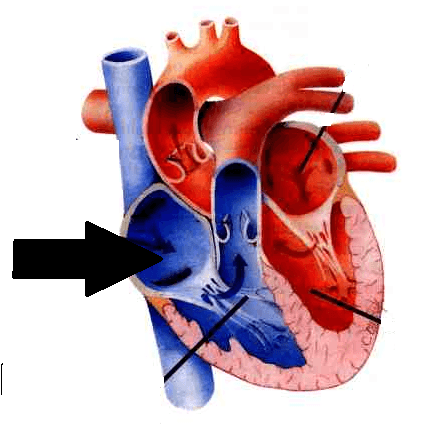
Identify the location of the heart where the bold arrow is pointing
Left atrium
Right atrium
Left ventricle
Right ventricle
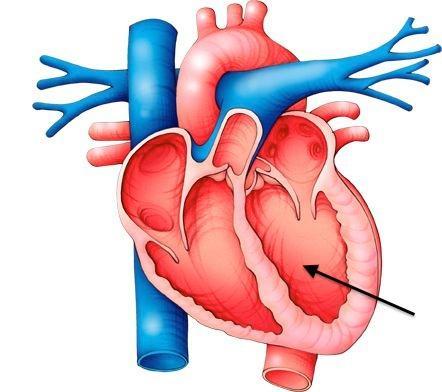
Identify the location of the heart where the arrow is pointing
Left atrium
Right atrium
Left ventricle
Right ventricle
The blood in the vena cava is...
oxygenated, returning to the heart
deoxygenated, returning to the heart
oxygenated, leaving the heart
deoxygenated, leaving the heart

Identify 8
Left Atrium
Pulmonary Arteries
Pulmonary Veins
Left Ventricle

