wayground logo

Free Printable Worksheets

Font size

S
M
L
XL
Worksheets

Year 7 Chemical World Test

Total questions: 87

Worksheet time: 2hrs 3mins

Name
Class
Date
1.
How do gases behave in a container?
a)
Cluster together
b)
form a solid
c)
They take the shape of their container
d)
leak out 
2.

Which states allow easy flow of particles (a)  

Choose from the below words
Gas and Solid
Gas and Liquid
Solid and Liquid
Gas only
3.

What sorts of things are made of particles? (a)  

Choose from the below words
Everything in the universe
Anything solid
Water 
Most solids, liquids and gases. 
4.
Can Solids be compressed?
a)
No
b)
Yes
c)
Sometimes (it depends what it's made of)
d)
Generally no
5.

Which state of matter can be compressed? (a)  

Choose from the below words
Solid
Liquid 
Gas
6.

What happens to particles as they heat up? (a)  

Choose from the below words
They slow down
Nothing
They don't move
They speed up
7.

Which state of matter has particles that move the least/slowest? (a)  

Choose from the below words
solid
water
gas
8.

Adding HEAT to matter causes its particles to: (a)  

Choose from the below words
move faster and farther apart
Move slower and farther apart
Move faster and closer together
Move slower and closer together
9.
Which of the following occurs when a liquid becomes a gas?
a)
the particles slow down
b)
the particles beak away from one another
c)
the particles move closer together
10.
How do the particles of matter move as the matter changes state in the diagram?
a)
The particles released energy and move as matter changed state?
b)
The particles released energy and moved more quickly.
c)
The particles gained energy and moved more slowly.
d)
The particles gained energy and moved more quickly.
11.
Which description best matches this particle model?
a)
Particles are closely packed, vibrate fixed position, strong intermolecular forces.
b)
Particles are closely packed, no movement, strong intermolecular forces
c)
Particles are closely packed, move around each other, medium intermolecular forces
12.
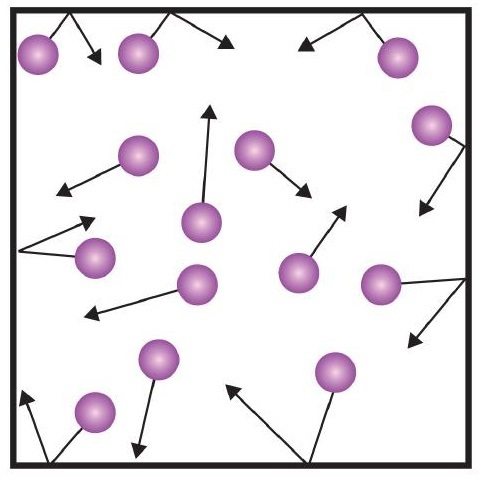
Which description best matches this particle model?
a)
Particles move fast in specific directions, weak intermolecular force
b)
Particles have a lot of space between them and move fast in random directions.
c)
Particles have lots of energy and have a medium intermolecular forces between them. 
13.

Which state of matter has tightly packed particle in fixed positions? (a)  

Choose from the below words
solid
liquid
gas
14.

Which ones can be units for density?

(Multiple responses)

a)

g/ mL

b)

g

c)

gcm3\frac{g}{cm^3}  

d)

cm4cm^4  

15.

What is the mass of a 25 cm3  liquid if it has a density of 5 g/cm3? (a)  

Choose from the below words
125 g
5 g
5gcm3\frac{5g}{cm^3}
0.2 cm30.2\ cm^3
16.

Helium balloons rise on earth because (a)  

Choose from the below words
helium is less dense than air
helium is more dense than air
helium is cooler than air
helium is warmer than air
17.

As a substance is COOLED it's DENSITY (a)  

Choose from the below words
increase
decreases
remains equal
18.

In which mixture can you see all of the parts? (a)  

Choose from the below words
homogeneous
heterogeneous
19.

In which mixture can you not see all of the parts? (a)  

Choose from the below words
homogeneous
heterogeneous
20.

Sand floating in water, but most of the sand is settled at the bottom this an example of which type of mixture? (a)  

Choose from the below words
A solution
A colloid
A suspension
A compound
21.

What is a mixture in which all the parts are EVENLY mixed? (a)  

Choose from the below words
energy
beaker
solution
salad
22.

Which of the following is a solution? (a)  

Choose from the below words
lemonade
trail mix
legos
iron filings and sand
23.

Chicken noodle soup is an example of a (a)  

Choose from the below words
homogeneous mixture
heterogeneous mixture
24.

What are the two types of Mixtures (a)  

Choose from the below words
Elements and Subatomic Particles
Protons and Electrons
Atoms and Compounds
Homogenous and Heterogeneous
25.

What is the definition of a solvent?

a)

The substance that is dissolved.

b)

The substance in which the solute is dissolved.

c)

Unable to be dissolved.

26.

Which of these is an observation? (a)  
Choose from the below words
The dog is 4 years old.
The dog is wearing a hat.
27.

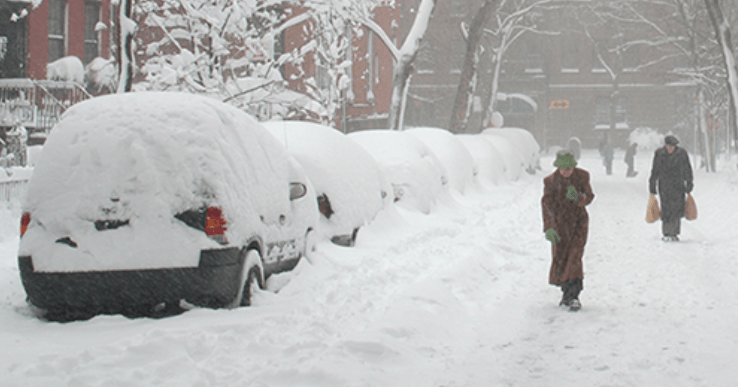
Select ALL of the QUALITATIVE answers below:

a)

The cars are covered in snow!

b)

This must be New Hampshire.

c)

There are 4 pedestrians.

d)

The pedestrians are carrying bags.

28.

In qualitative research, we depend mostly on our senses. (a)  

Choose from the below words
True
False
29.

Observation or Inference: I think the weather is cold. (a)  

Choose from the below words
Observation
Inference
30.
If your teacher asked you to make qualitative observations about the class’s pet hamster, which group of words might be used?
a)
A  mass of 3 kg, 11 cm long, age of 16 months
b)
A  mass of 3 kg, 11 cm long, cute
c)
A  long hair, white and brown colored, soft
d)
A  temperature, length, weight
31.
A student placed 50 mealworms in the middle of an aquarium containing a light, a cardboard tube and a water dish.  He waited five minutes and then recorded the data for the first trial in the table above.  The student repeated this procedure two more times, and recorded the results.  Read the results of all three trials.  Which inference could you make about mealworms based on the results.
a)
The mealworms probably prefer the darkness of a cardboard tube.
b)
There were 6 mealworms under the light in trial 2. 
c)
Mealworms love water. 
d)
There were 36 more mealworms in the cardboard tube versus the light in trial 3.
32.

What is an observation about this picture?

a)

The lady is working on a remote learning day.

b)

This lady has her hair in a bun.

33.
What is an inference? 
a)
Just a random guess
b)
A prediction or logical conclusions about our observations
c)
The same as an observation
d)
deciding if an observation is qualitative or quantitative
34.

Choose 2 inferences about this picture.

a)

Today is the dog's birthday.

b)

There is a candle on the cake.

c)

The dog has a tag on the collar.

d)

The dog will eat the cake.

35.

Observation or Inference: I think the weather is cold. (a)  

Choose from the below words
Observation
Inference
36.

Observation or Inference: I notice the tree by the pond has no leaves on it. (a)  

Choose from the below words
Observation
Inference
37.

Which statement is an observation about this picture?

a)

There are washing machines or dryers in the picture.

b)

The woman is at a laundry mat.

38.

Which two of these can be observations about a gorilla?

a)

The gorilla wants a bigger banana.

b)

The gorilla has 5 fingers on his right hand.

c)

The gorilla is hungry.

d)

The gorilla has dark brown hair.

39.

The cat looks mad. He must be hangry. (a)  

Choose from the below words
Observation
Inference
40.

In qualitative research, we depend mostly on our senses. (a)  

Choose from the below words
True
False
41.

The camptosaurus is going to eatthe stegosaurus (a)  

Choose from the below words
Observation
Inference
42.

Which of these is an observation about this picture?

a)

The blue team is winning.

b)

The blue team is the Golden State Warriors.

43.

Observation or Inference: The cat is scared. (a)  

Choose from the below words
Observation
Inference
44.

Choose 2 inferences about this picture.

a)

The person is wearing brown shoes.

b)

There are 2 carts showing in the picture.

c)

The person is trying to climb up in the dryer to hide.

d)

The cart is used for hanging and sorting clothes.

45.

Using any of your 5 senses to describe the world around you. (a)  

Choose from the below words
Observation
Inference
Quantitative Observation
Logical Theory
46.

An observation that has to do with adjectives like heavy. (a)  

Choose from the below words
Centimeters
Inference
Qualitative Observation
Quantitative Observation
47.

An observation that has to do with numbers and labels like 3.5 cm. (a)  

Choose from the below words
Observation
Touch, Taste, Sight, Hearing, Smell
Qualitative Observation
Quantitative Observation
48.

Qualitative or Quantitative: There is 300 mL of liquid in this beaker. (a)  

Choose from the below words
Qualitative Observation
Quantitative Observation
49.

The Camptosaurus is leaving tracks into the ground. (a)  

Choose from the below words
Observation
Inference
50.

Qualitative or Quantitative: I feel rough sand and a strong heat on the back of my neck. (a)  

Choose from the below words
Qualitative Observation
Quantitative Observation
51.

Qualitative or Quantitative: We bought 3.4 pounds of fruit. (a)  

Choose from the below words
Qualitative Observation
Quantitative Observation
52.

Qualitative or Quantitative: I hear a rush of wind, loud yells, and metal banging together. (a)  

Choose from the below words
Qualitative Observation
Quantitative Observation
53.

Qualitative or Quantitative: The green bar is 3.5 centimeters long. (a)  

Choose from the below words
Qualitative Observation
Quantitative Observation
54.

Identify the scientific equipment

a)

Beaker

b)

Conical Flask

c)

Filter Funnel

d)

Test Tube

55.

Identify the scientific equipment

a)

Beaker

b)

Flask

c)

Cup

d)

Conical Flask

56.

Identify the scientific equipment

a)

tube

b)

test tube

c)

beaker

d)

flask

57.

Identify the scientific equipment

a)

Funnel

b)

Filter Funnel

c)

Drip Tube

d)

flask

58.

Identify the scientific equipment

a)

clamp

b)

holder

c)

boss head and clamp

d)

clamp and holder

59.

Identify the scientific equipment

a)

burner

b)

fire maker

c)

bunsen

d)

bunsen burner

60.

Identify the scientific equipment

a)

evaporating dish

b)

evaporating bowl

c)

evaporating basin

d)

evaporating cup

61.

Identify the scientific equipment

a)

dropper

b)

pipette

c)

squeezer

d)

squeezy

62.

Identify the scientific equipment

a)

heat mat

b)

wire mat

c)

gauze mat

d)

metal mat

63.

Identify the scientific equipment

a)

gauze mat

b)

heat proof mat

c)

tile

d)

mat

64.

Identify the scientific equipment

a)

measuring cup

b)

measuring cylinder

c)

measuring device

d)

measuring tube

65.

Identify the scientific equipment

a)

retort stand

b)

stand

c)

holder

d)

standing device

66.

Identify the scientific equipment

a)

spoon

b)

spoodle

c)

spork

d)

spatula

67.

Identify the scientific equipment

a)

peg

b)

test tube peg

c)

test tube holder

d)

peg holder

68.

Identify the scientific equipment

a)

rack

b)

test tube holder

c)

wooden tube holder

d)

test tube rack

69.

Identify the scientific equipment

a)

temperature gauge

b)

heat checker

c)

thermometer

d)

cold checker

70.

Identify the scientific equipment

a)

tongs

b)

scissor tongs

c)

grabbers

d)

tong scissors

71.

Identify the scientific equipment

a)

stand

b)

tripod

c)

shelf

d)

science stand

72.

Identify the scientific equipment

a)

glass

b)

watch glass

c)

time glass

d)

glass dish

73.
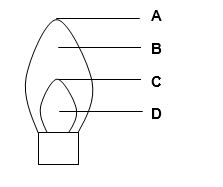
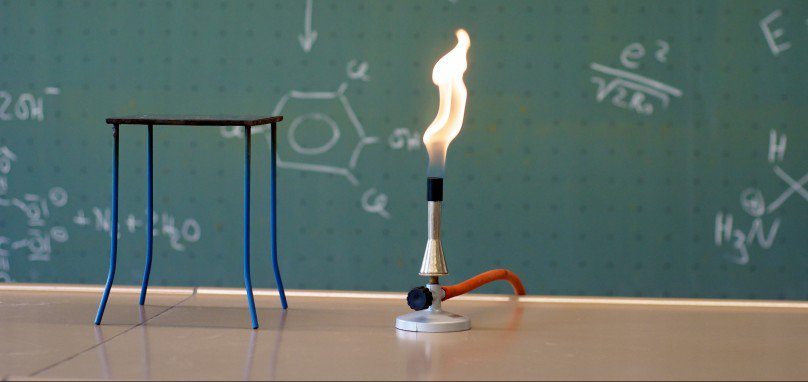
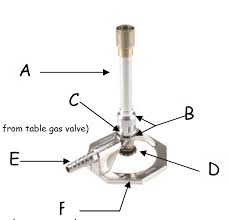
Which part of the Bunsen flame is the hottest?
a)
A
b)
B
c)
C
d)
D
74.

The gas should be turned on ____________ lighting the match.

a)

Before

b)

After

75.
When should you tie back long hair or baggy clothing?
a)
When working with chemicals
b)
When working with a Bunsen burner
c)
When doing dissections.
d)
Any time you are working in the lab.
76.
When is it OK to eat or drink in the lab?
a)
Always
b)
Never
77.
If you break glassware in the lab, you should...
a)
Tell the teacher
b)
Clean it up quickly before the teacher notices
c)
Scream at the top of your lungs
78.
Before leaving the lab you should always wash your hands.
a)
True 
b)
False
79.

What do you call the part of the burner that "twists" ?

a)

Base

b)

Collar

c)

Cylinder

80.
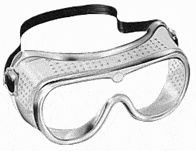
Goggles must be worn when using or working with a Bunsen Burner
a)
False
b)
True
81.

To produce the most heat, you should twist the collar until you see ______

a)

A dark blue cone

b)

An orange cone

c)

A yellow cone

d)

A light blue cone

82.

Name this part of the Bunsen Burner: A

a)

Barrel

b)

Collar

c)

Air Hole

d)

Base

83.
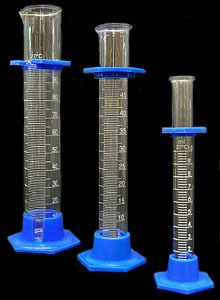
What are these?
a)
flasks
b)
test tubes
c)
graduated cylinders
d)
beakers
84.
Using one or more of your senses to gather information is called
a)
observing
b)
inferrring
c)
predicting
d)
classifying
85.
A possible explanation for a set of observations or answer to a scientific question is called a(n)
a)
prediction
b)
hypothesis
c)
theory
d)
law
86.
In a scientific experiment, the one variable that is purposely changed to test a hypothesis is called the ____________ variable.
a)
independent
b)
dependent
c)
controlled
d)
responding
87.
When heating a test tube, it should be
a)
pointed away from yourself and other students
b)
held with two fingers
c)
filled completely with the liquid being heated
d)
heated over a tripod and gauze mat.