wayground logo

Free Printable Worksheets

Font size

S
M
L
XL
Worksheets

Genetics

Total questions: 88

Worksheet time: 1hrs 6mins

Name
Class
Date
1.

Which of the following is the best definition for heredity?

a)

Heredity is the passing of particles from high concentration to low concentration.

b)

Heredity explains how DNA copies itself.

c)

Heredity is the passing of traits from parent to offspring.

d)

Heredity is the forming of clones.

2.

This scientist studied pea plants and was considered to be the "Father of Genetics".

a)

Reginald Punnett

b)

Gregor Mendel

c)

Charles Darwin

d)

Rosalind Franklin

3.

Y= yellow pod

y= green pod


What is the percentage of yellow pod when you cross a hybrid pod plant with a purebred green pod plant?

a)

25%

b)

50%

c)

75%

d)

100%

4.

According to this punnett square shown, the recessive trait is:

a)

Wrinkled peas

b)

Green pods

c)

Yellow pods

d)

Purple seeds

5.

Which of the following is showing a genotype that would be described as homozygous recessive (purebred)

a)

Dd

b)

dd

c)

DD

d)

dD

6.

Segments of DNA that code for specific traits are referred to as:

a)

RNA

b)

genes

c)

DNA splicing

d)

Chromosome

7.

The physical appearance of an organism is also referred to as:

a)

genotype

b)

phenotype

c)

chromosome

d)

incomplete dominance

8.

The genotype is:

a)

the genetic makeup of an organism.

b)

the physical appearance of an organism.

c)

the deletion of a chromosome.

d)

the passing of traits from parent to offspring.

9.

Which of the following is true regarding inheriting traits:

a)

Dominant traits are less likely to be seen.

b)

You must have only one recessive gene in order to express the trait.

c)

The recessive trait always is seen over the dominant trait.

d)

Dominant traits are more likely to be expressed because you only need one gene.

10.

Which of the following shows a genotype that would be considered homozygous? Choose all that apply.

a)

GG

b)

gg

c)

Gg

d)

Bb

e)

bb

11.

An allele is:

a)

different genes that code for different characteristics.

b)

different chromosomes.

c)

different forms of the same gene.

d)

section of the nucleus that forms chromosomes.

12.

A human body cell contains:

a)

46 chromosomes

b)

23 chromosomes

c)

21 chromosomes

d)

40 chromosomes

13.

A human sex cell contains:

a)

46 chromosomes

b)

23 chromosomes

c)

46 pair chromosomes

d)

20 chromosomes

14.

Which of the following is true regarding genes and chromosomes?

a)

Genes and chromosomes do not have any connection.

b)

Chromosomes make up genes.

c)

Chromosomes are made up of genes which are located in the cytoplasm of the cell.

d)

Genes are sections of the DNA strand and are located on chromosomes.

15.

What is a trait?

a)

A physical characteristic passed down from your mom

b)

A behavioral characteristic passed down from your dad

c)

A physical or behavioral characteristic passed down from your parents

d)

A behavioral characteristic passed down by your mom

16.

What is an allele?

a)

A trait

b)

Different forms of a gene

c)

DNA

d)

Different types of parents

17.

If "B" is brown and "b" is blond, what is the phenotype of someone who's genotype is "bb"

a)

Brown Hair

b)

Blond Hair

c)

Red Hair

18.

Heterozygous: Different, Homozygous:_____________

a)

The same

b)

Less Than

c)

Greater Than

d)

4 copies

19.
Which of these is a learned behavior for a dog?
a)
walking on four legs
b)
rolling over on command
c)
barking
d)
panting 
20.
Which of these is an inherited trait for humans?
a)
knowing how to read
b)
speaking English
c)
being able to play the violin
d)
having two arms 
21.
Which sentence is TRUE?
a)
Acquired traits are passed from parents to offspring
b)
Inherited traits are passed from parents to offspring
c)
Behaviors are never inherited
d)
Behaviors are always inherited 
22.
Which of these traits can a tree NOT pass to its offspring
a)
the shape of its leaves
b)
roots that grow toward the water
c)
a trunk scared by lightning 
d)
the kind of seed it forms 
23.
Knowing how to read a book is an example of
a)
a physical trait
b)
an inherited behavior
c)
a learned behavior 
d)
an inherited trait
24.
A mother dog and her puppy both have curly fur. Which best explains this?
a)
in dogs, curly fur is more common than straight fur
b)
in dogs, curly fur is an acquired trait
c)
the mother dog acquired curly fur and passed on that trait to her puppy
d)
the mother dog inherited curly fur and passed on that trait to her puppy
25.
Which of the following is a definition of inherited trait?
a)
a characteristic that a living thing gets from its parents
b)
a characteristic that a living thing gets during its lifetime
c)
a behavior that a living thing learns from its parents
d)
a skill that an animal develops after it is born 
26.
In a population of cardinals, all the birds have short beaks. Their short beaks are an example of
a)
a learned behavior 
b)
an inherited trait
c)
an acquired trait
d)
an inherited behavior 
27.

Two identical alleles for a trait is known as

a)

homozygous

b)

heterozygous

c)

mutation

d)

codominance

28.

A mutation is harmful to an organism if it

a)

changes the phenotype of an organism

b)

changes the DNA segment

c)

reduces the organism's chance of survival

d)

makes the organism better able to avoid predators

29.

What does Pp mean?

a)

two dominant alleles

b)

heterozygous alleles

c)

one dominant allele

d)

two dominant and recessive alleles

30.

A purebred horse with white hair is crossed with a purebred horse with brown hair. Each of their offspring has both white and brown hair. Why does this occur?

a)

several alleles work together to determine a trait

b)

two alleles for hair are dominant

c)

two alleles for hair are recessive

d)

the alleles for fur color are neither dominant or recessive

31.

Genotype is

a)

stem height

b)

feather color

c)

physical appearance

d)

genetic makeup

32.

Scientists call an organism with two different alleles for a trait

a)

factor

b)

purebred

c)

trait

d)

hybrid

33.

A mutation is

a)

any change that is harmful

b)

any change in a gene or chromosome

c)

any change that is helpful

d)

any change in the phenotype

34.

An organisms's allele combination is known as

a)

phenotype

b)

mutation

c)

hybrid

d)

genotype

35.

If a homozygous black cat (BB) is crossed with a homozygous white cat (bb), what is the probability of having a cat with white fur?

a)

100%

b)

0%

c)

75%

d)

25%

36.

A mother gives birth to a son, she then gives birth to a daughter. What is the likely hood that she will have another son?

a)

75%

b)

25%

c)

50%

d)

100%

37.
An offspring will receive how many alleles from each parent to determine a specific trait?
a)
one
b)
two
c)
three
d)
five
38.
Incomplete dominance means that the traits are
a)
expressed equally
b)
dominant
c)
recessive
d)
blended
39.
If green is dominant over purple, then what is the genotype for this individual?
a)
Purple
b)
Green
c)
GG
d)
gg
40.
Which is the correct phenotype for this organism?
a)
BB
b)
blue
c)
green
d)
bb
41.
In pea plants, the tall allele is dominant to the short allele. What key would demonstrate this?
a)
Tall = T
Short = S
b)
Tall = T
Short = t
c)
Tall = t
Short = T
d)
Tall = TT
Short = tt
42.

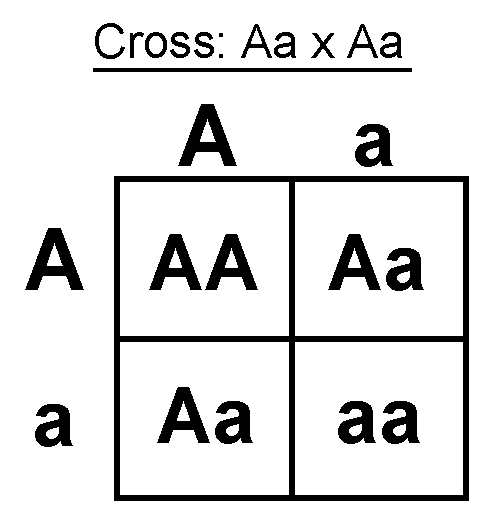
What is the genotypic ratio of the offspring?

a)

3:1

b)

1:3

c)

1:2:1

d)

2:2

43.

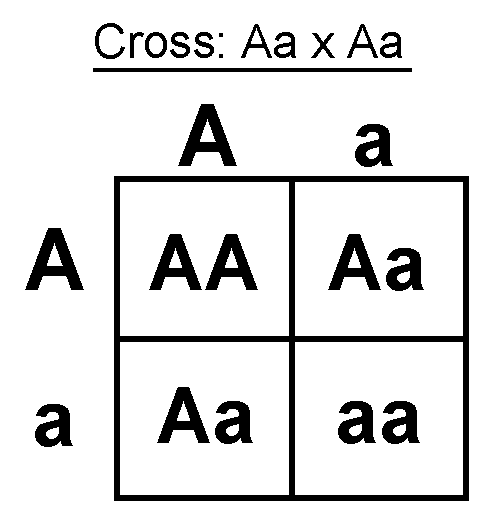
What are the phenotype percentages of the offspring?

(A-Brown fur color; a-white fur color)

a)

50 % Brown fur and 50% White fur

b)

25 % Brown fur and 75% White fur

c)

75 % Brown fur and 25% White fur

d)

0% Brown fur and 100% White fur

44.
What are the possible genotypes for this cross?
(Click the picture to see it without the text)
a)
TT = 25% Tt= 50% tt=25%
b)
all tall
c)
TT= 75% tt = 25%
d)
Tt = 100%
45.
In rabbits, black fur (B) is dominant over brown fur (b). If a rabbit has brown fur, what can you conclude about its genotype?
a)
It is BB.
b)
It is Bb
c)
It is brown
d)
It is bb.
46.
What does DNA stand for?
a)
Deoxyribose Nucleic Acid
b)
Denatured Natural Acid
c)
Do Not Accept
d)
I Don't Know
47.
What does DNA do?
a)

  It carries genetic codes from parents to offspring.

b)

It carries oxygen from the lungs to the body.

c)

It tells you who you are.

d)

It defines the species of an organism.

48.
What is the shape of a DNA?
a)
Double Helix
b)
Base Pairing
c)
The shape of you
d)
Hydrogen Bonding
49.
Adenine, Cytosine, Guanine and Thymine are examples of
a)
DNA structure
b)
DNA bases
c)
DNA double helix
d)
Paired bases
50.
The rules of DNA pairing states that Adenine (A) always pairs up with
a)
Thymine
b)
Cytosine
c)
Adenine
d)
Guanine
51.
The rules of DNA pairing states that Cytosine (C) always pairs up with
a)
Thymine
b)
Cytosine
c)
Adenine
d)
Guanine
52.
The sequence of bases forms the
a)
Genetic Code
b)
DNA base pair
c)
Double Helix
d)
Paired bases
53.
What holds the DNA bases together?
a)
Hydrogen bonds
b)
DNA bases
c)
Double Helix
d)
Paired bases
54.
What is a DNA molecule made of?
a)
Base, sugar, phosphate
b)
Base, sugar, coffee
c)
Base, roof, height
d)
DNA, sugar, phosphate
55.
Traits that are passed from generation to generation are called ____________________
a)
Excited Traits
b)
Inherited Traits
c)
Inclined Traits
d)
Special Traits
56.
_____________________ carries information for inherited traits.
a)
DNA
b)
FBI
c)
RNA
d)
CBS
57.
A nucleotide is made up of three parts:  which of these is not one of those parts?
a)
sugar
b)
phosphate
c)
amino acids
d)
base
58.
A strand of DNA that looks like a twisted ladder is called a _____________________
a)
triple twist
b)
corkscrew
c)
double helix
d)
chain reaction
59.
__________________________ are proteins that are made from many sub units.
a)
Nucleic Acids
b)
Armor
c)
Sugars
d)
Amino Acids
60.
RNA and DNA are all __________________, meaning they stand for something else.
a)
substitutes
b)
codes
61.
__________________ is similar to DNA.  This helps make protein for DNA.  It is a temporary copy.
a)
SEC
b)
GBA
c)
RNA
d)
PGA
62.
_____________________ is a cell organelle composed of RNA and Protein
a)
cytoplasm
b)
ribosome
c)
DNA
d)
Amino Acid
63.
__________________ is a change in the nucleotide base sequence of DNA.
a)
switch
b)
eraser
c)
creation
d)
mutation
64.
Which of the following best describes a DNA molecule?
a)
double helix
b)
contains ribose
c)
made of amino acids
d)
contains Uracil
65.
Why is DNA important?
a)
it is very small and very complicated
b)
it's in everything
c)
it serves as the blueprint for traits of all living things
d)
because we eat it every day for energy
66.
In a molecule of double-stranded DNA, the amount of Adenine present is always equal to the amount of
a)
cytosine
b)
guanine
c)
thymine
d)
uracil
67.
Which organelle is DNA usually found in?
a)
cell membrane
b)
vacuole
c)
ribosome
d)
nucleus
68.
What determines the code, or information, of a DNA molecule?
a)
the shape (structure) of the nitrogen bases
b)
the order (sequence) of the nitrogen bases
c)
the color of the nitrogen bases
d)
the frequency (number) of nitrogen bases
69.
Which 2 molecules form the sides (backbone) of the DNA ladder?
a)
deoxyribose sugar and adenine
b)
deoxyribose sugar and a hydrogen bond
c)
deoxyribose sugar and the nucleus
d)
deoxyribose sugar and phosphate
70.
What are the three components of a nucleotide?
a)
sugar, hydrogen, nitrogen base
b)
sugar, oxygen, nitrogen base
c)
sugar, phosphate, nitrogen base
d)
sugar, phosphate, protein
71.
DNA codes for...
a)
bases
b)
proteins
c)
amino acids
d)
phosphates
72.
Which two scientists are accredited with correctly deducing the double helix model of DNA?
a)
Watson and Crick
b)
Wilkins and Franklin
c)
Wilkins and Crick
d)
Watson and Franklin
73.
Which series is arranged in order from largest to smallest in size?
a)
gene, chromosome, nucleus, cell, DNA, nucleotide
b)
cell, nucleus, chromosome, DNA, gene, nucleotide
c)
nucleotide, chromosome, cell, DNA, nucleus
d)
cell, DNA, gene, nucleotide, nucleus, chromosome
74.

In eukaryotes, which organelle is DNA usually found in?

a)

cell membrane

b)

vacuole

c)

chloroplast

d)

nucleus

75.

DNA is made of ______ strands.

a)

1

b)

2

c)

3

d)

4

76.

DNA coils up into threadlike structures called______.

a)

traits

b)

chromatin

c)

chromosomes

d)

cells

77.
Which nucleic acid is single stranded?
a)
RNA
b)
DNA
78.
A nitrogen base, sugar and phosphate make up a unit that connects together to make a nucleic acid.  This unit is called a/an
a)
amino acid
b)
nucleotide
c)
hydrogen bond
d)
nucleus
79.
A long chain of amino acids is a/an
a)
protein
b)
nucleic acid
c)
tRNA
d)
mRNA
80.
Any change in the DNA is called a/an
a)
mistake
b)
exon
c)
mutation
d)
intron
81.
The physical appearance of an organism based on traits
a)
Genotype
b)
Phenotype
c)
Meiosis
d)
Genetics
82.
This trait will always be expressed if present because it will mask the expression of others
a)
stem cells
b)
heterozygous
c)
dominant
d)
recessive
83.
Hair colour is an example of
a)
genotype
b)
phenotype
84.
Having the genes for baldness is an example of
a)
genotype
b)
phenotype
85.
How tall you are is an example of
a)
genotype
b)
phenotype
86.

What is mitosis?

a)

stage in the cell life cycle when the cell is dividing

b)

stage in the cell life cycle when the cell is dying

c)

stage in cell life cycle when the cell is being born

d)

stage in cell life cycle when the cell is doing nothing

87.

Which type of cell is the only type of cell that can undergo mitosis?

a)

eukaryote

b)

prokaryote

88.

Why can bacteria not go through mitosis?

a)

they are eukaryotes

b)

they have too many nuclei

c)

they are prokaryotes with no nucleus

d)

they can only undergo meiosis