
NEW
Font size
 Worksheets
Remediation (Assessment 1 and 2) _Q3
Total questions: 45
Worksheet time: 23mins
1. Which of the following does not represent a point?
dot
edge of a notebook
intersection of two lines
tip of a pen
2. What is the geometric term represented by a nylon string?
point
line
plane
ray
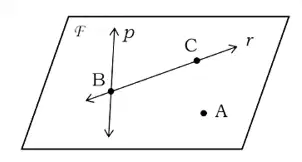
3. Which of the following is the name of the plane?
plane A
plane B
plane C
plane F
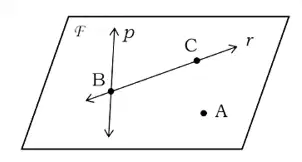
4. Which of the following is not a point?
A
B
C
F
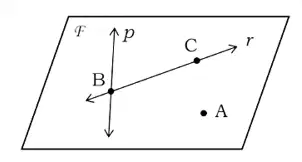
5. What is the best geometric term for line p and line r?
skew lines
parallel lines
intersecting lines
concurrent lines
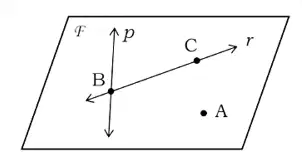
6. In the given figure, what is A?
line
point
ray
segment
7. What do you call the points that lie on the same line?
coplanar
collinear
common point
point of intersection
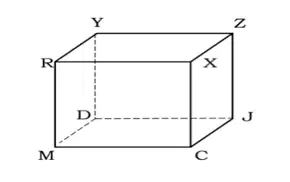
8. What is the intersection of plane ZYRX and plane CXRM?
line segment ZY
line segment YD
line segment RX
line segment CM
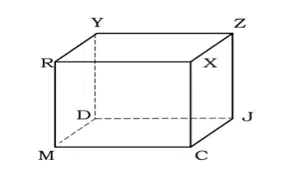
9. Which of the following lines does not contain M?
line RX
line RM
line DM
line CM
10. Which of the following does not represent a plane?
A. board
B. edge of a notebook
C. surface of the table
D. screen of an iPad
11. In every line, there are at least how many distinct points?
A. 5
B. 4
C. 3
D. 2
12. Which of the following represents a line?
A. dot
B. table cover
C. envelop
D. yarn
13. Which of the following represents a point?
A. tip of a pin
B. pen
C. peso bill
D. edge of the ruler
14. In every plane, there are at least how many noncollinear points?
A. 5
B. 4
C. 3
D. 2
15. Which of the following best describes a line?
A. Usually represented by a dot
B. A flat surface
C. Can be extended in both directions
D. Has width and thickness
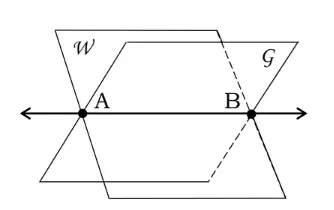
16. What is the intersection of planes W and G?
A. space
B. point
C. plane
D. line
17. Which of the following is a ray in the given figure?
A. ray AB
B. ray AG
C. ray AW
D. ray WG
18. If A and B are collinear, are they also coplanar?
A. yes
B. no
C. maybe
D. cannot be determined
19. What is the undefined term in geometry that has no dimension?
A. line
B. plane
C. point
D. space
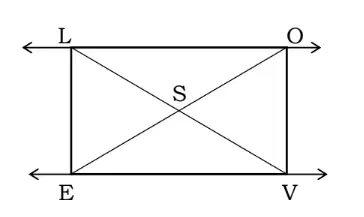
20.What is the intersection of line LV and line OE?
A. line
B. plane
C. point
D. space
21.What is the common point of line LV and line OE?
A. L
B. O
C. V
D. S
22. How do you call lines LO and VE?
A. concurrent lines
B. intersecting lines
C. parallel lines
D. skew lines
23.What are segments with equal length?
A. collinear segments
B. congruent segments
C. coplanar segments
D. opposite segments
24. The top of a table represents what geometric term?
A. point
B. plane
C. line segment
D. line
25. What does a rope represent?
A. line
B. point
C. plane
D. ray
26. Which of the following statements is TRUE?
A. An angle is formed by two noncollinear rays.
B. Two points determine an angle.
C. An angle divides a plane into two distinct parts.
D. Two distinct angles cannot share an interior point.
27. What is the sum of the measures of supplementary angles?
A. 45 degrees
B. 50 degrees
C. 90 degrees
D. 180 degrees
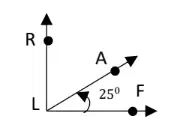
28. On the figures at the right, ∠RLA and ∠ALF are complementary angles. If
m∠ALF = 25, then what is the measure of m∠RLA?
A. 25
B. 55
C. 65
D. 155
29. Which of the following pairs of angles has sum equal to 90 degrees?
A. complementary angles
B. linear pairs
C. obtuse angles
D. supplementary angles
30. Which of the following angles has measure less than 90 degrees but greater than 0
degrees?
A. acute angle
B. obtuse angle
C. right angle
D. straight angle
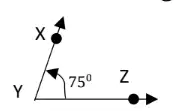
31. In the given figure, m∠XYZ = 75 degrees
, what kind of angle does it form?
A. acute angle
B. obtuse angle
C. right angle
D. straight angle
32. All of the following are measures of an obtuse angle EXCEPT:
950
1100
1200
1800
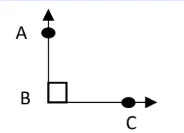
33. Given the figure at the right, if ∠ABC = 900
, which of the following statements
is TRUE?
A. ∠ABC is an acute angle.
B. ∠ABC is a right angle.
C. ∠ABC is an obtuse angle.
D. ∠ABC has no known classification.
34. Which of the following is a measure of an acute angle?
1700
1500
900
800
35. If m∠MAT = 1350 and m∠HAE = 450
, then which of the following could
describe the two angles?
A. complementary angles
B. vertical angles
C. supplementary angles
D. forms a right angle
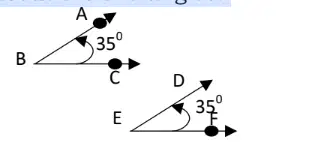
36. Given the figures, what can you conclude about the two angles?
A. linear pairs
B. congruent angles
C. vertical angles
D. perpendicular to each other
37. Which of the following is true about parallel lines?
A. coplanar lines that do not intersect no matter how far they are
extended
B. two lines with a common point
C. three or more lines that have a common point
D. straight lines that do not intersect and are not on the same plane
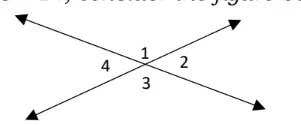
38. Which of the following are vertical angles?
A. ∠1 and ∠2
B. ∠1 and ∠4
C. ∠2 and ∠4
D. ∠2 and ∠3
39.Which of the following form a linear pair?
A. ∠1 and ∠2
B. ∠1 and ∠3
C. ∠2 and ∠4
D. None of these.
40. Which of the following describes the perpendicular lines?
A. lines that intersect to form a right angle
B. lines that meet at a common point
C. lines that do not meet
D. lines that meet to form complementary angles
41. Which of the following statements is NOT TRUE?
A. An angle is formed by two noncollinear rays.
B. Two points determine an angle.
C. An angle is a union of two rays.
D. An angle can be a right angle if its measure is equal to 90 degrees.
42. If two angles form a linear pair, then they are supplementary. What is the
sum of the measures of these two angles?
1800
900
500
450
43. Which of the following angles has measure greater than 90 degrees but lesser than
180 degrees?
A. acute angle
B. obtuse angle
C. right angle
D. straight angle
44. If an angle measures 90 degrees
, what kind of angle does it form?
A. acute angle
B. obtuse angle
C. right angle
D. straight angle
45. All of the following are measures of an acute angle EXCEPT:
900
850
780
50

