
NEW
Font size
S
M
L
XL
 Worksheets
ASSESSMENT 1ST SEMESTER
Total questions: 55
Worksheet time: 28mins
Name
Class
Date
1.
1. At what point is the kinetic energy of the child playing in a slide maximum?
a)
A. at the top of the slide
b)
B. at any point of the slide
c)
C. in the middle of the slide
d)
D. before the end of the slide
2.
2. Which quantity has the greatest influence on the amount of kinetic energy that a vehicle has while traveling down the road?
a)
A. Mass
b)
B. Size
c)
C. Velocity
d)
D. Weight
3.
3. The following scenarios show work being done EXCEPT
a)
a. raising a flag.
b)
b. doing push – ups.
c)
c. carrying a bag on your shoulder while walking.
d)
d. dragging a chair across the room.
4.
4. The rate of doing work refers to ________________.
a)
a. power
b)
b. energy
c)
c. momentum
d)
d. acceleration
5.
What is referred to as the energy of a moving object?
a)
A. Frictional Energy
b)
B. Potential Energy
c)
C. Gravitational energy
d)
D. Kinetic Energy
6.
6. Which of the following statements is TRUE about energy?
a)
a. An object only has energy if it is moving.
b)
b. A slow-moving object has high kinetic energy.
c)
c. An example of potential energy is the energy stored in elastic materials.
d)
d. There are certain forms of energy that cannot be converted into other forms.
7.
7. If the speed of an object doubles, its kinetic energy ______________________.
a)
a. is reduced to one – fourth
b)
b. is reduced to one – half
c)
c. doubles
d)
d. quadruples
8.
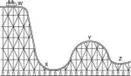
8. Which letter shows where is potential energy stored or at its maximum point?
a)
A. W
b)
B. X
c)
C. Y
d)
D. Z
9.
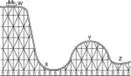
9. Which letter shows where kinetic energy is at its highest point?
a)
A. W
b)
B. X
c)
C. Y
d)
D. Z
10.
10. What is Energy?
a)
A. The ability to do anything
b)
B. The investigation of nature
c)
C. The ability to cause change or do work
d)
D. A fact of life
11.
10. Which is considered to have a balance force?
a)
A. A ball thrown upward
b)
B. A ball being dribbled by a basketball player
c)
C. A ball at rest on top of the table
d)
D. A ball rolled vertically
12.
11. Which of the following is an example of kinetic energy?
a)
A. An apple in a tree
b)
B. A car driving on the highway
c)
C. A bouncy ball on the table
d)
D. A stretched-out rubber band
13.
12. What is an example of potential energy?
a)
A. A bowling ball rolling down a lane
b)
B. An apple falling from a tree
c)
C. A car parked in a lot
d)
D. Sunlight heating up the atmosphere
14.
14. What is potential energy?
a)
A. The stored energy of an object because of its position or condition.
b)
B. The energy an object might have if it existed.
c)
C. The energy an object has due to its motion.
d)
D. All of these
15.
13. What is the unit of work?
a)
A. Watt
b)
B. Newton
c)
C. Joule
d)
D. Calorie
16.
15. Gravitational potential energy depends on the ________ and ________ of the object.
a)
A. Height and mass
b)
B. Friction and movement
c)
C. Mass and Movement
d)
D. Height and Friction
17.
16. What is the gravitational potential energy of a 5.0 kg object that is lifted to a height of 5.0 m?
a)
A. 25 J
b)
B. 30 J
c)
C. 245 J
d)
D. 250 J
18.
17. A kid applies a force of 70 N to a ball over 1.1 meters. How much work did he do on the ball?
a)
A. 70
b)
B. 77
c)
C. 770
d)
700
19.
18. If a 4 kg cat is running at 3 m/s what is its kinetic energy?
a)
12 J
b)
18 J
c)
36 J
d)
24 J
20.
19. Which of the following has the most potential energy?
a)
A car at the top of a hill.
b)
A person at the top of a hill.
c)
A car that is speeding down the hill.
d)
All of these have equal potential energy.
21.
20. What would have the greatest kinetic energy?
a)
A car that is driving down a hill.
b)
A ball that is rolling down a hill.
c)
A person that is rolling down a hill.
d)
A kid that is walking.
22.
21. Conservation of energy means that
a)
a. energy can be created but not destroyed
b)
b. energy can be destroyed but not created
c)
c. energy can both be created and destroyed
d)
d. energy can neither be created nor destroyed
23.
22. A crate of mass 50kg is pushed along a floor with a force of 20N for a distance of 5m. Calculate the work done.
a)
100 J
b)
1000 J
c)
10000 J
d)
10 J
24.
23. How much kinetic energy has a 0.16 kg cricket ball when it is thrown at a speed of 22m/s?
a)
352 J
b)
38.72 J
c)
77.44 J
d)
3.52 J
25.
25. If a small motor does 520 J of work to move a toy car 260. m, what force does it exert?
a)
1 N
b)
2 N
c)
3 N
d)
4 N
26.
26. A 4.00 kg rock is rolling 10.0 m/s. Find its kinetic energy.
a)
40 J
b)
200 J
c)
400 J
d)
1000 J
27.
27. A 10.0 kg rock is at the top of a 20.0 m. tall hill. How much potential energy does it have?
a)
20 J
b)
200 J
c)
980 J
d)
1,960 J
28.
28. An 8.0 kg cat is running 4.0 m/s. How much kinetic energy does it have?
a)
32 J
b)
64 J
c)
128 J
d)
320 J
29.
29. Kinetic energy depends on_________ and _________.
a)
height and mass
b)
speed and height
c)
energy and height
d)
speed and mass
30.
30. Which of the following answer choices is NOT an example of potential energy?
a)
A drawn bow in an archer's hand
b)
Running down a steep hill on vacation
c)
Holding a basketball in practice
d)
A baseball at its highest point in the air
31.
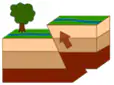
31. The Bohol fault system in Bohol Province, Philippines is an example of a fault where an upper block of rocks slides over a lower block which is separated from it by the fault. What do you call this type of fault?
a)
lateral fault
b)
normal fault
c)
reverse fault
d)
strike-slip fault
32.
32. Most earthquakes occur on faults. A fault is a thin zone of crushed rock between two blocks of rock and can be any length, from centimeters to thousands of kilometers. When an earthquake occurs on a fault, the rock on one side of the fault slips with respect to the other, but how do faults produce earthquakes?
a)
A. Tectonic plates which collide produce earthquakes.
b)
B. Magma which spreads beneath the rock layers produces faults.
c)
C. Rock materials from underneath that go out along faults produce earthquakes.
d)
D. Energy from inside the Earth makes the ground move. Once friction is overcome, a fault slips producing an earthquake
33.
33. What do you call the place inside Earth's crust where an earthquake originates?
a)
A. Fault
b)
B. Focus
c)
C. Mantle
d)
D. Epicenter
34.
34. People were interviewed after the earthquake and were asked about the effect tremor to their properties, buildings, and other infrastructures. Which method of earthquake measurement is determined in the situation?
a)
A. intensity
b)
B. magnitude
c)
C. location of the focus
d)
D. location of the active fault
35.
35. Why do earthquakes occur frequently in Japan, Indonesia, and Philippines?
a)
A. They are surrounded by seas.
b)
B. They are located near the equator.
c)
C. They are considered archipelagic countries.
d)
D. They are found within the Pacific Ring of Fire.
36.
36. How do seismologists locate the epicenter of an earthquake? They measure the ____
a)
A. largest surface wave to hit the surface.
b)
B. total damage of the p wave, s wave, and surface wave.
c)
C. difference between seismic waves on the first seismograph to receive the wave.
d)
D. difference between seismic waves on three or more seismographs. The epicenter is where the circles intercept.
37.
37. Which of the following seismic waves travels the fastest?
a)
A. Long Wave
b)
B. Primary wave
c)
C. Secondary Wave
d)
D. Surface wave
38.
38. You are a seismologist trying to find out the exact location of a recent destructive earthquake. Which of the following sequences must be applied?
I. Obtain data from three seismic stations.
II. Solve for epicentral distance from the stations.
III. Use a triangulation method to locate the earthquake's epicenter.
IV. Determine the time interval between the arrival of the P and S waves.
a)
A. I, II, III, IV
b)
B. I, IV, III, II
c)
C. I, IV, II, III
d)
D. II, III, IV, I
39.
39. In which of the following media can secondary waves travel?
a)
A. gases only
b)
B. solids only
c)
C. liquids only
d)
D. solids, liquids and gases
40.
40. What do you call a tropical cyclone formed in Northwest Pacific Ocean affecting Southeast Asia and the West Philippine Sea?
a)
A. storm
b)
B. cyclone
c)
C. typhoon
d)
D. hurricane
41.
41. Which of the following is the MOST LIKELY reason why a typhoon dies as it hits the landmass?
a)
A. Its pressure remains constant.
b)
B. Its wind speed is affected by the barrier trees.
c)
C. Its wind speed is affected by steep mountains
d)
D. It has not had enough fast-rising water vapor to sustain it.
42.
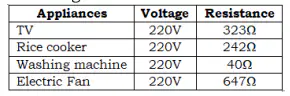
42. In the table given below, which of the following electrical appliances has the highest amount of current flowing in it?
a)
A. TV
b)
B. Rice cooker
c)
C. Washing machine
d)
D. Electric fan
43.
43. Which best explains why the air in the surroundings moves towards the eye during the formation of typhoon?
a)
A. Typhoons have no air pressure in the middle thus, pulling the air towards it.
b)
B. Typhoons have lower air pressure in the middle thus, pulling the air towards it.
c)
C. Typhoons have higher air pressure in the middle thus, pulling the air towards it.
d)
D. Typhoons have normal air pressure in the middle thus, pulling the air towards it.
44.
44. In which part of the world does a tropical cyclone that enters the Philippine Area of Responsibility forms and develops?
a)
A. Arctic Ocean
b)
B. Pacific Ocean
c)
C. Indian Ocean
d)
D. Atlantic Ocean
45.
45. What is the direction of the cyclonic circulation in the northern hemisphere caused by Coriolis effect?
a)
A. circular
b)
B. clockwise
c)
C. vertical
d)
D. counterclockwise
46.
46. How does the orbit of a comet compare to the orbit of a planet?
a)
Comets and planets have the same orbit
b)
Comets have a shorter rounded orbit than a planet
c)
Comets have a longer more oblong like orbit than a planet
d)
Comets do not have an orbit while a planet has the least eccentric orbit.
47.
47. Which of the following refers to rocky bodies that have fallen from space and hit the earth’s surface?
a)
a. Meteors
b)
b. Asteroids
c)
c. Meteorites
d)
d. Meteoroid
48.
48. Where do typhoons usually start to develop?
a)
a. mountain ranges
b)
b. low-pressure area
c)
c. high-pressure area
d)
d. area with high-temperature
49.
49. You are riding in a bus and the driver suddenly applied his force to the brakes.
You notice that your body moves forward, the bus moves again and your body moves
backward. Which property of matter illustrates this observation?
a)
A. Force
b)
B. Inertia
c)
C. Mass
d)
D. Net force
50.
50. In 1947, Chuck Yeager became the first pilot in history confirmed to have exceeded the speed of sound in level flight. Why did Chuck Yeager’s team choose a high altitude to break the sound barrier?
a)
A. when the temperature is lower, the speed of sound is faster
b)
B. when the temperature is higher, the speed of the sound is faster
c)
C. when the temperature is higher, the speed of the sound is slower
d)
D. when the temperature is constant, the speed of sound is also constant
51.
51. A rainbow can be seen in the sky after a rain. Which of the following statements best explain this spectacular phenomenon?
a)
A. The white clouds served as a prism made of different colors.
b)
B. The raindrops act like a prism that separates sunlight to different colors.
c)
C. The colors of the rainbow were derived from the raindrops in the atmosphere.
d)
D. The sunlight is reflected from the ground to sky and separated into different colors.
52.
52. Ohm’s law describes the relationship among current, potential difference (voltage), and resistance. Which of the following statements describe Ohm’s law?
a)
A. Current is directly related to resistance
b)
B. Voltage is inversely related to current
c)
C. At constant voltage, as the resistance increases, current decreases
d)
D. At constant voltage, as the resistance increases, current also increases
53.
53. In a series circuit, if one light bulb is burned out, what will happen to the other light bulbs?
a)
A. They will not light up
b)
B. They will continue to light up
c)
C. The brightness will increase.
d)
D. The brightness will decrease.
54.
54. Which of the following is a disadvantage of connecting too many bulbs in a parallel connection?
a)
A. Even if you switch off one bulb, other bulbs are not affected.
b)
B. It requires the use of several conducting wires of varying sizes.
c)
C. All bulbs in parallel connection are directly connected to the voltage source.
d)
D. Even if one of the light bulbs is damaged, all other light bulbs will still function.
55.
55. Most of the appliances around the house use electricity that is why it is a must to have several safety devices to prevent fire and electrocution. Which of the following statements is NOT true about safety devices used at home?
a)
A. use to prevent electric shock.
b)
B. cut the flow of current in case of overloading.
c)
C. used to provide an alternative route for current in the case of a grounded circuit.
d)
D. supply an unsteady amount of voltage to protect appliances against overloading.
Reset

