wayground logo

Free Printable Worksheets

NEW

Font size

S
M
L
XL
Worksheets

Punnett Squares

Total questions: 54

Worksheet time: 3hrs 1mins

Name
Class
Date
1.
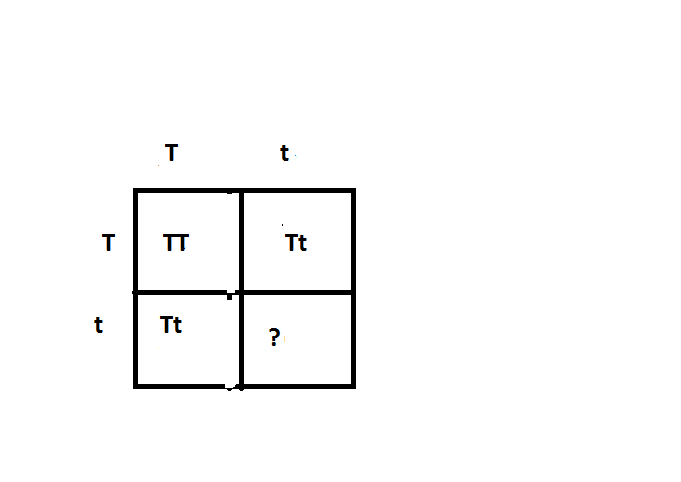
T - tall and t = short
In the punnett square below, what belongs in the missing square
a)
tt
b)
Tt
c)
Bb
d)
TT
2.
B = brown fur  b = white fur
In the punnett square, what is the probability for white fur? 
a)
0%
b)
25%
c)
50%
d)
75%
3.
In plants, tall (T) is dominant to short (t). Perform the following cross: Tt x Tt. What is the probability of producing a short plant?
a)
0%
b)
25%
c)
50%
d)
75%
4.
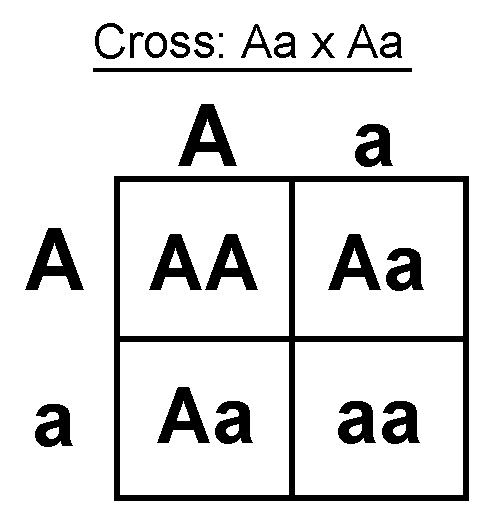
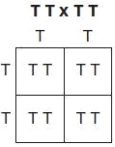
What is the probability of heterozygous offspring?
a)
25%
b)
50%
c)
0%
d)
100%
5.
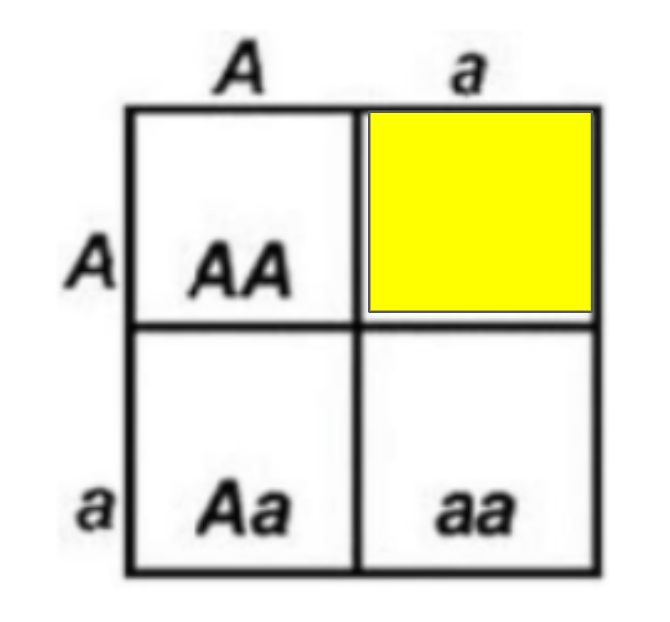
What allele combination should go in the missing box?
a)
AA
b)
Aa
c)
aa
d)
none of these
6.
In a flowering plant species, red flower color (R) is dominant over white flower color (r). What is the genotype of any red-flowering plant resulting from this species?
a)
rr
b)
R
c)
RR
d)
RR or Rr
7.
What is the phenotype of the offspring? (A-Brown hair; a-blond hair) 
a)
50 % Brown Hair and 50% Blond Hair 
b)
25 % Brown Hair and 75% Blond Hair 
c)
75 % Brown Hair and 25% Blond Hair 
d)
0% Brown Hair and 100% Blond Hair 
8.
A homozygous dominant brown mouse is crossed with a heterozygous brown mouse (tan is the recessive color). 
a)
100 % tan
b)
100 % brown 
c)
50 % brown and 50% tan 
d)
75 % brown and 25 % tan 
9.

If a heterozygous parent and a homozygous recessive parent mate, what percentage of their offspring will be dominant?

a)

25%

b)

50%

c)

75%

d)

100%

10.
Two brown eyed parents (Bb) have a baby. What is the chance the baby is blue eyed?
a)
0 %
b)
25%
c)
50%
d)
75%
11.
Aa, DD, bB, yy are all examples of
a)
genotypes
b)
phenotypes
12.
AA and Aa always show up as
a)
dominant
b)
recessive
13.
What ratio of the offspring from the cross shown will be homozygous recessive for the  trait of tallness? 
a)
0 in 4
b)
1 in 4
c)
2 in 4
d)
4 in 4
14.
Which of the following genotypes is homozygous dominant?
a)
A
b)
Aa
c)
AA
d)
aa
15.
Which of the following genotypes is heterozygous?
a)
Bb
b)
BB
c)
bb
d)
B
16.
Which of the characteristics is a lion least likely to pass on to its offspring?
a)
fur color
b)
length of tail
c)
scars on leg
d)
body size
17.
In a heterozygous genotype, the ___________ allele takes over in the phenotype.
a)
recessive
b)
dominant
c)
lower case letter
d)
both 
18.
What you see, or the physical appearance.
a)
Genotype
b)
Phenotype
c)
Homozygous
d)
Heterozygous
19.
T - tall and t = short
In the punnett square below, what belongs in the missing square
a)
tt
b)
Tt
c)
Bb
d)
TT
20.
B = brown eyes
b = blue eyes
What is true about these two brothers that have brown eyes?
One has genotype BB the other Bb.
a)
they have same phenotype and genotype
b)
they have different genotypes and phenotypes
c)
they have same phenotype but different genotypes
d)
they have same genotype but different phenotypes
21.
aa always shows up as
a)
dominant
b)
recessive
22.
Aa is
a)
homozygous
b)
heterozygous
23.
Which of the following is a phenotype?
a)
Aa
b)
red hair
c)
heterozygous
d)
DNA
24.
Which of the following is homozygous dominant?
a)
Yy
b)
Y
c)
yy
d)
YY
25.
Which of the following is homozygous recessive?
a)
Tt
b)
tt
c)
TT
d)
T
26.
What gender has an X and a Y chromosome?
a)
male
b)
female
c)
transgender 
d)
all of the above
27.
Complex molecule that carries genetic information that defines an organism's traits. It is stored in the nucleus.
a)
DNA
b)
protein
c)
RNA
d)
glucose nucleic acid (GNA)
28.
Dominant alleles are represented by a:
a)
Male gene
b)
lowercase letter
c)
recessive trait
d)
capital letter
29.
A heterozygous long-tusked elephant is crossed with a homozygous recessive short-tusked elephant. What is the probability of the offspring having short tusks?
a)
0%
b)
25%
c)
50%
d)
75%
30.
A heterozygous long-tusked elephant is crossed with a homozygous recessive short-tusked elephant. What is the probability of the offspring having short tusks?
a)
0%
b)
25%
c)
50%
d)
75%
31.
What is the probability of a purple-horned unicorn if a heterozygous pink-horned unicorn is crossed with a heterozygous pink-horned unicorn?
a)
0%
b)
25%
c)
50%
d)
75%
32.
Leonardo bet his friend Olivet that two heterozygous green-eyed sea monsters could not have a recessive blue-eyed baby sea monster. Olivet said they can have a blue-eyed sea monster.
Who wins the bet?
a)
Leonardo
b)
Olivet
c)
Both
d)
Neither
33.
Identify the homozygous dominant genotype:
a)
FF
b)
Ff
c)
ff
34.

Why do scientist use Punnett Squares?

a)

A tool scientist use to to see alleles

b)

A tool scientist use to see which alleles are dominant

c)

A tool scientist use to determine possible genotypes for offspring

35.

Why do scientist use Punnett Squares?

a)

A tool scientist use to to see alleles

b)

A tool scientist use to see which alleles are dominant

c)

A tool scientist use to determine possible genotypes for offspring

36.

Which of the following is a Homozygous Dominant Genotype?

a)

Yy

b)

XX

c)

zz

37.

Which of the following is a homozygous recessive genotype?

a)

HH

b)

dd

c)

Aa

38.

Which of the following is a heterozygous genotype?

a)

Gg

b)

UU

c)

pp

39.

In a Punnett Square, 1 box is equal to 25%. How much are 3 boxes equal to?

a)

25%

b)

50%

c)

75%

d)

100%

40.

Fill in the Yellow Box

a)

AA

b)

Aa

c)

aa

41.

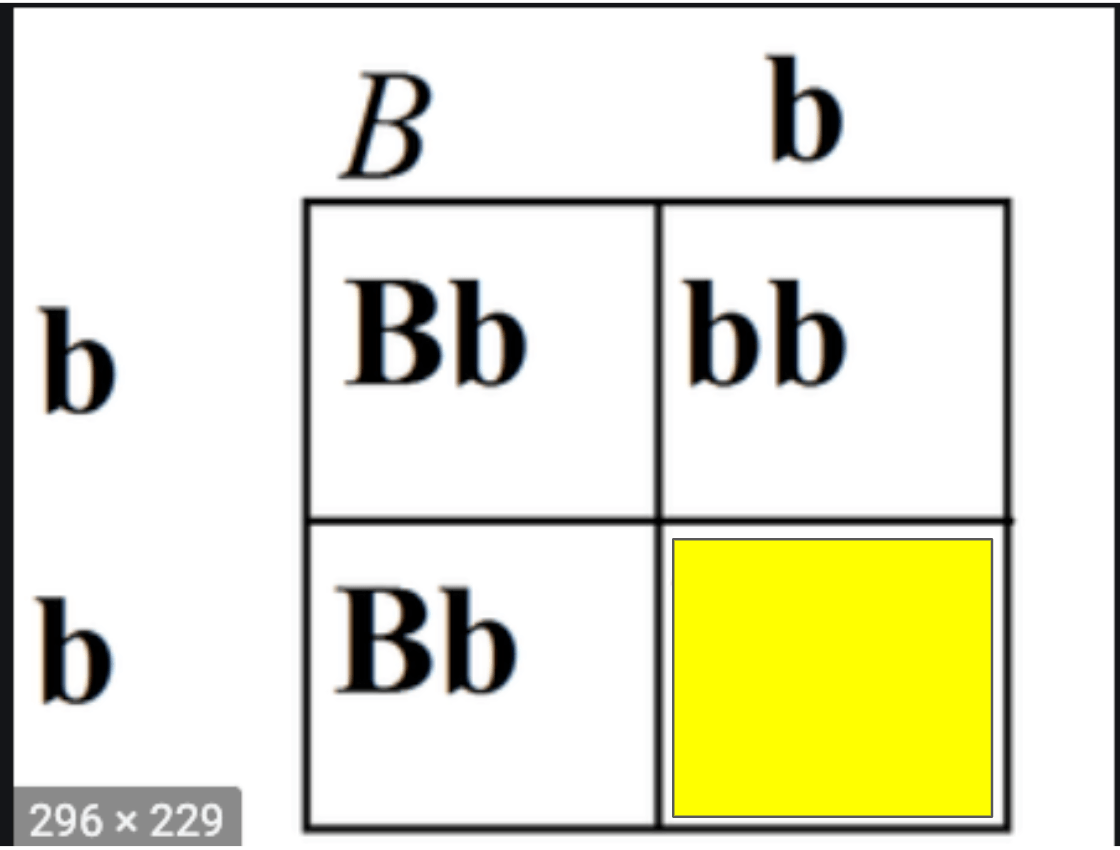
Fill in the Yellow Box

a)

Bb

b)

BB

c)

bb

42.

How chance the offspring born from this cross will have a homozygous dominant genotype?

a)

25%

b)

50%

c)

75%

d)

100%

43.

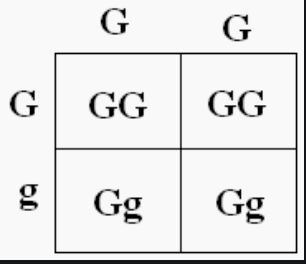
The punnett square is used to tell the color of a frogs skin. "G" means green skin and "g" means brown skin. What is the chance the baby frogs will have brown skin?

a)

0%

b)

25%

c)

50%

d)

100%

44.

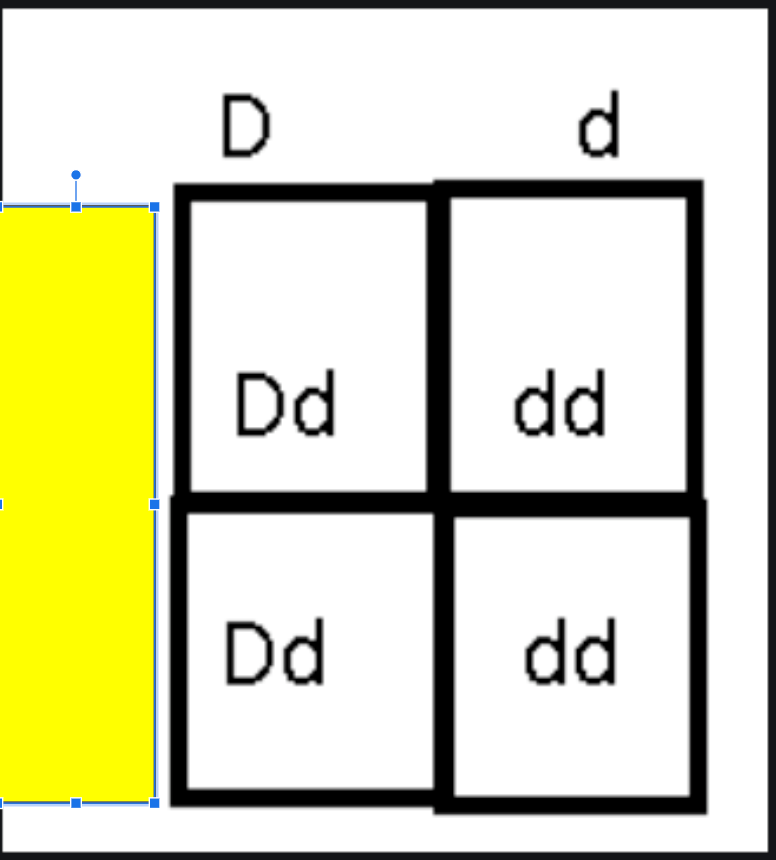
What is the mother's genotype?

a)

DD

b)

Dd

c)

dd

45.

In pea plants, round seeds (R) are dominant to wrinkled seeds (r). Which of the following represents the genotype of a pea plant that is heterozygous?

a)

RR

b)

round

c)

Rr

d)

wrinkled

e)

rr

46.

In pea plants, round seeds (R) are dominant to wrinkled seeds (r). Which of the following represents the genotype of a pea plant that is homozygous dominant?

a)

RR

b)

round

c)

Rr

d)

wrinkled

e)

rr

47.

In mice, black fur (B) is dominant to white fur (b). According to the Punnett square shown, the offspring in box 4 would:

a)

be white.

b)

be heterozygous.

c)

be gray.

d)

be homozygous.

48.

In mice, black fur (B) is dominant to white fur (b). According to the Punnett square shown, how many offspring would be black?

a)

0

b)

1

c)

2

d)

3

e)

4

49.

In humans, having freckles (F) is dominant to not having freckles (f). What is the percent chance that a married couple with no freckles will give birth to a child who has freckles?

a)

0%

b)

25%

c)

50%

d)

75%

e)

100%

50.

In humans, having freckles (F) is dominant to not having freckles (f).


Two people with freckles get married and give birth to three children. Two of the kids have freckles and one does not.


Both parents must have which genotype?

a)

FF

b)

Ff

c)

ff

51.

If black fur is dominant and white fur is recessive, what genotype would an organism with white fur have?

a)

FF

b)

Ff

c)

ff

52.

Cody crosses a plant producing wrinkled peas with a plant producing smooth peas. Weeks later, he discovers that all the offspring plants have smooth peas. Cody drew the Punnett square above to show the genotypes of the offspring plants. Which is the dominant phenotype in the pea plants used in Cody’s experiment?

a)

smooth

b)

wrinkled

c)

RR

d)

Rr

53.

Cody crosses a plant producing wrinkled peas with a plant producing smooth peas. Weeks later, he discovers that all the offspring plants have smooth peas. Cody drew the Punnett square above to show the genotypes of the offspring plants. What were the genotypes of the parent plants?

a)

RR and rr

b)

Rr and Rr

c)

RR and Rr

d)

Rr and rr

54.

Cody crosses a plant producing wrinkled peas with a plant producing smooth peas. Weeks later, he discovers that all the offspring plants have smooth peas. Cody drew the Punnett square above to show the genotypes of the offspring plants. What were the genotypes of the parent plants?

a)

RR and rr

b)

Rr and Rr

c)

RR and Rr

d)

Rr and rr