
 Worksheets
Natural Selection (w/ SEM 1 & EMS)
Total questions: 42
Worksheet time: 38mins
What is a non-adaptive trait?
a trait that makes it more likely than an individual will survive in a specific environment
a trait that makes it less likely than an individual will survive in a specific environment
a specific characteristic of an individual organism
an instruction for making a protein molecule
What is an adaptive trait?
a trait that makes it more likely than an individual will survive in a specific environment
a trait that makes it less likely than an individual will survive in a specific environment
a specific characteristic of an individual organism
an instruction for making a protein molecule
What is natural selection?
a group of the same type of organism living in the same area
a group of individuals born and living at about the same time
everything (living and nonliving) that surrounds an organism
process by which the distribution of traits in a population change over many generations
What is artificial selection?
The process of selecting or choosing specific plants or animals to breed for particular desirable genetic traits
a trait that makes it more likely than an individual will survive in a specific environment
survival of the fittest
process by which the distribution of traits in a population change over many generations
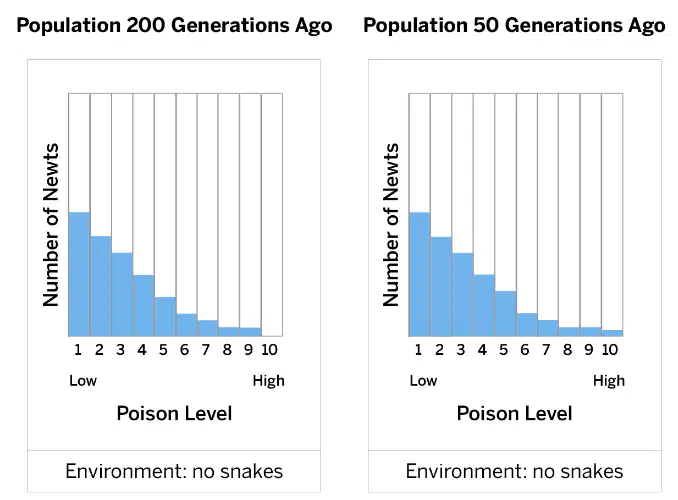
Which trait is considered a mutation?
Poison Level 1
Poison Level 5
Poison Level 8
Poison Level 10
Harbor seals live in northern oceans and have a layer of blubber (fat) that keeps them warm. Seals can have blubber of different thicknesses.
Seals with thicker blubber are more likely to stay warm and survive in cold ocean waters. But, in warm ocean waters, thicker blubber can make the seals overheat and die. If their environment changes to have warm water, which of the following seal populations will most likely survive?
Populations 1 and 2 will most likely survive.
Populations 2 and 3 will most likely survive.
Only Population 2 will survive because it is the only population with variation.
All the populations will survive because the seals will change the thickness of their blubber if they need to.

Guppies are small fish that live in South American rivers. They can have different-sized spots on their bodies.
The river bottoms are covered in rocks. Guppies with spots that are the same size as the rocks on the bottom are harder for bigger fish to see and catch.
The diagram below shows a population of guppies that live in a river. At time 1, the population had the same number of guppies with small and large spots. At time 2, after many generations, there were many more guppies with small spots and fewer guppies with large spots in the population.
How did the environment change between time 1 and time 2? How did the population change?
You cannot tell how the environment changed. With each generation, more guppies passed on the gene for small spots to their offspring.
The rocks became smaller. With each generation, more guppies with small spots survived long enough to pass on the gene for small spots to their offspring.
The rocks became smaller. Guppies with small spots are more likely to survive, so the guppies with large spots changed to have small spots.
The rocks became smaller. Guppies with small spots are more likely to survive, so both kinds of guppies passed on the gene for small spots to their offspring.

Scientists measured the spine size of a population of cactuses found in an area in 1970. They measured the spine size of the cactus population again in 2015. Which of the statements below best describes the difference in the cactuses at the two time points?
The cactuses in 1970 had smaller spines than the cactuses in 2015.
The cactuses in 1970 had larger spines than the cactuses in 2015.
There were more cactuses in 1970 than there were in 2015.
There was more variation in spine size in 1970 than there was in 2015.

Tree squirrels can have different fur colors.
Squirrels live in forests where foxes also live. Foxes hunt squirrels for food. Squirrels that have fur that is the same color as the trees are harder for the foxes to see and catch.
The diagram below shows a population of squirrels that live in a forest. At time 1, the population had the same number of black and gray squirrels. At time 2, after many generations, there were many more black squirrels and fewer gray squirrels in the population.
How did the environment change between time 1 and time 2? How did the population change?
You cannot tell how the environment changed. With each generation, more squirrels passed on the gene for black fur to their offspring.
There were more black trees. Squirrels with black fur are more likely to survive, so the squirrels with gray fur changed to have black fur.
There were more black trees. Squirrels with black fur are more likely to survive, so both types of squirrels passed on the gene for black fur to their offspring.
There were more black trees. With each generation, more squirrels with black fur survived long enough to pass on the gene for black fur to their offspring.

Blue jays are birds that live in the forest. They can have thick beaks, medium beaks, or thin beaks. Blue jays use their beaks to get to the seeds they eat. Blue jays with thinner beaks can easily reach and eat the seeds inside pinecones. Blue jays with thicker beaks can easily open and eat seeds with hard shells.
The population of blue jays shown above lives in an environment that has always had seeds with hard shells. Could there ever have been blue jays with thin beaks in this population?
No blue jays could have been born with a thin-beak trait because none of the adult blue jays had that trait to pass down.
No blue jays could have been born with a thin-beak trait in the past, but some with that trait could be born in the future if the environment changes to have pine cones with seeds.
A blue jay could have been born with a mutation in its genes for the thin-beak trait and lived for a little while, but it would have been more likely to die before it had offspring.
A blue jay could have been born with a mutation in its genes for the thin-beak trait, but having a mutation in its genes would have caused it to die when it was born.

These graphs show the wavelength and amplitude of light coming from three lasers. Could any of these lasers be giving off a different type of light?
Yes. Laser 2 could be giving off a different type of light because Laser 2 has a different wavelength than Lasers 1 and 3.
Yes. Laser 3 could be giving off a different type of light because Laser 3 has a different amplitude than Lasers 1 and 2.
Yes. All three lasers must be giving off different types of light because every light source gives off its own type of light.
No. All three lasers must be giving off the same type of light because all three are lasers, and the same kind of light source gives off the same type of light.

In order to see an object, light must be
transmitted into your skin
reflected off the object and into your eyes
reflected off the object then off the ground then into your eyes
absorbed by your genetic material
In order for light to change an object, that object must _______ the light and its energy.
reflect
transmit
increase
absorb
When a material allows light to pass through it,
the material reflects the light and changes
the material absorbs the light and doesn't change
the material transmits the light and doesn't change
material transmits the light and changes
the energy that an object has because its moving
energy
kinetic energy
potential energy
force
the energy that is stored in an object or system
potential energy
kinetic energy
energy
force
A magnetic ______________ can attract or repel an object at a distance.
force
pole
energy
field
The energy used to move a magnet _____________ a magnetic force is stored as ____________ energy in the magnetic field.
with, potential
with, kinetic
against, kinetic
against, potential

Based on the magnetic field line diagrams, what will happen next with these two sets of magnets?
The magnets in Set 1 will repel, and the magnets in Set 2 will attract.
The magnets in Set 1 will attract, and the magnets in Set 2 will repel.
The magnets in Set 1 will not move, and the magnets in Set 2 will attract.
In both sets, the magnets will attract.
Which of the following is an example of HOW the motion of an object can change?
Slow Down
Thrusters
Mass
Velocity
When you apply a strong force to an object in the same direction of its motion what will happen to the motion of the object?
Slow down
Change direction
Stop
Speed Up
When you apply a strong force in the opposite direction to the motion of an already slow moving object what is the most likely change in motion?
Speed up in the same direction of its current motion.
Stop moving for a second and then begin to move again in the opposite direction.
The object will change directions and continue moving.
The object will not be affected by a strong force, only a weak force will make a difference.
When in a collision both objects receive an equal force strength but the forces are exerted in ______ directions.
forward
backward
opposite
same
The amount of matter that makes up an object is the ___ of the object.
velocity
mass
speed
weight
Energy due to motion is ____________ energy.
Potential
Stored
Kinetic
Friction
Only living things have energy.
True
False

On the moon, the border between light and dark is...
(a)

What does Illuminate mean?
to shine light on something and make it barely visible
to flicker light on something
to shine light on something and make it visible
to make an entire object bright on all sides
Where is the moon positioned?
In line with the earths surface
Above the earths surface
Under the earths surface
It fluctuates it's position between the center earth and above the earth

When the half of the moon that we see from earth is half light and half dark it is a
(a)
A stronger force can cause a ______ change in velocity.
weaker
equal
greater
forces do not change the velocity of an object

Which location has guppies with medium spot size as the adaptive trait?
Population in Brazil
Population in Venezuela
Which population has both adaptive and non-adaptive traits?


What changed in the environment to cause evolution?
The water temperature increased.
The water temperature decreased.
The water temperature did not change.

Which prediction supports the following statement? Red is the adaptive trait to survive predators.


Which location had short giraffes as the
non-adaptive trait?
Population in Niger
Population in Somalia

Which prediction demonstrates white fur as the adaptive trait?


Which population has evolved to run away from predators faster?


What change in the environment caused the evolution?
The tree bark became gray.
The tree bark became black.
The tree bark became black and gray.
The tree bark became white.
Populations 1, 2, and 3 have evolved over time from brown to white fur. Which population shows variation of traits?



