
 Worksheets
Pressure
Total questions: 133
Worksheet time: 2hrs 44mins
How do you Calculate Pressure
Force(N)/Area(m2)
Force(kg)/Area(mi2)
Area(m2)/Force(N)

Kinetic theory of matter states that...
particles in an object are always moving.
solids can only become liquids.
solids can condense to liquids
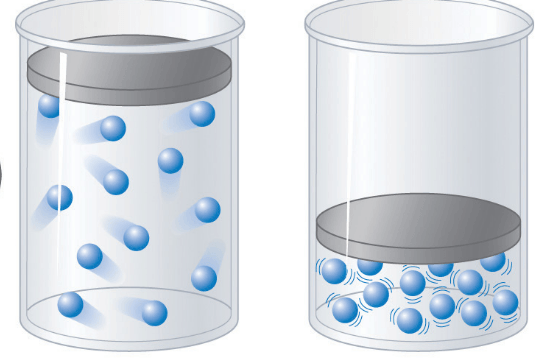

Which best explains why increasing the pressure on a gas decreases the volume of the gas sample?
Increasing the pressure causes the gas particles to hit the container walls more often.
Increasing the pressure on a gas sample moves the gas particles closer together.
Increasing the pressure on a gas sample causes the kinetic energy to increase.
The lead-acid cell is an example of which of the following types of cells
The dry cell
The primary cell
The voltaic cell
The secondary cell
With respect to recharging a primary or secondary cell, of the following statements, which one is correct?
The secondary cell can be recharged by passing current through it in the proper direction
The primary cell can only be recharged by changing the electrolyte
The primary cell can be recharged by passing current through it in the proper direction
The secondary cell can only be recharged by changing the electrodes


1 Pa = 1N/m2
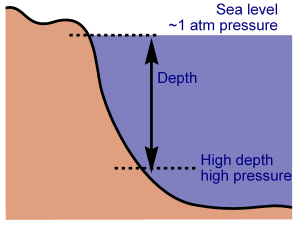
When you increase your depth under water, the water pressure on your body
increases
decreases
stays the same
An object will float on water if it is
less dense than water.
more dense than water.
the same density as water.

A 20N weight is hung from a spring balance which reads 17N when it is completely submerged in water. What is the upthrust of the body of water?
37N
20N
17N
3N
Why does an object sink?
Weight is bigger than upthrust
Weight is smaller than upthrust

1 Pa = 1N/m2
What is the SI unit use for hydraulic pressure?
Kg/m3
Pa
kg m-3
N m2
When you increase your depth under water, the water pressure on your body
increases
decreases
stays the same
Materials that can flow and take the shape of their containers include…
Both gases & liquids
Liquids
Gases
Neither gases nor liquid
Fluid pressure increases as depth increases.
True
False

These are Pascal's Vases. What would happen if you poured water into the right-hand tube?
The water would fill up the right hand tube before flowing to the others and filling them up.
The thinner tubes would fill up more than the thicker tubes
The thicker tubes would fill up further than the thinner tubes
The height of the water would be the same in all the tubes.

The reason gases can be compressed is because:
The particles are very close together.
The particles are merely vibrating.
The particles are unable to move.
The particles are very far apart.
How do you Calculate Pressure
Force(N)/Area(m2)
Force(kg)/Area(mi2)
Area(m2)/Force(N)
Pressure rxerted by air on the earth's surface
Pressure
Atmospheric pressure
Heat pressure
Unit to measure atmospheric pressure
Millibar
Cm
Meter
Choose factors that affect the pressure in liquid.
Pilih faktor yang mempengaruhi tekanan di dalam cecair.
depth
kedalaman
mass
jisim
density
ketumpatan
volume
isipadu

Calculate density of the blue liquid
Hitung ketumpatan cecair biru
755 kg m-3
1200 kg m-3
691 kg m-3
1120 kg m-3
Belows are list of application of pressure in liquid EXCEPT
Dibawah ialah senarai aplikasi tekanan dalam cecair KECUALI
position water tank at top of the house
kedudukan tangki air di atas rumah
Use of the siphon
Kegunaan sifon
rubber sucker
getah penyedut
construction of dam
pembinaan empangan
pressure of 1 atm equivalent to:
Tekanan 1 atm bersamaan dengan:
760 mm Hg
10.3 m H2O
100 mbar
100 kPa
Convert 45 cm Hg to unit Pascal
Tukar 45 cm Hg kepada unit Pascal
[density of mercury: 13 600 kg m3]
100 kPa
60 kPa
40 kPa
45 kPa
A wall of seaside can withstand 400 kPa of pressure. What is the pressure in unit m H2O?
Sebuah tebing laut boleh menahan tekanan sebanyak 400 kPa. Apakah tekanan itu dalam unit H2O
[density of water: 1000 kg m-3]
47.70 m
40.77 m
37.47 m
Which are properties of atmospheric pressure at high altitude
Yang manakah ciri-ciri tekanan atmosfera pada altitud yang tinggi.
Thin of air
udara nipis
low number of oxygen gas
rendah bilangan gas oksigen
cooler
lebih sejuk
high pressure
bertekanan tinggi
In outerspace, the pressure is almost zero. What astronauts do to counter it?
Di ruang angkasa, tekanan adalah hampir sifar. Apakah yang dilakukan oleh angkasawan untuk mengatasinya?
pressurize cabin of spacecraft
Beri tekanan pada kabin kapal angkasa.
pressurize space suit
Beri tekanan pada suit angkasa
bring along oxygen tank/generator
bawa bersama tangki/penjana oksigen
build from hard material
diperbuat daripada bahan yang keras
Among these statements, which are effects on human beings at extreme depth under the surface of the sea?
Antara berikut, yang manakah Kesan ke atas manusia dalam keadaan aras kedalaman lampau?
Nitrogen gas dissolves into the blood
Gas nitrogen melarut ke dalam darah
Body tissues absorb excess nitrogen gas
Tisu badan menyerap gas nitrogen yang berlebihan
Formation of nitrogen bubbles in the tissues or blood vessels if pressure is reduced too rapidly
Pembentukan gelembung nitrogen dalam tisu atau salur darah jika tekanan dikurangkan dengan terlalu cepat
Lower absorption of oxygen in the lungs
Penyerapan oksigen dalam paru-paru berkurang

The pressure exerted by the weight of air is called
atmospheric pressure
atmospheric temperature
altitude
density
Atmospheric pressure increases (gets bigger) as altitude increases (the higher up you go)
true
false

Which layer of the atmosphere has the most mass? (80% of the mass actually!)
stratosphere
troposphere
mesosphere
thermosphere

which layer of the atmosphere has the most pressure?
thermosphere
mesosphere
stratosphere
troposphere
Atmospheric pressure is practically nonexistent above the stratosphere.
true
false
what is a measure of how warm or cold the atmosphere is?
atmospheric pressure
atmospheric temperature
density
thermometer
atmospheric temperature decreases (gets colder) as altitude increases (the higher up in the atmosphere you go)
true
false

Why does temperature increase in the stratosphere?
decrease of the air pressure
it actually gets colder in the stratosphere
the ozone layer absorbs the sun's energy (heat)
it is unknown why the temperature changes
The temperature in the mesosphere is the
hottest
coldest
The thermosphere gets hot because
the molecules absorb the sun's radiation
the ozone layer absorbs the sun's energy
it actually gets colder
it is closest to the sun
If a hairspray can is heated, what can be expected of the pressure of the gas inside the can?
The pressure will increase
The pressure will decrease
The pressure will remain constant
The pressure will equalize
Pressure is
defined as the mass that an object exerts when at rest.
not a measurable in gases.
defined as the number of moles of substance divided by the mass of the substance.
created by the force of the gas particles impacting the walls of the container.
A student inflates a balloon with helium then places it in the freezer. The student should expect
the balloon's volume to increase
the balloon's volume to decrease
the number of particles to increase
Gases __________.
have a fixed shape
are easily compressed
have particles that do not flow easily
vibrate about a fixed point
Kinetic energy =
AF
21mv2
mgh
Vm

In the graph, air pressure is on the Y axis and altitude increases to the right on the X axis. What statement below best describes the graph?
pressure increases as altitude increase
pressure decreases as altitude increases
pressure decreases as altitude decreases
atmospheric pressure is zero at sea level.
What is Brownian motion?
The random movement of particles in a liquid or gas
The colour of atoms when viewed with a microscope
The movement of solid molecules
The pressure exerted on a container
Pollen grains suspended in water exhibit Brownian motion. How does a particle undergoing Brownian motion move?
In smooth curves
Randomly
Orderly with a pattern
In straight lines with no change of direction
Which of the following does NOT describe Brownian motion?


Which of these is under greater pressure?


The Kelvin temperature scale is directly proportional to
gas pressure
average kinetic energy of gas particles
the Fahrenheit scale
absolute zero
The temperature at which all particle motion stops is
absolute zero
100 degrees Celsius
100 K
1 atm
Kinetic energy =
Force per unit area
1/2 mv2
Kelvins
Temperature
Which unit is not equal to the others?
14.7 psi
101.3 kPa
1 atm
790 mm Hg
Which atoms of gas would move the fastest?
neon
argon
hydrogen
oxygen
Which diagram best depicts how gas pressure explains the Bill Nye hanging man experiment?


In the graph, air pressure is on the Y axis and altitude increases to the right on the X axis. What statement below best describes the graph?
pressure increases as altitude increase
pressure decreases as altitude increases
pressure decreases as altitude decreases
atmospheric pressure is zero at sea level.
If a hairspray can is heated, what can be expected of the pressure of the gas inside the can?
The pressure will increase
The pressure will decrease
The pressure will remain constant
The pressure will equalize

Pressure can be exerted by solids, liquids and gases.
TRUE
FALSE

The pressure inside the balloon will:
Decrease
Increase
Remain the same
Not enough information to formulate an answer

The pressure of the gas in the balloon in the ice water will be:
Greater than that of the balloon in the boiling water.
Less than that of the balloon in the boiling water.
The same as that of the balloon in the boiling water.
Not enough information to answer the statement.

This is an example of the everyday application of pressure in:
Solids
Liquids
Gases
Plasma

The pressure inside the syringe will decrease if we move the plunger in:
Direction A
Direction B
We don't have to move the plunger as the pressure will change on its own.
None of the above answers.

We can increase the pressure of a gas by:
Adding more gas.
Reduce the volume of the container.
Increase the temperature of the gas.
None of the above answers.
The reason gases can be compressed is because:
The particles are very close together.
The particles are merely vibrating.
The particles are unable to move.
The particles are very far apart.

As you go up to high altitudes, the Gas pressure decreases because _________
The air in the high altitudes are is not compressed
Because the amount of gas particles are decreasing
Because the gas particles in high altitudes are less dense
Because the gas particles are far away to the gravity
Why Mountain climbers takes oxygen tank with them ?
Because there is less pressure
Because there are less gas particles at high altitudes
Because they cant breath properly
All of the Above
What happens to the volume of the balloon if the temperature increased ?
The volume will increase
The volume will decrease
There will be more energy
There will be less gas pressure

Which container will have lower pressure?
Left
Right

A sample of a gas in a cylinder is shown. If the temperature is kept constant and the piston moves down to decrease volume, the pressure increases because the gas particles...
Expand
Become smaller
Lose velocity within the container
Collide more often within the container

What happened to the volume between the two steps?
Volume increased
Volume decreased
Volume stayed the same
If a balloon is cooled what will happen to the volume?
Volume will increase
Volume will decrease
Volume will not change

