
 Worksheets
G8 Physics Term 2
Total questions: 130
Worksheet time: 2hrs 2mins
The SI unit of moment of force is –
m
N
kgf
Nm
Moment can be calculated using the equation:
M = F × d
M = F / d
M = F2 × d
M = F / d2
When an object is in equilibrium, which equation is true?
Clockwise moment = anticlockwise moment
Clockwise moment + anticlockwise moment = 0
Clockwise moment / anticlockwise moment = 0
Clockwise moment + anticlockwise moment = resultant force
The moment of a force causes an object to
move forward
move backward
stop moving
turn about a fixed point
Jack has a weight of 300 N and sits 2.0 m from the pivot of see-saw. Jill has a weight of 450 N and sits 1.5 m from pivot. Who will move down?
Jack
Jill
Both of them
None of them

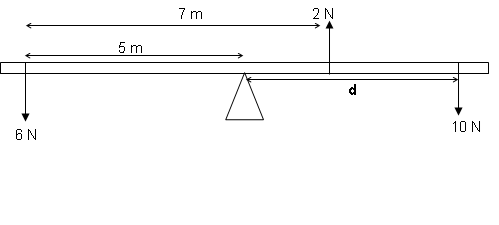
Assuming the system is in equilibrium, calculate the missing distance d
3.4 m
2.8 m
4.4 m
1.6 m


The diagram shows a beam. Without any weights, the beam balances at its centre.
Three weights are hung as shown.
At which point does a load of 2 N balance the beam?
A
B
C
D
Center of gravity is usually located where
more weight is concentrated
less weight is concentrated
less mass is concentrated
more mass is concentrated
Center of gravity of an object depends on it's
weight
mass
density
shape
Where will be the centre of gravity of a uniform rod lies ?
At its end
At its middle point
At its centre of its cross sectional area
Depends upon its material
Where the center of gravity of a circle lies?
At its centre
Anywhere on its radius
Anywhere on its circumference
Anywhere on its diameter
What is one way you might increase the stability of an object?
Lower the center of gravity
Raise the center of gravity
Increase the height of the object
Shorten the base of the object
If the original length of a spring is 20m and its extended length is 30m. What is the extension?
20m
30m
50m
10m
A bungee rope has a spring constant of 50N/m. How much a person must weighs in Newton if we want it to extend 10m?
200N
200kg
500N
500kg

What is the best description of the relationship shown in this graph?
In this graph, the relationship between force and spring constant is linear.
In this graph, the relationship between force and extension is non-linear.
In this graph, the relationship between force and extension is directly proportional.
In this graph, there is no relationship between force and extension.

When comparing spring A to B,
A has a larger spring constant than B so A is a stiffer spring
B has a larger spring constant than A so B is a stiffer spring
1 pascal is equivalent to a force of ...................
1 Nm-2
1 Nm
1 Nm2
1 Nm-1
The atmospheric pressure at the plains is .......... that at the hilly regions .
lower than
equal to
higher than
What is the equation used to calculate pressure?
pressure= force/mass
pressure =mass/volume
pressure=area/force
pressure=force/area

Diagram shows the design of a dam. Why does the thickness of the dam increase with its depth?
The design of this structure is stronger.
Water pressure increases with depth.
The cost of construction is lower.
Water pressure acts uniformly in all directions.
THE PRESSURE WHICH IS EXERTED BY THE AIR AROUND US IS KNOWN AS:
FRICTION
FORCE
ATMOSPHERIC PRESSURE
MUSCULAR FORCE
When divers return to the surface of water quickly, the pressure is ________.
Increased
Decreased
Not changing
The pressure exerted by a liquid
increases with depth.
decreases with depth.
is constant
first increases and then decreases.
The pressure of the water at the bottom of a pond is ___ at the surface of the pond.
either lower or higher
higher than
same
lower than
Which of the following does not affect the pressure beneath the surface of a liquid?
Strength of the gravitational field
Area of the liquid surface
Density of the liquid
Depth of the liquid

The diagrams show, to the same scale, the vertical sections of a set of circular vessels, each containing the same depth of water.
The water exerts the same pressure on the base of each vessel.
The water exerts the greatest pressure on the base of vessel S.
The water exerts the greatest pressure on the base of vessel P.
The water exerts the same force on the base of each vessel.
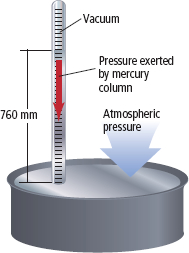
Explain what would happen to the column of mercury in the barometer as shown if the atmospheric pressure fell.
As the pressure falls, the column of mercury will drop lower.
As the pressure falls, the column of mercury will remain unchanged.
As the pressure falls, the column of mercury will rise higher.
As the pressure falls, the density of the mercury will increase.
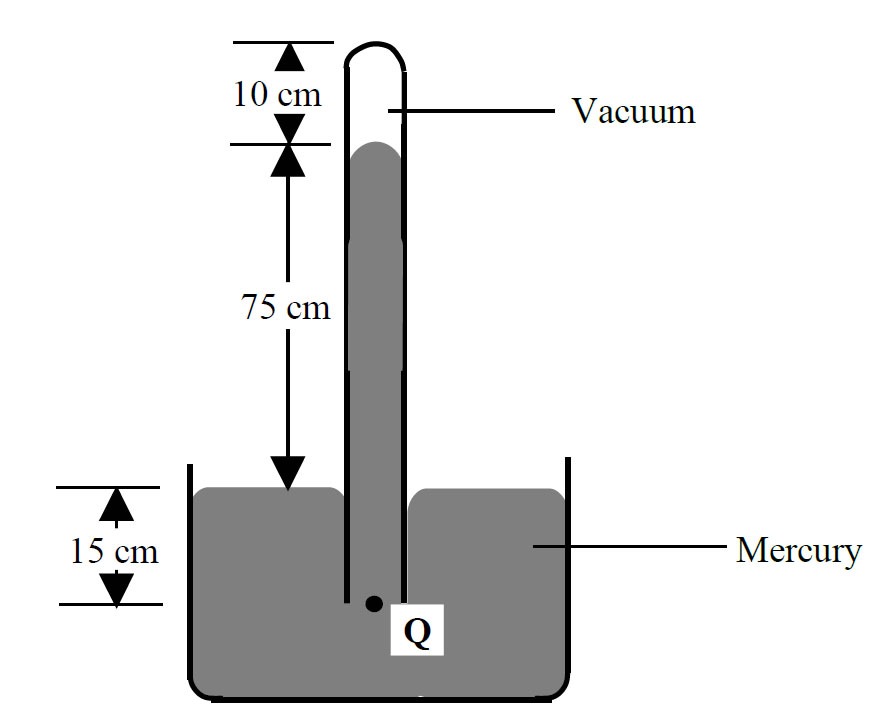
The diagram shows an apparatus set up to measure atmospheric pressure.
Calculate the pressure at point Q.
10 cm Hg
85 cm Hg
90 cm Hg
15 cm Hg
A container with a volume of 2000m3 contains a gas at a pressure of 500Pa. What happens to the volume if the gas pressure drops to 400Pa?
It stays at 2000m3
It rises to 2500m3
It rises to 4000m3
It reduces to 1600m3
It reduces to 1900m3
What assumption do we make when we use the formula P1V1 = P2V2?
There is no change in pressure
There is no change in volume
There is no change in temperature
There is no change in your mood
There is no change in gravitational field strength
Which of the following situations would result in the highest number of collisions between particles and container walls?
High temperature, high pressure, high volume
High temperature, high pressure, low volume
High temperature, low pressure, high volume
High temperature, low pressure, low volume
Low temperature, low pressure, high volume
Which of the following situations would result in the lowest number of collisions between particles and container walls?
High temperature, high pressure, high volume
High temperature, high pressure, low volume
High temperature, low pressure, high volume
High temperature, low pressure, low volume
Low temperature, low pressure, high volume
What type of relationship do pressure and volume have?
work is done when
the object you apply a force on moves
any force is applied to an object, regardless if it moves or not
the force is zero
the force and direction of motion are perpendicular
Which form of energy is involved in a pencil falling from a desk?
kinetic
nonmechanical
gravitational potential
elastic potential
An object in motion
potential energy
elastic potential energy
nonmechanical energy
kinetic enerty
A moving van burns gasoline in its engine. During this process it converts
chemical energy to mechanical energy
kinetic energy to potential energy
thermal energy into electrical energy
mechanical energy into kinetic energy
What is the unit of report for energy?
Joules
meters
newtons
grams
How could I increase the internal energy of an object
Increase the temperature
Increase the colour
Increase the pH
Increase the mass


A stretched rubber band has energy in this energy store
Magnetic
Electrostatic
Elastic
Nuclear

Two negatively charged particles which are close together have energy in this energy store
Electrostatic
Magnetic
Nuclear
Elastic

Energy which is transferred by a force moving an object through a distance
Mechanically
Electrically
By Radiation
By Heating

Calculate the potential energy of a car with a mass of 2,500 kg that is on a hill 100 meters above sea level.
250,000 J
2,450,000 J
2,451,663 J
248 J

Lilly's cat ran through your yard. The cat has a mass of 5 kg. He is running at a speed of 3 m/s. What is the kinetic energy of the cat as he runs?
8.5 J
45 J
7.5 J
22.5 J
A 5 Kg body is having a Kinetic energy of 250 J. What is the velocity of the body?
10 m/s
15 m/s
20 m/s
40 m/s
What is the mass of a ball that has a kinetic energy of 115 J and is traveling at 9 m/s?
1035 kg
23.5 kg
12.8 kg
2.84 kg
A exercise ball is on a table 2.5 m above the ground. What is the mass of the ball if it has a GPE of 56.8 J?
71 kg
22.72 kg
142 kg
2.32 kg
The three types of fossil fuel are natural gas, coal and ...
methane
oil
uranium
wood

In a thermal power station, the place where the fossil fuels are burnt is called the...
generator
turbine
condenser
furnace

What turns the turbine in a thermal power station?
hamsters
water
air
steam

What do we call the device which produces electricity in a power station?
turbine
condenser
generator
transformer
Nuclear fuel is relatively cheap and reliable.
True
False
Choose the energy that is described below.
Flowing water turns a wheel to do work to make electricity.
WInd
Solar
Hydropower (water)
Biomass
Human power.
Choose the energy that is described below.
Sunlight shines on solar panels, which are made to convert light energy into electricity.
WInd
Solar
Hydropower (water)
Biomass
Human power.
Which is NOT renewable energy?
solar energy
wind energy
Bioenergy
LED energy
Which is the widely used green energy as of now?
Solar energy
Water energy
Wind energy
All of the above
Which of the following is a disadvantage of renewable energy?
High pollution
Available only in few places
High running cost
Unreliable supply

A
B
C
D

A
B
C
D

A
B
C
D

A
B
C
D

A
B
C
D
Which fossil fuel is used the most as an energy resource?
Oil
Natural gas
Coal
Fossil fuel are stores of
Kinetic energy
Chemical energy
Thermal energy
Potential energy
Resources that are not able to be reproduced as quickly as they are used are called _____.
renewable resources
non-renewable resources
replaceable resources
non-replaceable resources
2. Geothermal energy uses heat from ____ to produce electricity.
oil
coal
natural gas
the earth
What type of power plant uses the potential energy of water trapped behind a dam?
Nuclear power plant
Solar station
Hydroelectric power plant


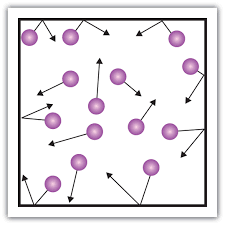
A gas typically consists of:
low energy particles that experience high attractive forces between them.
low energy particles that experience no attractive forces between them.
high energy particles that experience high attractive forces between them.
high energy particles that experience little attractive force between them
If I add heat to a solid, how will the motion of the particles be affected?
They will move slower
They will stop moving
They will move faster
They will move to a different container
This is considered as the average kinetic energy of a particle.
Temperature
Specific Heat Capacity
Heat


In Celsius it's at 273 degrees. Or 0 degrees Kelvin.
To double the kinetic energy of particles you need to___
Double the temperature in Kelvin
Double the temperature in Celsius
Halve the temperature in Kelvin
Halve the temperature in Celsius
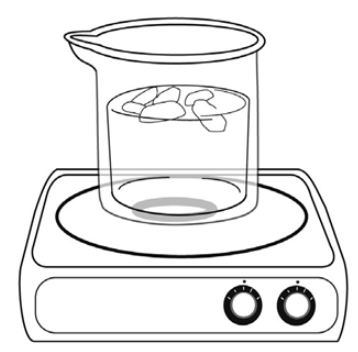
Emerson places a beaker of water on a hotplate and turns the hotplate on. The temperature in the room is 25 ºC. After the water heats to 75 ºC, she adds pieces of ice to the beaker.
Which of the following describes a transfer of heat energy that occurs during this experiment?
from the air to the water
from the ice to the beaker
from the water to the ice
from the water to the hotplate

Strip A is not expanding as much as strip B when exposed to the same heat source. Which statement is accurate?
Strip A has a higher heat capacity
Strip B has a higher heat capacity
What probably causes creaking noises in most homes?
Ghosts
Expansion and shrinking of materials as temperature changes
Hobbits
Aliens
How can we use expanding liquids in medicine?
Thermometer
Pump up tyres
Pump up the patient
Cleaning hospitals
As the temperature of an abject increases, its molecules
move faster
get smaller (condense)
move farther apart (expand)
move faster and farther apart (expand)


A student inflates a balloon with helium then places it in the freezer. The student should expect
the balloon's volume to increase
the balloon's volume to decrease
the balloon's moles to increase
the balloon's moles to decrease

A
B
C
D

Select the appropriate answer (s).
Metal P
Metal Q
Metal R
Metal S

A
B
C
D

A
B
C
D


The diagram shows some rice being boiled in a pan. What is the main methods by which thermal energy is transferred (i) through the metal pan and
(ii) through the water?
(i) conduction (ii) conduction
(i) convection (ii) convection
(i) conduction (ii) convection
(i) convection (ii) conduction
Convection can take place in ____________.
solids only.
liquids only.
liquids and gases only.
solids, liquids and gases.
In the process of convection, energy is transferred _________.
because of temperature differences in a solid
because of density differences in a liquid
by the diffusion of molecules throughout a fluid
by the vibration of molecules

Some dye in a beaker of water is gently heated. Why are the streaks of dye seen in the water?
The hot dye is a better conductor than the cool water.
The hot dye is a better convector than the cool water.
The hot water is less dense than the cool water.
The hot water is denser than the cool water.

Which of the following correctly shows the direction of convection currents in water?
A
B
C
D

What is truth about radiation energy?
(chose one)
<- (Example of waves of sun)
requiers direct
touch
have temperatures
warms
only ocucurs in solds
use rays or electromagnectic
waves (sun)

What kind of heat transfer is occurring when the sun warms the sand?
Conduction
Convection
Radiation
Density

The baby chickens kept warm from a heat lamps demonstrates this type of heat transfer.
conduction
radiation
convection
density

Warm air rises and the cool air sinks demonstrates this type of heat transfer.
conduction
radiation
convection
Insolation

A group of friends gather around a fire to stay warm.
What type or energy is?
conduction
radiation
convection
waves
(sun)
True or false
Water evaporates above 100 C
False
True
True or false Condensation occurs when a a liquid turns into gas
True
False
True or false More liquid will condense on a cool surface than a warm one
True
False
The water vapour cools and _________.
as it rises into the air.
condenses
evaporates
water
vapour
Luisa went into the bathroom after her sister had a bath.
it was full of mist and the mirror was cover in the drop of liquid.
Name the process that made the drops of liquid form
Condensation
Evaporation
Infiltartion
precipitation
20 g of water. specific heat of water is 4.18 J/g°C. temperature changes from 25° C to 20° C, how much heat energy (Q) moves from the water to the surroundings?
418 J
209 J
83 J
4.18 J

10 kg of aluminium is heated from 120C to 220C. How much energy is needed?
8 970 000 J
897 J
8970 J
89 700 J
897 000J
Latent heat is
the heat absorbed or released at a boiling process during a change of phase
the heat absorbed or released at a constant temperature during a change of phase
the heat absorbed or released at a constant temperature during a change of phase of 1 kg object
the heat absorbed or released by an object to increase or decrease its temperature by 1 degree Celcius
The heat absorbed by melting a solid is known as
latent heat of fusion
latent heat of solid
latent heat of liquid
latent heat of vaporisation

The graph shows the cooling curve of a substance. At which stages the specific latent heat released?
AB and CD
BC and DE
AB and EF
BC and CD
Calculate the energy absorbed by 30 g of 100 ⁰C water that is turned into 100 ⁰C.
67 800 J
6 7800 J
678 J
67.8 J
specific latent heat of vaporisation is
the amount of heat required to change 1 kg of the substance from the solid to liquid phase without change in temperature
the amount of heat required to change 1 kg of the substance from the liquid to gaseous phase without change in temperature
the amount of heat required to change the temperature 1 kg of the substance by 1 degree Celcius

